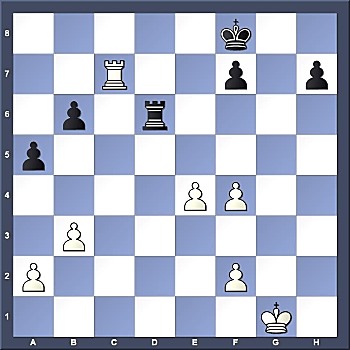
Our Game of the Week is from the National Capital Open, where 2017 Canadian Champion GM Bator Sambuev was White against Svitlana Demchenko.
White is up a pawn, but Black's Rook is ready to counter-attack; what should White play? Complete game and notes below.
61 players competed in the National Capital Open, November 10-12, 2017 at the RA Centre in Ottawa. The Open section had 6 Masters, topped by Canadian Champon GM Bator Sambuev, who also topped the final standings:
Thanks to TD and Org. Halldor Palsson for running the tournament and posting the games online.
..
[Event "National Capital Open"]
[Site "RA Centre"]
[Date "2017.11.11"]
[Round "3"]
[White "Sambuev, Bator"]
[Black "Demchenko, Svitlana"]
[Result "1/2-1/2"]
[ECO "A14"]
[WhiteElo "2618"]
[BlackElo "2222"]
[Annotator "John Upper"]
[PlyCount "104"]
[EventDate "2017.??.??"]

1. Nf3 d5 2. c4 e6 3. g3 Nf6 4. Bg2 Be7 5. O-O O-O 6. b3 c5 7. e3 Nc6 8. Bb2 {
[#]} b6 {By far the most popular move, but not the best scoring.} ({Tony
Kosten, who has played and published about this c4/Bg2 opening for years,
recommends} 8... d4 {going into a kind of reversed Benoni structure} 9. exd4
cxd4 10. Re1 Ne8 $1 {aiming to shore up the center with ...f6 and ...e5.} 11.
Ne5 Nxe5 12. Rxe5 f6 13. Re1 e5 {with several games, including Giri,A (2782)
-Nakamura,H (2787) Paris, 2016 (½-½, 35).}) 9. Nc3 Bb7 10. cxd5 Nxd5 (10...
exd5 {is playable, but White gets an easy-to-play game against the hanging
pawns after} 11. d4 $1 {with lots of examples, including the model game:
Kramnik,V (2795)-Jones,G (2644) London, 2012 (1-0, 49).}) 11. Nxd5 Qxd5 12. d4
{[#] This position has been reached hundreds of times from various move orders.
Black is ahead in development, but White will gain time with a free hit on the
Qd5. Strategically, White hopes to get the B pair or to saddle Black with a
weak pawn on c5. Statistically, White scores nearly 70%, which is great, but a
less-impressive +50 Elo, which suggests this is a position that higher-rated
White's aim for in the hopes of squeezing out a technical win.} Rfd8 $6 {
since the e-file isn't likely to open It looks normal to aim to play Rac8 and
Rfd8; OTOH, now Bxb7 will gain a tempo on the Ra8, and f7 is less well
defended, a fact Bator pounces on. Black's alternatives:} (12... cxd4 $4 {
avoids the weak pawn on c5, but loses an exchange after:} 13. Nxd4 $18 Qd7 (
13... Qxg2+ 14. Kxg2 Nxd4+ 15. f3 $18) 14. Nxc6 Bxc6 15. Qxd7 Bxd7 16. Bxa8 $18
) (12... Rad8 13. Ne5 Qd6 14. dxc5 Qxc5 15. Qe2 Nxe5 16. Bxb7 {With the Ra8
now safely on d8, Black has time to develop and force off one of the white Bs.}
Bf6 17. Rfd1 Ng4 18. Bxf6 Nxf6 19. Qa6 Ng4 $6 (19... Rxd1+ $142 20. Rxd1 Qc2
$11 21. Bf3 Ne4 (21... h5 $5 22. Qxa7 $2 Ne4 $17) (21... g5 $5) 22. Qe2 Qxe2
23. Bxe2 Nc3 $11) 20. h3 Ne5 21. Qxa7 h5 22. Qa4 b5 23. Qa5 Rxd1+ 24. Rxd1 h4
25. gxh4 $16 {1-0 (40) Botvinnik/Polugajevsky -Keres,P/Prins,L Amsterdam
(exhibition), 1966.}) (12... Qf5 13. Ne5 Nxe5 14. Bxb7 Rad8 15. Qe2 Qd3 16. Ba6
Qxe2 17. Bxe2 cxd4 18. Bxd4 Nc6 19. Bc3 Ba3 20. Rab1 Nb4 21. Bb2 Bxb2 22. Rxb2
Rc8 23. Rd1 Rfd8 $11 {Rapport,R (2691)-Wei,Y (2607) Gibraltar, 2014.}) 13. Ne5
Qd6 14. Qh5 Nxe5 (14... g6 15. Qf3 Nxe5 16. Qxb7 Nd3 17. Ba3 $14) 15. Bxb7 Rab8
16. dxc5 (16. dxe5 Qd2 {Only move.} 17. Rab1 (17. Bc1 Qc3 {Only move.} $15) 17... Rxb7 $11) (16.
Be4 Ng6 17. Ba3 $14) 16... Qxc5 {[#]} 17. Rfc1 $5 {Always a difficult choice,
using this R keeps a2 defended.} Nc4 $1 (17... g6 {gives up a pawn, but Black
gets enough play for it after} 18. Rxc5 gxh5 19. Rxe5 Rxb7 (19... Bf6 $4 20.
Ba6 $18 {the Bs will run riot across the open center.}) 20. Rxh5 Rd2 {with counterplay.}) 18.
Qg4 Qg5 $1 19. Rxc4 Rxb7 {Only move.} 20. Qf3 Qd5 {Only move.} (20... Rbd7 $4 21. Rg4 $18) 21. e4
Qg5 (21... Qd3 {is playable, but very tricky since there are lines where the Q
gets trapped on the d-file:} 22. Qg4 Bf8 23. Bf6 $1 h5 $1 24. Qg5 Re8 (24...
Ra8 25. Qxh5 b5 (25... gxf6 $4 26. Rd1 $18)) 25. Qxh5 gxf6 $4 26. Rd1 $18 {
trapping the Q.}) 22. h4 Qg6 23. Rd1 Rbd7 (23... Rxd1+ 24. Qxd1 h5 $14) 24.
Rxd7 Rxd7 25. Rc8+ Rd8 (25... Bd8 26. Qc3 Qg4 $1 27. Kh2 (27. Qc7 $4 Qd1+ $19)
27... h5 $13) 26. h5 $1 Qg5 27. Rc7 a5 28. h6 $16 e5 29. hxg7 Kxg7 {[#]} 30.
Qf4 $5 {Pretty, but probably not best} (30. Rb7 $1 {increases the pressure
before trading Qs.} Rd6 (30... Bc5 $4 31. Qxf7+) 31. Qf4 Re6 32. Qf5 $1 {
Black is getting choked, and White threatens Kg2 then f4}) 30... Qxf4 31. gxf4
Kf8 $16 (31... Bd6 32. Rc6 (32. Rb7 $1 Kf8 33. Rxb6 Bc5 34. Rb5 Bxf2+ $16)
32... f6 33. fxe5 Bxe5 (33... fxe5 $2 34. Rxd6 $18) 34. Bxe5 fxe5 35. Rxb6 a4
$5 $16 {looks close to winning for White.}) 32. Bxe5 Bd6 33. Bxd6+ (33. Bf6 $4
Bxc7 34. Bxd8 Bxd8 $19) 33... Rxd6 {[#]White is up a pawn, but Black's R is
ready to counter-attack; what should White play?} 34. Rc2 $2 (34. Kg2 $142 Rd2
35. Rb7 $16) (34. Rc3 {lets White save all his pawns, but makes his R very
inactive:} Rg6+ 35. Kf1 (35. Rg3 Rd6) 35... Rg4 36. Rf3 Rh4) (34. f5 $142 $1 {
keeping this pawn gives White more control over Black's K and this looks good
enough to win:} Rd4 35. f3 Rd1+ 36. Kg2 Rd2+ 37. Kg3 Rxa2 38. f6 $18) 34...
Rg6+ $1 35. Kh2 (35. Kf1 Rg4 36. Ke2 (36. f5 Rxe4 37. f6 Re6 38. Rc8+ Re8 39.
Rc6 (39. Rxe8+ $4 {and the f6-pawn drops at the start of a losing pawn ending.}
) 39... Re6 $11) 36... Rxf4 37. Ke3 Rg4 38. Rc8+ (38. Rc6 Rg6 $11) 38... Kg7
39. Rb8 Rg6 40. Rb7 h5 $11) 35... Rg4 36. e5 Rxf4 37. Kg3 Re4 38. f4 a4 $1 39.
Kg4 axb3 40. axb3 {[#]} Kg7 (40... Rb4 41. Kf5 Kg7 42. Rc7 Kf8 $11 {should
also draw, but is not so clear cut.}) 41. Rc4 Re1 (41... Rxc4 42. bxc4 Kg6 {Only move.}
43. f5+ {Only move.} Kg7 44. Kf4 (44. Kg5 $4 f6+ 45. exf6+ Kf7 $19) 44... h6 {Only move.} 45. Kg4
Kf8 46. Kh4 Kg8 {Only move.} 47. f6 Kh8 {Only move.} 48. Kg4 Kg8 $11) 42. Rb4 Rg1+ 43. Kf3 (43. Kf5
h5 44. Rxb6 h4 45. Rd6 (45. Rb7 $4 h3 $19 46. e6 h2 47. e7 (47. Rxf7+ Kg8 $19)
47... h1=Q 48. e8=Q Qh3+ 49. Ke4 Re1+ $19) 45... h3 46. Rd2 Rg2 47. Rd3 h2 48.
Rh3 Rb2 $11) 43... h5 44. f5 Rf1+ 45. Ke4 h4 46. Kd5 Rxf5 47. Rxh4 f6 $11 48.
Re4 {[#]} Kf7 $1 {The pin leaves gives Black time to improve her K before
making exchanges.} 49. b4 (49. Kd6 Rxe5 50. Rxe5 fxe5 51. Kxe5 Ke7 $11) 49...
Ke7 50. b5 (50. Kc6 Rxe5 51. Rd4 $11 (51. Rxe5+ $4 fxe5 52. Kd5 Kf6 {Only move.} 53. Ke4
Ke6 54. b5 Kd6 $19) 51... b5 52. Rd5 Ke6 $11) 50... Kd7 51. Re1 Rxe5+ 52. Rxe5
fxe5 (52... fxe5 53. Kxe5 Ke7 {Only move.} $11) 1/2-1/2
..