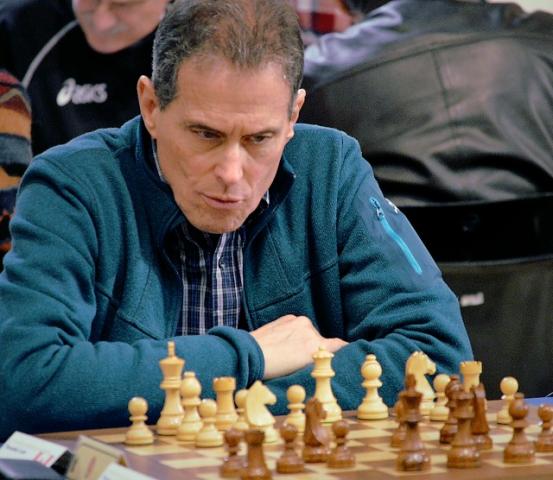
The 27th FIDE World Championship ended this week in the Northern Italian resort town of Acqui Terme.
The World Senior Championship has four sections: Men's and Women's in both 50+ and 65+ age groups. The Men's sections were 11 round Swisses, the Women's were 9 rounds.
[Event "World Senior +65"]
[Site "Acqui Terme"]
[Date "2017.11.16"]
[Round "9"]
[White "Piasetski, Leon"]
[Black "Pashayan, Genrikh"]
[Result "1-0"]
[ECO "A11"]
[WhiteElo "2269"]
[BlackElo "1953"]
[Annotator "Leon Piasetski"]
[PlyCount "77"]
[EventDate "2017.??.??"]
[SourceTitle "CFC Newsfeed"]

{Acqui Terme has a classic centre dating back to Roman times, a few spas and
is surrounded by vinyards. However, my main focus was on chess and I spent
most of my free time on prep. Despite the results not meeting my expectations,
I did play a few good games. My best effort was against Pashayan from Armenia.
Typically, most seniors have a lot of experience and can play a reasonable
game even if their rating has fallen from their peak years. However, my
opponent was a bit of a mystery since there were few games of his in the
database. Nevertheless, coming from Armenia I expected him to put up a lot of
resistance.} 1. Nf3 d5 2. g3 Nf6 3. Bg2 g6 4. c4 c6 5. b3 Bg7 6. Bb2 O-O 7. O-O
{I chose a classic Reti opening against his fianchetto defense. From the few
games available I knew he played solidly but his next few moves seemed a bit
odd ...} Re8 8. Qc2 a5 9. d3 Na6 10. a3 Qb6 11. Nbd2 Bg4 {[#] Black has
developed his pieces but the knight on a6 is not too impressive ... I spent a
while figuring out the best way to approach the task at hand. Finally I
realized that it would be optimal to achieve b4 at some point and so found a
job for my rook. Of course, 12. h3 was an option but it turns out that my
opponent neded little encouragement to rid himsef of his bishop.} 12. Rab1 Bxf3
$2 ({Black should focus on getting in ...e5 ASAP and with 12. ... Nd7 Black
could achieve this right away. Instead he chose to give up his bishop and
solidify his central stand with 13. ...e6. Best was} 12... Nd7 13. Bxg7 Kxg7
14. b4 axb4 15. axb4 Nc7 16. Rfc1 $14 (16. c5 Qa7 17. Qb2+ e5 18. Ra1 Qb8 19.
Rxa8 Qxa8 20. e4 dxe4 21. dxe4 Nb5 $11 {although white still has an edge.}))
13. Nxf3 e6 14. e3 c5 {Finally, my opponent decides to challenge my central
control but with his knight stuck on the rim, prospects are ... not so great :
-)} 15. Rfc1 Qd6 16. Be5 {Possibly better was 16.Ne5 but I wanted to line up
my queen and bishop on the long diagonal for maximum pressure.} Qe7 17. Qb2
Rac8 18. d4 {[#]} Red8 $6 {Black had two alternatives:} (18... cxd4 $6 19. Bxd4
Nc5 20. Ne5 Red8 $16 (20... Nfd7 $2 21. Nxd7 Nd3 22. Nf6+ $18)) (18... b6 19.
Qe2 Qb7 20. Bf1 $1 Nb8 21. cxd5 Nxd5 (21... exd5 22. Bh3 Rc6 (22... Nbd7 23.
Qb5 Red8 24. dxc5 Rxc5 25. Rxc5 Nxc5 26. Rc1 Nfe4 27. b4) 23. Qb5 cxd4 24. Bxf6
Bxf6 25. Rxc6 Qxc6 26. Qxc6 Nxc6 27. Bd7) 22. dxc5 bxc5 23. Bxg7 Kxg7 24. Qb2+
Kg8 25. Ne5 {but White is much better in any case.}) 19. cxd5 exd5 20. Bf1 $2 {
Nothing wrong with Bf1, but Bh3 was much stronger ...} (20. Bh3 Rc6 21. Bf1 Nb8
22. dxc5 Nbd7 23. Bd6 $16 {Now White threatens to capture on a6 and then on c5
which wins a pawn because the queen must protect both c5 and f6.}) 20... cxd4
21. Bxa6 bxa6 22. Bxd4 Ne8 23. Ne5 {Simpler was} (23. Rxc8 Rxc8 24. Rc1 Bxd4
25. Nxd4 Rc5 26. a4 $16 {but the long diagonal optics were tempting.}) 23...
Qb7 (23... Qe6 24. a4 $14) 24. Nd3 $2 (24. Qd2 $16 Rxc1+ (24... Qb5 25. a4 $16)
25. Rxc1 Qxb3 26. Qxa5 $16) 24... Qb5 $2 (24... Bxd4 25. Qxd4 Rxc1+ 26. Rxc1
Qxb3 $11) {[#]} 25. Nc5 {This was my idea: put the knight in a dominating
position where it attacks the weakened queenside.} ({Better was}25. Rd1 $1 Bxd4 26.
Qxd4 Ng7 27. b4 Nf5 (27... Rc4 28. Qf6 $18) 28. Qf4 Rc4 29. Qf3 h5 30. bxa5
Qxa5 31. Nb4 d4 32. e4 Ne7 (32... Nd6 33. Nd5 $18) 33. Qf6 $16) 25... Rc6 ({
I allowed} 25... Rxc5 26. Rxc5 Qxc5 27. Bxc5 Bxb2 28. Rxb2 {since the bishop
is much stronger than the knight. However, here it was best to give up the
c-file and build up pressure on the weak d-pawn.}) 26. a4 Qb8 (26... Qb6 27.
Nd3 $14) 27. Rc2 $2 {I saw the upcoming tactic based on black doubling rooks
but missed the simple defense 27. ... Bd4 28. exd4 ( or 28. Qxd4 Qb4) Nd6 29.
Qc3 Nf5 30. Rd1 Qb6 which equalizes. Instead white should play} (27. Nd3 Bxd4 (
27... Rdc8 28. Rxc6 Rxc6 29. Bxg7 Nxg7 30. Nf4 Qd6 31. Rd1 Rc5 32. e4) 28. Qxd4
Rxc1+ 29. Rxc1 Qxb3 30. Rc6 Qb7 31. Rb6 Qa8 32. Nc5 Rd6 33. Rb7 Rc6 34. Re7 $16
) 27... Rdc8 $2 ({Better was} 27... Bxd4 28. exd4 Nd6 29. Qc3 Nf5 30. Rd1 Qb6 $11) 28.
Rbc1 {[#]} Qb4 $2 (28... Bxd4 29. Qxd4 Rd8 30. Rc3 $16) 29. Bxg7 Nxg7 (29...
Rxc5 30. Rxc5 Rxc5 31. Rxc5 Qxc5 32. Qc3 Qe7 33. Bd4 $18) 30. Ne6 $1 {A
pleasing geometrical motif ! I had foreseen taking on a6 which wins a pawn but
this is of course much stronger.} fxe6 31. Rxc6 Rf8 32. Qe5 {Centralizing with
threats ...} Qg4 33. Rc7 Nh5 34. Rc8 Qf3 35. Qxe6+ Kg7 36. Rxf8 Qxf8 37. Rc7+
Kh6 38. Qxd5 Qb4 39. h4 {Although I was disappointed with my overall
performance in Acqui Terme, this game at least improved my spirits. Perhaps
next time my result will also improve!} 1-0