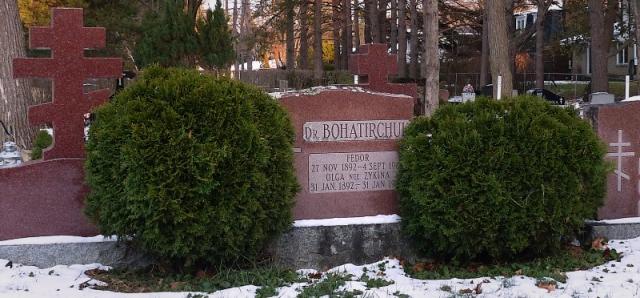
This week -- November 27, 2017 to be precise -- marked the 125th anniversary of the birth of Fedor Bohatirchuk, the Ukrainian-born Canadian Champion. Chessbase marked the occasion with a wonderful article which you can read that article here:
It has good photos and some nice game fragments, though I would have liked a bit more evidence to back up Lawrence Day's (plausible) claim that Bohatirchuk was Boris Pasternak's inspiration for Dr.Zhivago.
Bohatirchuk's greatest claim to chess fame comes from his enviable record against future World Champion Mikhail Botvinnik: +3 =1 -0.
A future post will include a selection of tactics featuring Bohatirchuk against top Canadian Champions.
..
[Event "URS-ch08 Final"]
[Site "Leningrad (Russia)"]
[Date "1933.09.03"]
[Round "15"]
[White "Bohatirchuk, Fedor Parfenovich"]
[Black "Botvinnik, Mikhail"]
[Result "1-0"]
[ECO "B73"]
[Annotator "John Upper"]
[PlyCount "115"]
[EventDate "1933.08.16"]
[EventType "tourn"]
[EventRounds "19"]
[EventCountry "URS"]
[Source "ChessBase"]
[SourceDate "1999.07.01"]

1. e4 c5 2. Nf3 d6 3. d4 cxd4 4. Nxd4 Nf6 5. Nc3 Nc6 6. Be2 g6 7. Be3 Bg7 {
Diagram [#]} 8. Qd2 {This can transpose to the mainline (with 00 and Nb3) but
gives Black the option to trade a pair of minors, which Botvinnik does.} (8.
Nb3 Be6 9. f4 O-O 10. g4 (10. O-O Na5 11. Nxa5 (11. f5 Bc4) 11... Qxa5 12. Bf3
Bc4 13. Re1 Rfd8 $11 {0-1 (29) Rauzer,V-Botvinnik,M Leningrad (Russia) 1933
URS-ch}) 10... d5 $5 11. f5 Bc8 12. exd5 Nb4 13. d6 $5 Qxd6 {Botvinnik found
the following perpetual check after a thought of twenty minutes. - ChessBase}
14. Bc5 Qf4 $1 15. Rf1 Qxh2 16. Bxb4 Nxg4 17. Bxg4 Qg3+ 18. Rf2 Qg1+ 19. Rf1
Qg3+ 20. Rf2 Qg1+ {½-½ Alekhine,A-Botvinnik,M Nottingham, 1936.}) (8. O-O O-O
) 8... Ng4 9. Bxg4 Bxg4 10. Nd5 $1 {Diagram [#]  White sets up a Maroczy bind
(e4 + c4) where he's already traded the LSB, which can be a problem piece,
blocked by its own pawns. It's worth comparing this to some lines in the Bb5
anti-Sicilian, where it's the queenside N that gets traded for White's LSB.} ({Today, a more usual continuation would be to press on the kingside. Here's an example: MVL is known as a world-class expert in the Najdorf, but it is a little surprising to see him get a nearly winning position against a Dragon expert like Jones after only 20 moves.} 10. f3 Bd7 11. h4 Ne5 12. b3 Rc8 13. h5 gxh5 14. Rxh5 Qa5 15. Nd5 Qxd2+ 16. Kxd2 e6 17. Nf4 Ng6 18. Nd3 $1 $14 d5 $6 19. e5 $1 $16 {White has a big advantage in this French-style middle game. (1-0, 48) Vachier
Lagrave,M (2796)-Jones,G (2665) chess.com, 2017.}) 10... O-O ({Here's another
Bohatirchuk win from the same position a year later. It looks to me like
Black had learned from Botvinnik's failure to get play with ..
.f5 in our main game, and so he keeps his kingside flat, generating enough piece play for
equality on the queenside.} 10... Rc8 11. c4 Qa5 12. Nc3 (12. b4 $5 {looks
reasonable, gaining a tempo to pursue White's usual plan of queenside
expansion; but grabbing the extra space leaves White missing his LSB:} Qd8 $1
13. Rc1 Ne5 14. f3 Bd7 15. Qe2 {and Black goes ...e6 and ...Qc7 to attack c4.})
12... a6 13. Rc1 O-O 14. b3 Bd7 15. O-O Rfd8 16. Rfd1 {Diagram [#]} Bxd4 $5 {
Standard when White has an LSB and Black is left with a N which can use the
dark squares, but here it doesn't result in that kind of play.} 17. Bxd4 Nxd4
18. Qxd4 Bc6 19. Qe3 e6 (19... b5 $1 {with counterplay}) 20. Rd3 Rd7 21. Rcd1 Rcd8 22. Qg3
Qc5 23. h3 b5 24. cxb5 axb5 25. Rc1 $2 Bxe4 {If his K was on h2 then White
would be able to take the B and play Nf6+, but here Black captures on c1 with
check.} 26. Rdd1 Qf5 $1 (26... Bb7 $2 27. Nd5 $1) 27. Qe3 Ba8 28. Ne2 e5 $1 29.
Ng3 Qf6 30. Qe2 h5 $5 (30... Rb8 {doesn't concede the pawn.}) 31. Qxb5 h4 32.
Nf1 Qg5 33. Ne3 d5 34. Rc8 Rxc8 35. Qxd7 Rd8 36. Qg4 (36. Qc7 $1 d4 {
threatening the N and mate on g2} 37. Ng4 f5 $140 $2 (37... d3 38. f3 $18) 38.
Nh6+ $1 $18) 36... Qf6 37. Qe2 e4 38. Ng4 Qg7 (38... Qd6 $11) 39. Qa6 Qc3 40.
Qf6 Rc8 (40... Qxf6 $142 41. Nxf6+ Kf8 42. Nxe4 $14) 41. Nh6+ Kh7 42. Qxh4 Kg7
43. Ng4 $18 Rc7 44. Kh2 f5 45. Qh6+ Kf7 46. Ne3 Qe5+ 47. Kg1 Bb7 48. h4 Rc8 49.
h5 gxh5 50. Qh7+ Qg7 51. Qxf5+ Kg8 52. Nxd5 {(1-0, 63) Bohatirchuk,F-Ilyin
Zhenevsky,A Leningrad (Russia), 1934.}) 11. c4 Bd7 (11... Rc8 12. O-O Nxd4 13.
Bxd4 Rxc4 {is a not-very-good sac mentioned by John Emms in "Dangerous Weapons:
The Sicilian".} 14. Bxg7 Kxg7 15. Ne3 Rxe4 16. f3 Bxf3) 12. O-O f5 $5 {Active,
but leaves Black with hanging pawns on the center files which will requre very
active play to justify. It might be relevant that Botvinnik was 22 when he
played this game, while Bohatirchuk, who puts out all the fires, was 41.} 13.
exf5 Bxf5 14. Nxf5 Rxf5 15. Rad1 Qd7 16. Bh6 $14 {Trading pieces leaves Black
with more long-term problems defending his central pawns.} Bxh6 17. Qxh6 Raf8
18. Qd2 Ne5 19. Ne3 Rh5 20. f3 Qe6 21. b3 Qf6 {Diagram [#]} 22. f4 $1 $14 (22.
Qd5+ Rf7 23. Qxb7 Qf4 $13) (22. Nd5 $1 Qf7 (22... Qh4 23. g3 (23. h3 $4 Nxf3+
$19) 23... Qh3 24. Nxe7+ $18) 23. Qe3 e6 24. Nc3 $16) 22... Nc6 23. Rde1 Qg7
24. Nd5 {Diagram [#]} g5 $2 (24... Rhf5 $142 25. g3 (25. b4 e5 $1 {with counterplay}) 25...
e5) (24... e5 $5 25. fxe5 $14) (24... Qh6 25. g3 Re5 $5 26. Ne3 $16) 25. Qe2 $1
$16 {Gains a tempo on the Rh5 to completely control the e-file.} (25. Nxe7+ $5
Nxe7 26. Qe2) (25. Nc7 $1 Qh6) 25... Qh6 $6 (25... Rh6 $142 {may be
objectively better, but still leads to a terrible R ending:} 26. Nxe7+ Nxe7 27.
Qxe7 gxf4 28. Qxg7+ Kxg7 29. Re7+ $18) 26. fxg5 $18 {The tempo on the Qh6
breaks the battery on h2 and kills Black's counterplay.} Rxg5 27. Nxe7+ Kh8 28.
Rxf8+ Qxf8 29. Nxc6 bxc6 {Diagram [#]White has outplayed the future World
Champion and is up a pawn, with a safer K and better pawn structure.} 30. Qe7 (
30. Qe8 {was more ruthless} Qxe8 (30... Rg8 31. Qxc6 $18) 31. Rxe8+ Rg8 (31...
Kg7 32. Re7+ $18) 32. Rxg8+ Kxg8 33. b4 $18 {and the outside queenside passer
will win.}) 30... Qxe7 31. Rxe7 Ra5 32. a4 d5 33. cxd5 cxd5 34. Rd7 $18 a6 35.
Ra7 d4 36. Rd7 Rc5 37. Rxd4 Rc1+ 38. Kf2 Rc2+ 39. Kf1 Rb2 40. Rd8+ Kg7 41. Rb8
a5 42. Rb5 Kg6 43. h4 $1 $18 h5 44. Kg1 Kh6 45. Kh2 Kg6 46. Kg3 Rb1 47. Kf2 Kh6
48. Ke3 Rg1 49. Rxa5 Rxg2 50. Rb5 Rg3+ 51. Kf2 Rg4 52. Rb6+ Kg7 53. a5 Rxh4 54.
a6 Rh2+ 55. Kg3 Ra2 56. b4 h4+ 57. Kxh4 Kf7 58. b5 1-0
..