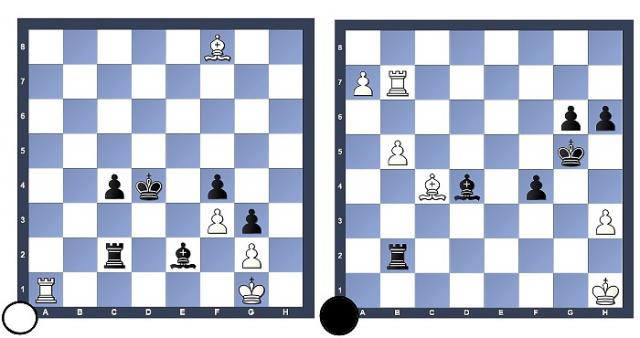
That's the quote at the start of Laszlo Polgar's "Chess Endgames", a fat collection of 4560 thematically-organized endgame positions which (as Laszlo well-knew) showed just how many problems remain even when very few pieces remain. Positions 4423-4446 in Polgar's book are RB vs RB of opposite colour endings. He might consider adding these games to any future edition of his collection...
Our two positions come from top boards of Round 4 at last weekend's RA December Open. Both were RB vs RB with opposite-coloured Bs. The general wisdom is that opposite coloured Bs increase attacking chances in the middlegame, but they increase the drawing margin in endgames. The reason is the same for both conclusions -- neither B can oppose the other -- so an attack supported by the B will have one more attacker than defender, and (in the endgame) a blockade on the colour of one B cannot be broken by a B on the other colour. Because of the awkward position of the white Kings in our two examples they feature both themes: mating tactics and defensive blockades.
The coloured circles in the lower left corner of the diagrams indicate the player to move. Take some time to at least come up with some ideas before looking at the games and analysis...
..
[Event "RA December Open"]
[Site "RA Centre"]
[Date "2017.12.10"]
[Round "4"]
[White "Collins, Christian"]
[Black "Gordon, David"]
[Result "0-1"]
[ECO "B32"]
[WhiteElo "2015"]
[BlackElo "2291"]
[Annotator "John Upper"]
[SetUp "1"]
[FEN "5B2/8/8/8/2pk1p2/5Pp1/2r1b1P1/R5K1 w - - 0 59"]
[PlyCount "20"]
[EventDate "2017.??.??"]

{Both players were under 2 minutes (plus 30 second increment) for the
remainder of the game, so any mistakes should be judged with that in mind....
and remembered, as a reason to polish our endgame skills so that we don't have
to calculate these positions from scratch with little time at the end of a
long game.} 59. Bd6 {Only move.} {Threatening Bxf4, which could cover the potential
promotion on c1 and win the g3-pawn.} Ke3 ({It helps to know that the ending of
RB vs R is a draw, but it's a difficult draw which has often been lost even by
2700+ GMs. Knowing this, Black and White could go for this ending -- to see
who knows it better -- with the following:} 59... c3 60. Bxf4 Rb2 61. Bxg3 c2
62. Ra4+ Bc4 63. Bf4 Rb1+ {and winning the B; but (as mentioned) this should
be a draw even if Black wins both of White's pawns.}) 60. Bc5+ {Only move.} Kd3 (60...
Kd2 61. Bd6 c3 62. Bxf4+ $11) 61. Bd6 Bxf3 $5 {Clearly Black's best try to win.
The position is still objectively drawn, but now White will have to solve some
different problems.} (61... c3 62. Bxf4 $11 Rd2 $5 63. Rc1 c2 64. Bxd2 Kxd2 65.
Rxc2+ Kxc2 66. f4 $1 $11 {is a draw: White gives up the f-pawn then oscilates
his K between h1 and g1 so Black's K can't get close enough to attack g2
without creating stalemate.}) 62. gxf3 $11 (62. Ra3+ {also draws:} c3 63. gxf3
Ke3 64. Ra4 Kxf3 65. Rxf4+ {Only move.} $11) 62... Ke3 63. Re1+ {Not White's only move,
but forcing, which is a bonus when in time trouble.} Kxf3 64. Rf1+ {Only move.} Kg4 (
64... Rf2 65. Rxf2+ gxf2+ 66. Kf1 $11) 65. Rxf4+ Kh3 {[#]White has more than
one way to hold this, but the ideas behind the different defences are not
obvious.} 66. Rf1 $4 {The most natural, but actually losing!} (66. Be7 $1 $11 {
threatening Rh4#} Rc1+ $5 (66... g2 67. Rf3+ $1 {driving the K away} Kg4 68.
Rf2 $11 {forking the Rc2 and g2 pawn will either win the g2 pawn or force off
Rs, allowing White to draw by stopping the g-pawn with his K and the c-pawn
with his B.}) 67. Rf1 Rc3 $1 {Preventing the Rf3 check from the previous line,
but it's still not enough to win.} 68. Rf4 $6 {Threatening mate on h4, but
allowing Black to go to an ending with some winning chances with} (68. Re1 $11)
(68. Bf6 $11) 68... g2 {Now White doesn't have the third-rank check to force
the Black K away. Even so, White can save the game with another mate threat:}
69. Kf2 {Only move.} $11 Rc2+ 70. Kf3 {Only move.} g1=N+ $1 $15 {Black is nominally better, but RN
v R is easy to defend, so White can sac the B for the pawn and draw.} ({
Of course, not} 70... g1=Q $4 71. Rh4#) (70... Kh2 71. Bc5 $11 {threatening
mate again!})) ({White can hold this another way:} 66. Rf8 $1 {Think of it
like this: assume the B will sac itself for the c-pawn, and the R defends the
g-pawn as in Philidor's defence (in RP vs R): when the pawn goes to the sixth
rank the attacking K has nowhere to hide, so the defending R goes behind it
and checks the attacking K perpetually.} Rc1+ (66... c3 67. Rh8+) (66... g2 67.
Rf3+ Kg4 68. Rg3+ $11) 67. Rf1 Rc3 68. Rf8 g2 69. Rh8+ $11) 66... Rg2+ {Only move.} {
The critical tempo-gaining tactic: Black forces the white K to step onto a
square which is vulnerable to the ...g2+ fork, and so gains time to put the R
on a more active square.} 67. Kh1 Rd2 {Double Attack: Xd6 and X...g2.} 68. Bxg3
Kxg3 (68... Kxg3 69. Rc1 Rd3 $1 {the back rank mate protects the c-pawn and
the White K is too far away and cut off to stop it from promoting.} 70. Kg1 c3
71. Kf1 Kf3 (71... Re3 72. Re1 Kf3 $19) 72. Ke1 Ke3 $19) 0-1


[Event "RA December Open"]
[Site "RA Centre"]
[Date "2017.12.10"]
[Round "4"]
[White "Demchenko, Svitlana"]
[Black "Villeneuve, Robert"]
[Result "1-0"]
[ECO "A41"]
[WhiteElo "2288"]
[BlackElo "2046"]
[Annotator "John Upper"]
[SetUp "1"]
[FEN "8/PR6/6pp/1P4k1/2Bb1p2/7P/1r6/7K b - - 0 42"]
[PlyCount "16"]
[EventDate "2017.??.??"]

42... f3 $1 (42... Rb1+ $6 43. Kg2 Ra1 44. b6 Bxb6 45. Rxb6 Rxa7 $14 {Black
has good drawing chances since RB vs R is a theoretical (but challenging) draw.
}) 43. Re7 {Only move.} $11 {White must defend against ...Be5.} (43. a8=Q $4 Rb1+ 44. Bf1
Rxf1+ 45. Kh2 Be5#) 43... Kh4 $4 {Black looks to set up a mating net.
Unfortunately for him, White has a saving resource consisting of "only moves"
which, while not obvious a few moves ago, aren't terribly hard to find when
everything else loses immediately. Instead, Black had two ways to draw, both
of which have tactical subtleties:} (43... Rb1+ 44. Kh2 Ra1 $11 {collecting
the a-pawn saves the game, but doesn't give Black winning chances:} 45. h4+ $5
{is similar to Kg3, but has a devilish trap} (45. Kg3 f2 46. h4+ Kf5 (46... Kh5
$4 47. Be2#) 47. Rf7+ Ke5 48. Re7+ Kd6 49. Re6+ Kc5 50. Rc6+ Kb4 51. b6 Bxb6
52. Rxb6+ Kxc4 53. Kxf2 $11) 45... Kf4 $4 (45... Kf5 46. Kg3 $11 {transposes
to the previous line.}) (45... Kxh4 $4 46. Re4+ Kg5 47. Rxd4 $18) 46. Bd3 {Only move.}
$18 Be5 (46... Bf6 47. Re4+ Kf5 {Only move.} 48. Ra4+ $18 {cuts off the black R and
supports promotion on a8.}) 47. Rxe5 $3 Kxe5 48. b6 $18 {and the rook can't
stop both pawns.}) ({Interestingly, during the postmortem none of us suggested
...Rg2, perhaps because we all thought Black was playing for the win:} 43...
Rg2 $1 {sets up a drawing mechanism on g1 and g2 to force a draw. White has
ways to try to trick Black, but if he sees through them it's equal:} 44. Re5+
$5 {another nice trick} (44. a8=Q {shows the drawing mechanism:} Rg1+ 45. Kh2
Rg2+ 46. Kh1 $11) (44. Re1 $2 {stops the drawing mechanism but at the cost of
giving away White's only trump to} Bxa7 $19 {and Black wins.}) (44. h4+ $5 {
gives Black a chance to go wrong:} Kxh4 45. Re4+ Kg3 (45... Kh3 $4 46. Rxd4 $1
$18 (46. Bf1 {also wins.})) 46. Rg4+ {Only move.} Kxg4 47. a8=Q Rg1+ 48. Kh2 Rg2+ $11)
44... Kf4 $4 (44... Kf6 {Only move.} $11) 45. Re4+ {Fork and Decoy.} Kxe4 (45... Kg3 46.
Rg4+ {Only move.} Kxh3 47. Rxd4 $18) 46. a8=Q+ Kf4 47. Qf8+ Kg3 48. Qd6+ {Only move.} $18 {wins
the B and so ends the mate/perpetual threats.}) 44. Re4+ {Only move.} $18 Kg3 45. Rg4+ {Only move.}
Kxh3 46. Bf1+ {Only move.} Kxg4 47. a8=Q $18 Be5 (47... Kg3 48. Qb8+ {Only move.} $18) 48. Qe4+ Bf4
49. Qxg6+ Kh4 50. Qf6+ {Wins the R and the game.} 1-0
..