

You are here
GM-Elect Hambleton Annotates

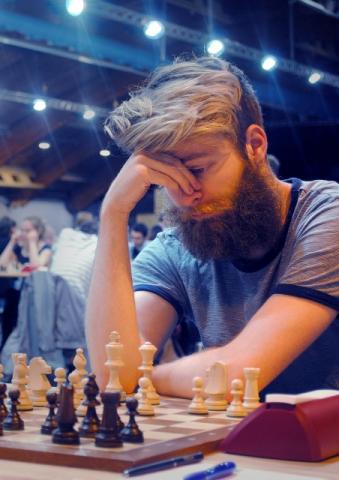
Everyone following Canadian chess will know that IM Aman Hambleton scored his final GM Norm in late December in Spain. That result not only earns him FIDE's Grandmaster title, but also pushed his rating back over 2500, and allowed him to finally shave the beard he had promised to let grow until making his final Norm.
Aman has annotated many of his games for an upcoming issue of Chess Canada. Here are three -- a draw, a loss, and a win -- from three different 2017 tournaments along the way. None of them are opening knockouts. Each is a complex, back-and-forth fight, each with at least one phase of time-pressure and (in two of them) long battles into the endgame.
photo: Aman at the 2017 RTU Open.
For more on Aman's final norm, including links to more of his annotated games, see http://chess.ca/newsfeed/node/1028
To watch Aman streaming online, subscribe to the ChessBrah stream: https://www.twitch.tv/chessbrah
..
() - ()
Round: Result:
Round: Result:
[Event "Riga Technical University Open"]
[Site "?"]
[Date "2017.08.11"]
[Round "7"]
[White "Alekseenko, Kirill"]
[Black "Hambleton, Aman"]
[Result "1/2-1/2"]
[ECO "E15"]
[WhiteElo "2575"]
[BlackElo "2461"]
[Annotator "Aman Hambleton"]
[PlyCount "152"]
[EventDate "2017.??.??"]

{In round 7 of the RTU Open I played against GM Kirill Alekseenko, a very
young GM from Russia with the Black pieces. I knew to expect 1. d4, but didn't
have any expectations after that. In preparation I checked the QID, which was
my main weapon at the time.} 1. d4 Nf6 2. Nf3 e6 3. c4 {Alekseenko informs me
that he will not be playing the London System, something that every d4 players
seems to be capable of these days.} b6 4. g3 Ba6 5. Qc2 {This move usually
indicates that White is planning to sacrifice a pawn as my opponent did in
this game. The compensation is more than enough.} (5. b3 Bb7 6. Bg2 Bb4+ 7. Bd2
c5 {is another variation where I have many games. My first loss in this line
was very recently in a Canadian weekend event against GM Bruzon from Cuba.})
5... Bb7 6. Bg2 c5 (6... Bb4+ 7. Bd2 Be7 8. O-O c6 (8... d5 9. cxd5 exd5 10.
Bf4 $14) 9. c5 $5 $14) 7. d5 (7. O-O cxd4 8. Nxd4 Bxg2 9. Kxg2 Qc7 {is a
version of the Hedgehog that Black can be happy with. White hasn't achieved
very much by exchanging the Bishops so quickly.}) 7... exd5 8. cxd5 Nxd5 9. O-O
Be7 10. Rd1 Nc6 {Defending the Nd5 indirectly because of ...Nb4.} 11. Qf5 (11.
a3 Nc7 12. Nc3 Ne6 13. e3 O-O 14. Nd5 $13) 11... Nf6 12. Nc3 d5 $6 (12... d6 {
is the computer's recommendation, keeping the extra pawn. I was not convinced
by variations such as} 13. e4 Qd7 14. Qxd7+ Nxd7 15. Nd5 $36) 13. Nxd5 Nxd5 14.
Ng5 Bxg5 15. Rxd5 (15. Bxd5 O-O 16. Bxg5 Qc8 17. Qxc8 Raxc8 $11 {seemed to me
like rough equality.}) 15... Qc8 16. Qxc8+ (16. Qxg5 O-O 17. Be3 Nb4 $11) 16...
Rxc8 17. Rxg5 O-O 18. Bd2 f6 19. Rh5 (19. Bd5+ Kh8 20. Rh5 g6 21. Rh4 Rfd8 22.
Bxc6 Rxc6 $15 {leaves Black on the better side of an opposite Bishop endgame.})
19... Rcd8 20. Bc3 g6 21. Rh4 Rd7 22. Rf4 f5 23. h4 Nd8 {[#] When your
opponent has the Bishop pair, its almost always correct to try to exchange the
remaining Bishops on the board. I also have my Kingside pawns arranged on
light squares, which will benefit me in any endgame against the Bc3.} 24. Bxb7
Nxb7 (24... Rxb7 25. Rd1 {is certainly not necessary.}) 25. g4 Nd8 (25... fxg4
26. Rxg4 {keeps Black's pawns together, but now White has a passed e-pawn -
editor.}) 26. gxf5 Rxf5 (26... gxf5 27. Kh2 Rff7 28. Rg1+ Kf8 $11 {was another
good option, with ...Ne6-d4 coming.}) 27. Rxf5 gxf5 28. e3 b5 {It's time to
start advancing my pawn majority.} 29. a3 Kf7 30. Kf1 Nc6 31. Ke2 a5 32. Bd2 a4
(32... c4 33. Rc1 {intending a4 to break up the pawn chain left me feeling a
bit overextended.}) 33. Rg1 Ne5 34. Bc3 Nc4 35. Rg5 Ke6 36. e4 $1 {I didn't
consider this move at all. Luckily it wasn't a big issue, but it's still an
unpleasant shock to completely miss your opponent's idea.} fxe4 37. Rxc5 Rd5
38. Rc6+ Rd6 39. Rc8 h5 ({I should have immediately continued with the idea
that I spotted in a few moves, but it didn't occur to me yet:} 39... Rd3 40.
Rh8 Nxa3 $11) 40. Rf8 Rd3 $1 {Despite sacrificing a pawn, Black activates his
Rook and prepares ideas like ...Nxa3. I preferred this "active defence" to the
alternative ...Rd5 where White still has some pressure.} (40... Rd5 41. Rf6+
Kd7 42. Rf4 $13 {White has all the options.}) 41. Rf4 Rh3 42. Rxe4+ Kd5 43.
Rd4+ Kc6 {There is no good way to prevent ...Nxa3 except...} 44. Kf1 Nxa3 $1 {
[#] Based on my opponent's reaction, it was clear that he underestimated this
move.} 45. Rd8 (45. Kg2 {is the testing variation, but it looks very risky for
White to attempt} Rxc3 46. bxc3 Nb1 47. Rd8 Nxc3 $1 (47... a3 48. Ra8 $8 Kb7
49. Ra5 Kb6 50. Ra8 $11) 48. Rc8+ Kd5 49. Rxc3 b4 50. Rc8 b3 {Only move.} 51. Rb8 Kc4 52.
Rc8+ Kd3 53. Rd8+ Kc2 54. Rc8+ {The position should be drawn by perpetual. If
Black gets greedy for more, he could actually lose.} Kb2 $4 55. f4 {Only move.} $18 a3
56. f5 a2 57. f6 $3 {Only move.} (57. Ra8 a1=Q 58. Rxa1 Kxa1 59. f6 b2 60. f7
b1=Q 61. f8=Q $11) 57... a1=Q 58. f7 $18 {and White will eventually escape the
checks and coordinate his extra Rook.}) 45... Nc4 46. Rc8+ Kd5 47. Rd8+ Kc5 48.
Rc8+ Kd5 49. Rb8 {[#]} Kc6 (49... Nd6 $17 {was the obvious alternative that
should have been played. This was a big missed opportunity.} 50. Bb4 $2 Rb3 {
is winning for Black.}) 50. Rc8+ Kd7 51. Rc5 Nd6 (51... a3 52. bxa3 Rxc3 53.
Rxb5 {was at least a better try than what I played in the game, as the h5 pawn
will fall, but R+N vs. R is hardly a winning attempt.}) 52. Rxh5 a3 53. Kg2 a2
{Completely overlooking my opponent's very logical defensive resource.} 54.
Rh7+ {Only move.} Ke6 55. Ra7 Rxh4 56. Rxa2 {[#] Now I believe White has very decent
winning chances and with time low I decided to force a position which would be
easier to calculate. I'm not sure if this was the correct decision, but I
believe that the ensuing endgame should objectively be drawn.} Ra4 $5 57. Rxa4
bxa4 58. Kf3 Kd5 59. Ke3 Ne4 (59... a3 $1 60. b3 (60. bxa3 Nc4+ $11) 60... Ne4
61. Ba1 Nxf2 62. Kxf2 Kc5 $11 {would have ended the suffering.}) 60. Bb4 Nf6
61. Ba3 Ng4+ 62. Ke2 Ne5 63. f4 Nc6 64. Kd3 Nd4 65. Bb4 Nf5 66. Bc3 Nd6 67. Bd4
Nb5 68. Be5 Na7 69. Kc3 Nc6 70. Bc7 Nd4 {Setting a trap that my opponent falls
right into. There was still a defensive task ahead if White moved his Bishop
somewhere instead.} 71. Kb4 a3 $1 72. bxa3 (72. Kxa3 Nb5+ 73. Kb4 Nxc7 $11)
72... Ne6 73. Bb6 (73. Be5 Nxf4 74. Bxf4 Kc6 75. Ka5 Kb7 $11) 73... Nxf4 74.
Kb5 Ne2 75. Ba5 Nd4+ 76. Kb6 Kc4 {Black will sacrifice his Knight for the
remaining pawn and make a draw at last. For a brief moment in the endgame I
had very good chances to win, but I immediately spoiled it with a series of
inaccuracies. Then I had to scramble just to save a draw in what was a very
back and forth game. This result left me still with good norm chances going
into the final two rounds in Riga.} 1/2-1/2


[Event "Isle of Man International"]
[Site "?"]
[Date "2017.09.24"]
[Round "2"]
[White "Naiditsch, Arkadij"]
[Black "Hambleton, Aman"]
[Result "1-0"]
[ECO "C42"]
[WhiteElo "2702"]
[BlackElo "2479"]
[Annotator "Aman Hambleton"]
[PlyCount "173"]
[EventDate "2017.??.??"]

{In round 2 of the Isle of Man International I was paired against GM Arkadij
Naiditsch, formerly of Germany, now representing Azerbaijan. There was a
random draw of pairings in round 1 of this event, so it was natural to have
such a strong pairing so early in the event.} 1. e4 e5 2. Nf3 Nf6 {I had
prepared to play the Petroff this game, for the first time in my career,
against arguably one of the leading experts in this variation. Naiditsch has
had a lot of experience playing against the Chinese players who have all
studied the Petroff extensively together.} 3. Nxe5 (3. Nc3 {I had expected
this move, since he is very dangerous in the 4 Knights variation, and because
the Petroff would no doubt come as a big suprise to him. I assumed there was a
good chance he would prefer not to play the main lines since I had obviously
prepared myself for them.} Nc6 4. Bb5 Nd4 5. Bc4 Bc5 6. Nxe5 Qe7 7. Nf3 d5 $1
$44 {is very unclear, and has been preferred by Black as of late; see  (½-½,
49) Sutovsky,E (2657)-Naiditsch,A (2687) Wijk aan Zee, 2010.}) 3... d6 4. Nf3
Nxe4 5. d4 d5 6. Bd3 Be7 7. O-O Nc6 {[#]} 8. Re1 (8. c4 Nb4 9. Be2 {is another
main line, with a lot of theoretical discussion.} O-O 10. Nc3 Bf5 11. a3 Nxc3
12. bxc3 Nc6 13. Re1 Re8 {with over 300 games, including: Nakamura,H (2787)
-Akobian,V (2615) Saint Louis, 2016 (1-0, 37).}) 8... Bf5 9. Nc3 Nxc3 10. bxc3
Bxd3 11. Qxd3 O-O 12. Rb1 Na5 {[#] So far we have been following a previous
game that Naiditsch played against Giri, which ended in a draw. I was
expecting him not to repeat, and indeed he did not.} 13. Re2 (13. Bf4 Bf6 14.
h3 c6 15. Nh2 Bg5 16. Be5 b6 17. Qg3 Nc4 18. Nf3 Bh6 19. Re2 f6 20. Bf4 Bxf4
21. Qxf4 Qd7 22. Rbe1 Rae8 $11 {(½-½, 38) Naiditsch,A (2710)-Giri,A (2737)
Linares, 2013.}) 13... c6 14. Bf4 Bf6 15. Rbe1 Nc4 16. h3 h6 {[#] Thus far, I
haven't made any blunders, but because of my inexperience in the Petroff I was
consuming a lot of time on the clock to make seemingly obvious moves. I knew
that time trouble was going to be an issue, but it was difficult to prevent.}
17. Nh2 ({Moves like} 17. Be5 {concerned me. I didn't like exchanging all the
minor pieces and completely conceding the e-file, nor did I enjoy the fact
that my Queen has to stay protecting f6 if I don't trade on e5.}) 17... Bg5 18.
Bxg5 Qxg5 19. Ng4 Nd6 20. Re5 Qg6 (20... Rae8 {is quite an interesting
resource that I didn't even consider; but it involves sacrificing a pawn,
which seems unnecessary e.g.} 21. Rxg5 Rxe1+ 22. Kh2 hxg5 23. Qd2 Re6 24. Qxg5
$13) 21. Qg3 Rae8 $5 (21... Rad8 $11 {White has no threats,but I was thinking
only of simplifying by exchanging pieces. I was playing this way because of my
opponent's reputation in this opening, which is not very objective.}) 22. Rxe8
Rxe8 23. Rxe8+ Nxe8 24. Qb8 Qe6 25. Kf1 (25. Qxb7 Qe1+ 26. Kh2 h5 27. Ne5 Qxf2
$11 {should be enough for a draw, with many perpetual check motifs in the air.}
) 25... Qe7 26. Qxa7 f6 {[#] I had calculated until here, understanding that I
would sacrifice a pawn but regain a lot of coordination with my pieces and
White's doubled c-pawns do not make a good impression. Black intends ...Nd6-c4
with good counterplay.} 27. Ne3 Nd6 28. Qc5 Qe6 29. a4 Kh7 {played on
increment. Had I noticed the idea behind ...Nf5 earlier I would have played it
immediately. This gives an extra tempo to White.} (29... Nf5 30. Nxf5 Qxf5 $11)
30. a5 Nf5 31. c4 Nxe3+ 32. fxe3 Qxe3 33. cxd5 Qf4+ 34. Ke2 Qe4+ {[#] With my
time situation so low, I knew that there was no chance my opponent would
accept a perpetual in this situation. Maybe it was even objectively best to
continue playing, I'm not entirely sure. I was confident that the position
should be equal, but proving that was a different story.} 35. Kd1 cxd5 36. g4
Qh1+ (36... h5 $1 {makes the most sense, keeping the White Queen tied to the
defence of the d4 pawn and looking to create a passed pawn on the Kingside.}
37. Kc1 hxg4 38. hxg4 Qxg4 39. Qxd5 f5) 37. Kd2 Qxh3 38. Qc8 $1 {Annoyingly,
the g4-pawn stops the advance of all my Kingside pawns while the a-pawn was
starting to scare me. I chose a move which could result in mass
simplifications, but to be honest I couldn't forsee any of the resulting
variations with so little time on the clock.} h5 $6 39. Qf5+ Kh8 40. Qxh5+ Qxh5
41. gxh5 Kg8 {[#] Time control has finally been reached and after a long
forcing variation we are left with an endgame that should objectively be drawn
but requires very careful attention and precise play.} 42. c4 dxc4 43. Kc3 Kf7
44. Kxc4 f5 45. Kd3 Kf6 46. Ke3 Kg5 47. d5 f4+ 48. Ke4 (48. Kf3 Kf5 49. d6 Ke6
50. Kxf4 Kxd6 51. Kg5 Ke7 52. Kg6 Kf8 $11) 48... Kg4 49. d6 f3 50. Ke3 $1 Kg3
51. d7 f2 52. d8=Q f1=Q 53. Qg5+ Kh3 54. Qxg7 Qe1+ 55. Kf3 Qd1+ 56. Kf4 Qd2+ (
56... Qxh5 $4 57. Qg3#) 57. Kf5 Qd3+ 58. Kg5 Qe3+ 59. Kg6 Qe4+ 60. Kh6 {[#]}
Qe3+ (60... Qf5 $1 {placing White's pieces in a funny kind of zugzwang and
attacking the a5 pawn.} 61. Qc3+ Kh4 62. Qb4+ Kh3 63. Qxb7 Qf6+ 64. Kh7 Qf5+
65. Kg8 Qxa5 $11) 61. Qg5 Qe6+ 62. Kg7 Qd7+ 63. Kf8 Qc8+ 64. Ke7 Qc7+ 65. Ke8
Qc8+ 66. Kf7 Qd7+ 67. Kf8 Qc8+ 68. Kg7 Qd7+ 69. Kh6 Qe6+ 70. Qg6 Qe3+ 71. Kh7
Qe7+ 72. Kg8 Qd8+ 73. Kg7 Qe7+ 74. Qf7 Qe5+ 75. Kg8 Qg3+ 76. Kf8 Qd6+ 77. Ke8
Qe5+ 78. Kd7 Qb5+ (78... Qxa5 $11) 79. Kc8 Qxa5 80. Qe6+ Kh4 81. h6 Qa8+ 82.
Kd7 b5 83. Ke7 {[#]} b4 $4 {The final blunder, based on the following sequence
which ends with Black unable to give a check without allowing an exchange of
Queens.} (83... Qb7+ 84. Kf8 Kg5 $1 $11 {activating the King was something I
did not consider. As the game reached its conclusion I think my opponent had
amassed almost a one hour time advantage!}) 84. h7 Qa7+ 85. Qd7 {Only move.} Qe3+ 86. Kf7
Qf4+ 87. Ke8 {A disappointing loss, epecially after nearly 90 moves and 6.5
hours of play. Despite the fact that my opening went very smoothly, I spent a
lot of time calculating things that would be basic to a routine Petroff player.
The time disadvantage was the deciding factor in this game, along with my lack
of confidence in an unfamiliar middlegame.} (87. Ke8 Qe5+ 88. Qe7+ {or 87. ...
Qb8+ 88. Qd8+}) 1-0


[Event "Sunway Sitges"]
[Site "?"]
[Date "2017.12.18"]
[Round "4"]
[White "Hambleton, Aman"]
[Black "Bologan, Victor"]
[Result "1-0"]
[ECO "A26"]
[WhiteElo "2474"]
[BlackElo "2607"]
[Annotator "Aman Hambleton"]
[PlyCount "71"]
[EventDate "2017.09.23"]

{In round 4 of the Sunway Sitges Open, after successfully holding Zubov (2626)
to a draw with Black in the previous round, I found myself playing GM Bologan,
from Moldova, with White.} 1. c4 {Bologan is an acclaimed author, and he has
written books about the Philidor and Nimzo, among many others. Because of this,
I didn't feel like entering the main lines of d4 or e4 would be wise. Instead,
I decided to steer the game into lesser explored, non-theoretical territory.}
e5 2. g3 Nf6 3. Bg2 g6 (3... c6 {had been Victor's choice during most of his
previous games against the English} 4. Nf3 e4 5. Nd4 d5 6. cxd5 Qxd5 7. Nc2 $13
{was Navara,D (2646)-Bologan,V (2682) Birmingham, 2005.}) 4. Nc3 Bg7 5. e4 {
Indicating that White will continue with Nge2 and try to play a for a quick f4
break.} (5. Nf3 d6 6. d4 Nbd7 7. O-O O-O {enters King's Indian Defence
territory -- another opening Bologan has published a book about! -- and I
didn't have a lot of experience utilizing the fianchetto system against it.})
5... Nc6 6. Nge2 d6 7. d3 Nd7 $1 {Bologan shows his class! This is an
extremely important move, delaying castling in order to achieve the harmonious
manoeuvre ...Nc5-e6, controlling d4.} (7... O-O 8. O-O Be6 9. h3 Qd7 10. Kh2
$14 {and White is already noticeably better with an easy plan of f4-f5 and
Kingside expansion.}) 8. O-O Nc5 9. Be3 (9. f4 $5 Nb4 {bothered me during the
game. Strangely, White is losing a pawn in this position.} 10. Be3 Nbxd3 11. f5
$14) 9... O-O 10. h3 {Although I wasn't concerned at the time, looking back at
it now I think that I was playing this part of the game too slowly. The
position requires a bit more conviction and direct play.} (10. d4 exd4 11. Nxd4
Ne5 12. b3 a5 13. h3 $14 {was always an option, returning to a KID-style
position, but I didn't feel that waiting until his Knight re-routed to c5 was
any sort of achievement.}) 10... a5 11. Qd2 Nd4 12. f4 (12. Rad1 Bxh3 $1 {
was threatened, winning a pawn.}) 12... f5 13. Kh2 (13. fxe5 dxe5 14. Nd5 Nxe2+
15. Qxe2 Ne6 $13 {and the Nd5 looks very unstable with ...c6 on the horizon.
Although the engine maintains that White is slightly better, I don't
necessarily agree.}) 13... c6 14. Bg1 {removing the Bishop so that Nxd4 is
finally possible, removing Black's most powerful piece.} a4 15. Rad1 (15. Nxd4
exd4 16. Ne2 fxe4 17. dxe4 d3 {did not look good for me during my calculations.
}) 15... Qa5 16. Nxd4 exd4 17. Ne2 fxe4 18. dxe4 Be6 {[#] The computer
dislikes this move, and makes a claim that White is now slightly better. I was
in severe time pressure at this point and ...Be6 was exactly what I expected
him to play. To both myself and my opponent, he was the one pushing for an
advantage. Psychology plays a major factor in chess!} 19. Bxd4 Qxd2 20. Rxd2
Bxc4 21. Bxg7 Kxg7 22. Ra1 (22. Rc1 Bxa2 23. Rxd6 $14 {for some reason I
evaluated that Black's Queenside majority would be a lot more intimidating
than the computer is giving it credit for.}) 22... Bxe2 $5 {This move came as
a huge surprise to me, because I was under the impression that Black was
better. Perhaps my opponent had made a more accurate evaluation of the
position and didn't like his chances after Nc3, when White manages to
consolidate.} (22... a3 {was a much better try e.g.} 23. b4 (23. b3 Bxb3 $1 $19
) 23... Nd3 $15) 23. Rxe2 Rfe8 24. Rd1 Re6 25. Rd4 {At this point, despite
being low on time, I knew that I had survived the tactical part of the game
and had at least stabilized the position.} a3 {Expected, as my opponent was
still playing off my poor time management and was trying to complicate things.}
26. bxa3 (26. b3 Nxb3 $15) (26. b4 Ra4 27. Red2 Na6 $13) 26... Rxa3 27. Red2
Kf7 28. f5 (28. Rxd6 Rxd6 29. Rxd6 Rxa2 $11 {is playable, but allowing such a
big structural imbalance did not seem wise. Black's Queenside pawns can be
very dangerous here.}) 28... gxf5 29. exf5 Ree3 30. Rh4 $1 {I was extremely
proud of this move with seconds on my clock. White's coordination between his
Rooks is ruined after Rxd6. Instead, this move activates both pieces
simultaneously.} (30. Rxd6 Rxg3 31. Rh6 Kg7 $11 {remains unclear and play
continues. I was looking for a more forcing continuation.}) 30... d5 (30...
Rxg3 31. Rxd6 {now we see the purpose of Rh4: both of White's Rooks contribute
to the position. Both f6 and Rxh7 are real threats.}) 31. Rxh7+ Kf6 $2 (31...
Kg8 {should absolutely be played, but perhaps my opponent was discouraged
after missing the variation} 32. Rc7 Rxg3 33. Bxd5+ $1 $11) 32. g4 {[#]} d4 $4
{It became very clear at this moment that my opponent was playing for the win
in a completely unnecessary fashion. Perhaps he was unaware how comfortable
and capable I am while playing only on increment, because his past few moves
and next few moves just cannot be explained.} 33. Rxd4 Rxa2 34. Rd6+ Kg5 35.
Rh5+ ({Hoping for something absurd like} 35. Rg6+ $4 Kf4 $19 {when it is White
who is nearly getting checkmated and Black's King can hide safely under the
cover of White's pawns.}) 35... Kf4 36. f6 {Time control was at move 40 but it
now became fully clear to my opponent that Rf5+ cannot be stopped and Black's
threats are nonexistent against the White King. Bologan was not in good
spirits after the game but he has only himself to blame. While I didn't manage
an advantage from the opening, I was never significantly worse despite how
badly my opponent wished that to be true. This unexpected victory moved me to
3.5/4 with a very strong start to the tournament.} 1-0
merida
46
..
© 2013-20 CFC & McGill Students' Chess Club
Designed by Shao Hang He.