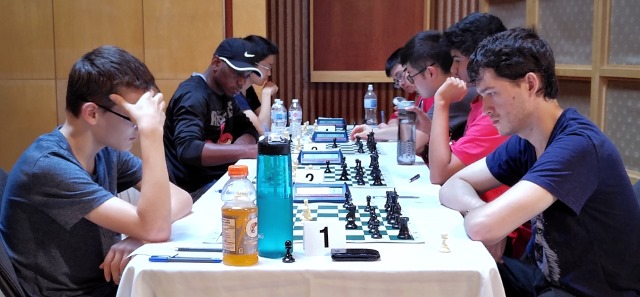
Our Canadian Game of the Week comes from the 2018 Toronto Open, and features cowinner Nicholas Vettese beating IM Artiom Samsonkin in an endgame stemming from a rare line in the French...
[Event "Toronto Open"]
[Site "Toronto"]
[Date "2018.09.01"]
[Round "5.1"]
[White "Vettese, Nicholas"]
[Black "Samsonkin, Artoim"]
[Result "1-0"]
[ECO "C10"]
[WhiteElo "2341"]
[BlackElo "2553"]
[Annotator "John Upper"]
[PlyCount "59"]
[EventDate "2018.??.??"]
[EventCountry "CAN"]
[SourceTitle "Annex CC"]

1. e4 e6 2. d4 d5 3. Nc3 Nc6 {[#] Played about 20x less frequently than the
main moves -- ....Bb4 and ...Nf6 -- but there are still a lot of GM games and
theory here. In his book "Dangerous Weapons: The French" (Everyman, 2007),
John Watson dubbed this the "Hecht-Reefschläger" variation, after the two
Germans who played it frequently. More tellingly, Watson called that chapter
"Swearing in Church", since blocking the c7 pawn is a kind of heresy among
French players.   More recently, both Jobava and Rozentalis have played it
repeatedly, though both with an Elo minus.} 4. Nf3 Nf6 {Again, White has
several decent options: e5 and Bg5 being the most popular.} 5. Bd3 (5. exd5
exd5 6. Bb5 Bg4 7. h3 Bxf3 8. Qxf3 Be7 9. Bg5 a6 10. Bxc6+ bxc6 11. O-O O-O 12.
Rfe1 h6 13. Bh4 Qd7 14. Re2 a5 15. Rae1 Bd8 16. b3 Rb8 17. Na4 Ne4 18. Bxd8
Rbxd8 19. Qf4 Qd6 20. Qxd6 cxd6 21. c4 Nf6 22. Rc1 Rb8 23. cxd5 cxd5 $16 {
with a bigger advantage than Fischer needed to convert in his match with
Petrosian; (1-0, 46) Fischer-Petrosian Buenos Aires (m9) 1971.}) (5. e5 Ne4 6.
Bd3 Bb4 7. Bd2 (7. O-O {is possible, gambiting for development.}) 7... Nxd2 8.
Qxd2 O-O 9. a3 Ba5 10. b4 Bb6 11. Na4 Nxd4 12. Nxd4 Bxd4 13. Bxh7+ Kxh7 14.
Qxd4 {with what looks like a good N vs bad B middlegame, but one where
computers slightly prefer Black after ...b6; Sevian,S (2624)-Shtembuliak,E
(2506) Philadelphia 2018 (1-0, 39).}) 5... Bb4 (5... Nb4 {has been played by
French GM Christain Bauer a few times. It makes sense of ...Nc6 by gaining the
B-pair, but falls further behind in development, and it's not clear how good
the B-pair will really be when the center gets closed.}) 6. O-O Bxc3 $1 {
Otherwise, White goes e4-e5 then Ne2 and Black will get squashed with no play
at all.} 7. exd5 {Only move.} {[#]Black has a couple of ways to win a pawn, but White
gets enough for it in either case.} exd5 (7... Nxd5 $2 8. bxc3 Nxc3 9. Qd2 Nd5
{the B-pair, half-open center, and development lead give White more than
enough comp for the pawn.} 10. c4 (10. Ba3 $16) 10... Ndb4 $2 11. Bb1 O-O 12.
a3 Na6 13. Bxh7+ $1 $18) (7... Nxd4 $6 8. bxc3 Nxf3+ 9. Qxf3 Qxd5 10. Qg3 $14 {
as above, the B-pair, half-open center, and development lead give White enough
comp for the pawn.} O-O 11. c4 Qd4 12. Be3 Qg4 13. Qxc7 $16 {1-0 (37)
Areshchenko,A (2667)-Zaragatski,I (2475) Germany 2010}) (7... Bxd4 8. dxc6 Bb6
9. Qe2 (9. cxb7 Bxb7 $14) 9... bxc6 10. Ne5 Bb7 11. Bg5 h6 12. Bh4 Qd4 13. Bg3
O-O (13... Qxb2 $2 14. Ng6 $3 fxg6 15. Qxe6+ Kd8 16. Bxg6 $18) 14. c3 Qd5 15.
Rad1 c5 $1 16. Bh7+ Nxh7 17. Rxd5 exd5 18. c4 d4 19. Nd3 Rfe8 $14 {(1-0, 67)
Brkic,A (2590)-Jobava,B (2685) Batumi 2018}) 8. bxc3 {This pawn structure is
very common in the Petroff, though usually via ...Nf6-e4xc3 so Black would
still have the DSB. It also comes from an anti-Winawer line (3...Bb4 4.exd5)
where White usually has to spend a tempo with a2-a3 to induce ...Bxc3. That
extra tempo for White is doubly useful here, since Ba3 is also an option.} O-O
9. h3 Re8 10. Re1 Ne4 11. Ng5 $5 (11. c4 Bf5 (11... Nb4 $6 12. cxd5 Qxd5 $2 13.
c4 $18) 12. Bf4 (12. cxd5 $1) 12... Nb4 13. a3 Nxd3 14. cxd3 Nf6 15. Qb3 b6 16.
Rxe8+ Nxe8 $14 {0-1 (53) Kathmale,S (2367)-Puranik,A (2514) Abu Dhabi 2018})
11... Bf5 $1 (11... Nxc3 $4 {is obviously awful:} 12. Bxh7+ Kf8 13. Ba3+ $18) (
11... Nxg5 $6 12. Bxg5 (12. Rxe8+ Qxe8 13. Bxg5) 12... Rxe1+ (12... f6 $2 13.
Qh5 $18) 13. Qxe1 {with the B pair and a relatively open positon.}) 12. Nxe4 {
[#]} Bxe4 (12... dxe4 13. Bb5 (13. Bf1 $14 {would be the Karpov move, keeping
the B safe until after White clears up the pawn situation.}) 13... Qd5 14. c4
$5 Qxd4 15. Qxd4 Nxd4 16. Bxe8 Rxe8 (16... Nxc2 $2 17. Re2 Nxa1 18. Ba4 {
traps the N.}) 17. Rb1 (17. Rd1 Nxc2 18. Rb1 e3 19. fxe3 {Only move.} Nxe3 20. Bxe3 Bxb1
21. Rxb1 Rxe3 22. Rxb7 $11) 17... Nxc2 18. Re2 Nd4 {with some comp.}) 13. Bxe4
dxe4 14. d5 $5 {Computers disapprove, but transferring the pawns to light
squares before Black can blockade makes sense.} Ne7 (14... Na5 15. Qd4 f5 16.
c4 b6 17. Bb2 $13) 15. c4 Ng6 16. Qd4 {Black has a tough decision here.} Qf6 $6
{This goes into an endgame where Black is a bit worse, but may have thought
his drawing chances were better than in the middle game after ...f5 where
White has attacking chances and Black has no clear counterplay.} (16... f5 {
feels loose, and White can consider R lifts along the 3rd.}) 17. Qxf6 gxf6 18.
Bb2 f5 19. Rad1 Rad8 20. c5 c6 21. d6 {[#]} Re6 $2 {Probably the losing move.}
(21... Ne5 {doesn't help, because of the vulnerable black K;} 22. Re3 $1 Nc4 $2
(22... f6 23. Rb3 $16) 23. Rg3+ $18 {and Bg7-f6 with checks wins material.}) (
21... b6 {Is the move Black wants to play, and it is playable now, though
White seems to keep a plus in all lines.} 22. cxb6 (22. Bd4 bxc5 (22... Nf4 23.
cxb6 $16) 23. Bxc5 Rd7 $14) (22. Re3 bxc5 23. Ba3 (23. Ra3 Re6 $2 24. Rxa7
Rexd6 25. Rxd6 Rxd6 26. Ra8+ Nf8 27. a4 $18) 23... Re5 24. Rc3 {Black is under
pressure, but not under ground.}) 22... axb6 23. Re3 Re6 24. Rb3 b5 25. d7 $1
$14 {a subtle move?} Nf8 (25... Re7 26. c4 $16 {creates an outside passer.}
bxc4 $4 27. Rb8 $1 $18) 26. c4 bxc4 27. Rb7 {with a position only White can
win.} Re7 $2 28. Ba3 {Only move.} Rexd7 29. Rdxd7 Nxd7 (29... Rxd7 30. Rb8 $18) 30. Be7
$18) 22. Re3 $1 {If the game goes Ra3 forcing a7-a6 then Black's b7 pawn would
be backwards on a half-open file, and Black could only undermine the d6-pawn
by giving White a new passer on b6.} b6 23. Ra3 f4 (23... bxc5 24. Rxa7 Rexd6
25. Rxd6 Rxd6 26. Ra8+ Nf8 27. a4 {with the pin on the Nf8 requiring a couple
of moves to clear, there is no stopping the a-pawn.}) 24. Rxa7 bxc5 25. d7 $18
Ne5 26. Rc7 $1 {Threatening Rc8.} Kf8 (26... Kg7 {self-pins the Ne5 and so
loses to} 27. Rc8 $18) 27. Ba3 $1 e3 28. Rc8 Rd6 29. Bxc5 e2 30. Rxd8+ 1-0