IM David Cummings is a point behind coleading GMs Karen Movsziszian and Giorgi Bagaturov (6.5), IM Edward Porper, FM Victor Plotkin, FM Dale Haessel with 6 each in the 50+ section.
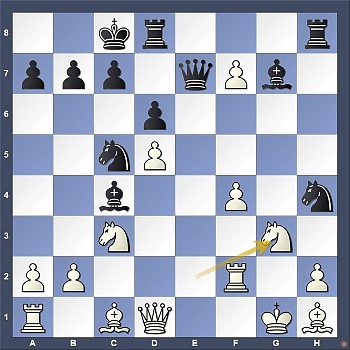
It is Black to play after 18.Ng3. What happens if 18... Nd3? What should Black play?
It's funny to think of a 1...g6 player gambiting his pawns for a kingside mating attack, but one of the main ideas of these defences is to tempt White's pawns forward where they and squares behind them can be attacked. So, although this game gets settled by a sharply calculated mating attack, the weak squares that made that attack possible are the goal of Black's opening strategy.
..
[Event "World Senior 50+"]
[Site "Bled"]
[Date "2018.11.26"]
[Round "7"]
[White "Petran, Peter"]
[Black "Dougherty, Michael"]
[Result "0-1"]
[ECO "A25"]
[WhiteElo "2256"]
[BlackElo "2155"]
[Annotator "John Upper"]
[PlyCount "50"]

1. g3 g6 {It's funny to think of a 1...g6 player gambiting his pawns for a
mating attack, but one of the main ideas of these defences is to tempt White's
pawns forward where they and squares behind them can be attacked. So, although
this game gets settled by a sharply calculated mating attack, the weak squares
that make that attack possible are the goal of Black's opening strategy.} 2.
Bg2 Bg7 3. c4 e5 4. Nc3 Nc6 5. e3 d6 6. Nge2 Be6 7. d4 exd4 (7... Bxc4 8. d5
Bxe2 9. Qxe2 Nb8 10. Qb5+ Nd7 11. Qxb7 $14 Rb8 12. Qxa7 Nc5 13. Qa5 f5 14. O-O
e4 15. Nb5 Ne7 16. Rd1 O-O 17. Bf1 Rb7 18. Rb1 Qb8 19. a4 Kh8 20. b3 $16 {
this setup -- Nb5, a4, b3 -- is also a strong way to kill Black's queenside
play in the Benko.} Ng8 21. Ba3 Nf6 22. Bxc5 dxc5 23. Bc4 Ng4 24. d6 cxd6 25.
Nxd6 Ra7 26. Qxc5 Ne5 27. Rd5 Nf3+ 28. Kg2 h5 29. Nb5 Re7 {1-0 King,D (2560)
-Wolff,P (2540) New York, 1990.}) 8. exd4 $2 (8. Nxd4 $1 Bd7 9. O-O Nge7 10. b3
O-O 11. Nde2 Qc8 12. Bb2 {White is clearly better: extra center space,
potential to use d5, and ability to advance his e and f-pawns without
weakening his K much.} Bh3 13. Qd2 Ne5 14. Nf4 Bxg2 15. Kxg2 Nf5 16. e4 Ne7 17.
Ncd5 Nxd5 18. Nxd5 Qd8 19. Rae1 Nd7 {Black will really have to play ...c6 at
some point, but doesn't get around to it until it's too late.} 20. Bxg7 Kxg7
21. f4 f6 22. h4 Re8 23. h5 a5 24. e5 $1 c6 25. exd6 cxd5 26. Rxe8 Qxe8 27. Re1
Qc8 28. Re7+ Kh6 29. hxg6 f5 30. Qd4 Nf8 31. Qf6 {1-0 (31) Flores,D (2562)
-Pancevski,F (2464) Tromsoe Olympiad, 2014.}) 8... Bxc4 $15 9. d5 Ne5 (9...
Nce7 $2 10. Qa4+ b5 11. Nxb5 $14) 10. O-O ({There are no forcing ways to take
advantage of the slightly loose Bc4:} 10. Qa4+ Qd7 $19) (10. f4 Nd3+ $19) 10...
Ne7 11. f4 $2 {White is down a pawn for nothing, and clearly feels he has to
force matters; but just like the Pachman game below, Black plays good moves
and White's position just gets worse.} Nd7 $1 (11... Nd3 $2 12. Qa4+ $13) 12.
Rf2 (12. g4 h5 $1 13. f5 hxg4 $1 14. f6 Nxf6 15. Qd4 Bxe2 16. Rxf6 O-O (16...
Bf3 $1) 17. Ne4 Nf5 $1 18. Qc3 Qe7 19. Bg5 Qe5 20. Re1 Qxc3 21. bxc3 Bc4 22.
Nd2 Bd3 {0-1 (22) Pachman,L-Emma,J Mar del Plata, 1959. This loss cost Pachman
clear 1st at Mar del Plata, where he still tied for first with Najdorf and
finished just ahead of the 15-year-old Fischer.}) 12... Nf5 {Both ...00 and ...
h5 are good too, but this move has the added bonus of goading White into
trying to punish Black... and weakening his own king in the process.} 13. g4
Nh4 {Outpost!} 14. Bh1 (14. b3 Ba6 15. Be3 Bxe2 $6 (15... Nxg2 $17) 16. Rxe2
Bxc3 $4 17. Bd4+ $18) 14... h5 $1 15. gxh5 Qe7 $1 (15... Rxh5 {is also good}
16. Ng3 Qe7 $5 (16... Rh7 $17) 17. Nxh5 gxh5 {with ...000 and ...Rg8 and
positional comp that the computer rates as winning for Black.}) 16. hxg6 O-O-O
$1 17. gxf7 Nc5 $1 18. Ng3 {[#]Critical Position What happens after ...Nd3?}
Nd3 $1 {Black gets an octopus on d3, but hangs the Bg7. This is another move
the computer ranks as best, but only if you play the forcing continuation in
the game.} (18... Qxf7 {defends the Bg7 and also wins:} 19. Be3 Bxc3 20. bxc3
Rdg8 $19) 19. Qg4+ Kb8 20. Qxg7 {White is up a piece and two pawns, but Black
has a winning attack with a series of only moves:} Qe1+ {Only move.} 21. Rf1 (21. Nf1 $2
Qxf2#) 21... Nf2 {Only move.} 22. Bg2 (22. Rxe1 Nh3#) (22. Qg4 {Is an ugly way to
prolong the game, but Black has choices of ways to win, including} Bxf1) 22...
Nf3+ $1 (22... Bxf1 $1 {is mate in six, with variations similar to the game:}
23. Bxf1 (23. Nxf1 Nf3+ {Only move.} 24. Bxf3 Nh3+ 25. Kg2 Qf2+ 26. Kh1 Qxf1+ 27. Qg1
Qxg1#) 23... Nh3+ 24. Kh1 Qf2 25. Bxh3 Nf3 26. Nf1 Qxf1+ 27. Bxf1 Rxh2#) 23.
Bxf3 {Only move.} Bxf1 $1 (23... Nh3+ {also wins, but requires Black to find an
additional sac:} 24. Kh1 Bxf1 {Only move.} 25. Be3 Nf2+ $1 26. Bxf2 Rxh2+ {Only move.} {and mate
in 3.}) 24. Bd2 (24. Nxf1 Nh3+ 25. Kg2 Qf2+ {is the same mate as above.}) 24...
Nh3+ {Only move.} 25. Kh1 Be2+ (25... Bg2+ {is slightly faster} 26. Kxg2 Qf2+ 27. Kh1
Qxf3#) (25... Be2+ {is less efficient but more stylish, giving Black another
chance to sac his Q for a minor piece mate:} 26. Nf1 (26. Rxe1 Bxf3#) 26...
Bxf3+ 27. Qg2 Bxg2+ 28. Kxg2 Qf2+ 29. Kh1 Qg1#) 0-1
..