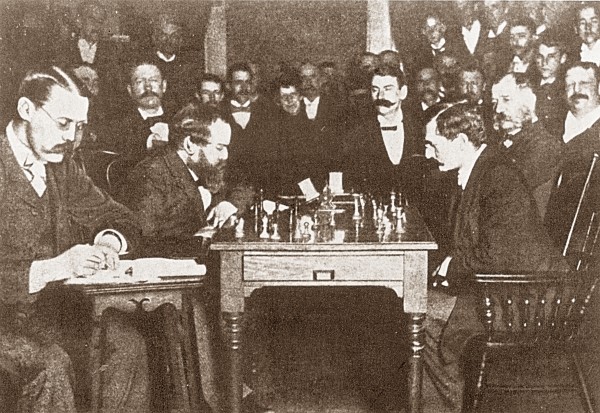
Lasker won the World Championship by defeating Wilhelm Steinitz in an 1894 match held in New York City, Philadelphia, and -- for games 12-19 -- Montreal.
Here is the final game of that match, along with fragments from other games from the match, and comments from both Lasker and Steinitz.
..
[Event "5th World Championship"]
[Site "Montreal"]
[Date "1894.05.26"]
[Round "19"]
[White "Lasker, Emanuel"]
[Black "Steinitz, William"]
[Result "1-0"]
[ECO "D40"]
[Annotator "John Upper"]
[PlyCount "103"]
[EventDate "1894.03.15"]
[EventType "match"]
[EventRounds "19"]
[EventCountry "CAN"]
[Source "ChessBase"]
[SourceVersion "2"]
[SourceVersionDate "1999.07.01"]
[SourceQuality "1"]

{Before the match, Steinitz said, "I believe that Lasker is a really fine
player. Moreover, the latter had the chance to study all my games, my books
and therefore my style and if I do lose he will have to beat me with my own
weapons…” (NYT, March 11, 1894). One of Steinitz's weapons was the Bishop
pair, and Lasker showed he had learned well...} 1. d4 d5 2. c4 e6 3. Nc3 Nf6 4.
Nf3 Be7 5. e3 O-O 6. Bd3 c5 {[#]} 7. dxc5 {Like Kramnik over 100 years later,
Lasker believed that a good way to defeat the World Champion was to go for
queenless middlegames. But he had already proved he could beat Steinitz in a
more complex middlegame:} ({Game 15 of the match continued:} 7. O-O cxd4 8.
exd4 dxc4 9. Bxc4 Nbd7 10. Bb3 Nb6 11. Bg5 $14 {and Lasker went on to win this
IQP middlegame; 1-0 (44) Lasker,E-Steinitz, WC m g15, Montreal 1894}) 7... dxc4
8. Bxc4 Qxd1+ 9. Kxd1 {[#]} Nc6 $6 {Steinitz had already played this in game
11 of the match; he lost that game, but had found an improvement at move 11.
"Already inaccurate. The most comfortable development for Black involves
fianchettoing his queen's bishop, so Black's knight will belong on the
d7-square." - Schuyler, "Your Opponent is Overrated".} ({Here's how Black
should develop:} 9... Bxc5 10. Ke2 a6 11. Bd3 Be7 12. Rd1 b5 13. a3 Bb7 14. b4
Nbd7 15. Bd2 ({On} 15. Bb2 {Black will maneuver a N to c4, more-or-less
forcing White to concede the B-pair with Bxc4.}) 15... Rac8 16. Rdc1 Rfd8 17.
Be1 Nb6 18. e4 Nc4 (18... Nh5 19. g3 (19. Bd2 Bf6 20. g4 $2 {traps the N, but
loses to} Bxc3 $19 {when ...Bxa1 or ...Nf4 will win.}) 19... f5 $1 $17) 19.
Bxc4 bxc4 20. Nd2 Nd7 21. Rc2 Ne5 22. f3 f5 23. Bf2 Bf6 24. Rb1 Rd3 25. Na4 c3
26. Nb3 fxe4 27. fxe4 Bxe4 28. Nbc5 Bg6 29. Re1 Rd2+ 30. Rxd2 Bh5+ 31. Ke3 Ng4+
32. Kf4 cxd2 33. Rd1 g5+ {0-1 (33) Bogdanovich,S (2567)-Korobov,A (2715) Kiev
2013}) 10. a3 Bxc5 11. b4 {[#]} Rd8+ {Improving over game 11.} (11... Bb6 $6
12. Ke2 Bd7 13. Bb3 Rac8 14. Bb2 a5 $2 15. b5 $16 Ne7 16. Ne5 Be8 {Black
(temporarily) keeps the Bs, only to give one back to reconnect his Rs.} 17. a4
Bc7 18. Nc4 Bd7 19. Rac1 Ned5 20. Nxd5 Nxd5 21. Ne5 Bxe5 (21... Be8 $2 22. Nd3
$1 f5 23. Ba3 $18) 22. Bxe5 f6 23. e4 $1 {Giving up the Bishop pair for a
structural advantage.} fxe5 24. exd5 Kf7 25. Rhd1 (25. d6 $1 Rxc1 26. Rxc1 Rc8
27. Rxc8 Bxc8 28. Ke3 {and the tactics work for White in this B ending; e.g.}
b6 29. Bc2 Bb7 30. Bxh7 Bxg2 31. Bg8+ $1) 25... Ke7 26. d6+ Kf6 27. Ke3 Rxc1
28. Rxc1 Rc8 29. Rxc8 Bxc8 30. Bc2 Kf7 31. Bxh7 g6 32. Ke4 Kf6 (32... Kg7 33.
Kxe5 Kxh7 34. Kf6 $18 {the d-pawn will cost Black his B, and Black has no way
to use the intervening moves.}) 33. g4 g5 34. Kf3 Kf7 35. Be4 Ke8 36. h4 Kd7
37. h5 Ke8 38. Ke3 {1-0 (38) Lasker,E-Steinitz,W g11, Philadelphia, 1894}) 12.
Ke2 Bf8 13. Bb2 $11 Bd7 $6 {"Even with the c6-knight misplaced, it is still
better to fianchetto this bishop after ...b7-b6, or ...a7-a6 and ...b7-b5.
Where it stands, the bishop is both an obstruction and a target, just as in
[game 11]." - Schuyler, "Your Opponent is Overrated".} 14. Rhd1 Rac8 15. Bb3
Ne7 16. Nd4 (16. Ne5 Be8 $14 {White should be able to get his minors to better
squares faster than Black after the impending exchange of Rs.}) 16... Ng6 17.
Rd2 {[#]} e5 $6 {Another small mistake. Dislodging the N and clearing a
diagonal for the Bd7 seems perfectly sensible, but the pawn becomes exposed on
e5, and defending it ties up Black's minors.} (17... Ne5 18. Rad1 Be7 (18...
Nc4 $6 19. Bxc4 Rxc4 20. Nf3 Rc7 21. Ne5 Be7 $14) 19. Ndb5 Ne4 $17 {according
to Steinitz, though it's hard to see any advantage for Black after} 20. Rd4)
18. Nf3 Bg4 (18... Bc6 19. Rad1 Rxd2+ 20. Rxd2 Be7 21. Bc2 Re8) 19. Rxd8 $1
Rxd8 20. h3 $1 Bxf3+ {Black gives up the B pair, and is left with light square
weaknesses.} (20... Bc8 $5 21. Ng5 Nh8 22. Nb1 {with better Bs and pressure on
e5.}) 21. gxf3 (21. Kxf3 $2 Rd2 {with the initiative.}) 21... Be7 22. Rc1 Kf8
23. Na4 $5 {[#] For me, this is the most interesting move of the middlegame:
it semi-threatens both Rc7 and Nc5, neither of which is winning, and both of
which can be stopped by Black's next move, which White of course saw. So why
play Na4? Partly, it may just be "maneuvering"... keeping the game going and
forcing the opponent to discern the threats from the non-threats and respond
accordingly. Partly, it is a way to encourage Black's pawns to move -- this
reduces their future mobility and weakens some squares (the pawns can't go
back) and so makes other maneuvers possible while limiting Black's defensive
options.} b6 24. Nc3 Bd6 25. Rd1 {Tying Black further.} Ne8 (25... Ke7 $2 26.
Nb5 Bb8 27. Rxd8 Kxd8 28. Bxf7 $18) (25... Bc7 26. Rxd8+ Bxd8 27. Nb5 a6 28.
Nd6 {wins f7 or e5.}) 26. Nb5 Rd7 $6 27. Bc2 $1 Ke7 28. Bf5 $18 {White wins
the a-pawn or (as Black prefers) the exchange.} a6 (28... Rb7 29. Be4 ({or} 29.
Bc8 Rb8 30. Nxa7 Ra8 31. Nc6+ $18) 29... Rd7 30. Bc6 $18) 29. Bxd7 Kxd7 30. Nc3
f5 31. b5 $1 axb5 (31... a5 32. Nd5 $18 {wins the b6-pawn.}) 32. Nxb5 Ke6 (
32... Kc6 33. Nxd6 ({or} 33. a4 {, but exchanging on d6 leaves the c-file open
for White's R.}) 33... Nxd6 34. Rc1+ Kd7 35. a4 $18) 33. Bc3 Ne7 34. Nxd6 Nxd6
35. Bb4 Nd5 36. Rc1 (36. Bxd6 $4 Nc3+ $14) 36... Nf7 (36... Nxb4 37. axb4 b5
38. Rc7 $18) 37. Bd2 Nd6 38. Kd3 Kd7 39. e4 $1 Nf6 40. Be3 fxe4+ 41. fxe4 b5 (
41... Ndxe4 42. Bxb6 $18) 42. f3 Nc4 43. Rc3 (43. Rxc4 {also wins, but
Lasker's regrouping is much faster.}) 43... Ne8 44. Bc1 {Dominating the Nc4
and freeing the R.} Ncd6 45. Rc5 Nc7 (45... Ke6 46. Bb2 Nc4 47. Rxb5 $18) 46.
Rxe5 Ne6 47. Rh5 h6 48. Re5 g5 49. h4 gxh4 50. Rh5 Kc6 51. Rxh6 Nc5+ 52. Kc2 {
This win ended the match +10 = 4 -5, making Lasker the new World Champion.
"When Steinitz entered this contest he felt sure of victory. But when fate
went against him and he found himself, for the first time in his life, beaten,
he behaved with the utmost chivalry. His way of resigning the last game of the
match was to call for cheers for the new champion of the world.”  - Lasker,
Lasker's Chess Magazine, 1906.} 1-0
..