

Bareev book announced

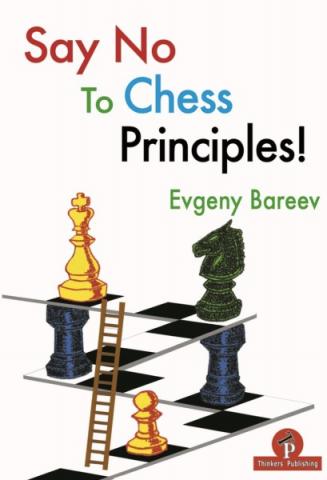
Thinker's Publishing has announced a forthcoming book: Say No to Chess Principles! by Russian-born but now Canadian resident GM Evgeny Bareev.
Evgeny Bareev has won major tournaments in Budapest, Moscow, Dortmund, Hastings, and Wijk aan Zee, as well as the World U16 championship. He earned four Olympiad gold medals played on the winning Soviet and Russian teams in 1990, 1994, 1996, and 1998. His rating peaked October 2003 at world #4 -- behind three former, current, and future World Champions: Kasparov, Kramnik and Anand. His previous book, co-written with Ilya Levitov, is From London to Elista (NiC, 2007), a fascinating and funny behind-the-scenes look at his work with Kramnik during his successful and scandalous World Championship matches. He currently lives and teaches chess in Toronto.
Bareev's Say No to Chess Principles! will be the eighth chess book written by a Canadian player published in the past three years:
- David Cummings, The English (Everyman, 2016)
- Jean Hebert, The Sicilian: Thematic Sacrifices and Attacks (le pion passe, 2017)
- Michael Song and Razvan Preotu, The Chess Attacker's Handbook (Gambit, 2017)
- George Huczek, A to Z Chess Tactics (Batsford, 2017)
- Raja Panjwani, The Hyper Accelerated Dragon (Thinkers, 2017)
- Yelizaveta Orlova, Chess for Beginners: Know the Rules, Choose Your Strategy, and Start Winning (Zephyros, 2018)
- John and Joshua Doknjas, The Sicilian Najdorf (Gambit, 2018)
- Evgeny Bareev, Say No to Chess Principles! (Thinkers, 2019)
All excerpts below are from the "teaser" available on the Thinker's Publishing website:
Readers familiar with Bareev's From London to Elista will look forward to his sense of humour, which is on display even in the chapter titles -- Chapter 3: When a Piece in the Center is Grim; Chapter 4: A Piece Down in a Worse Position -- and in his confessional intro "WHY I WROTE THIS BOOK":
I feel it my duty to explain myself to the reader.
Nowadays, if you walk into any chess shop, you’ll see thousands of books with the same tried and true ‘updated and overanalyzed examples’ gathering dust on the shelf. Even though I understand that my book will likely take its rightful place in the depths of those same bookcases, I wrote it anyway. What is it that lurks behind this decision? Is it avidity? Vanity? Stupidity? Or perhaps maybe greed compounded by stupid vanity? What really was it that pushed me to make this childish mistake?
You can read the rest of his apology to find his explanation.
From: "What this book is about":
Chess has very strict, but also fairly simple, rules: rapid development, control of the center with pawns or pieces, timely castling and defense of the king, the creation of various weaknesses in the opponent’s position, attacking those weaknesses, and control of open lines. At the same time a player shouldn’t get his queen stuck in the enemy camp, or ruin his own pawn structure. Those who know these rules will succeed.
...However it also happens that chess players often discover significant resources which formally exist outside the typical rules of chess. Those who know how to break all the rules and work around those specific guidelines reach the very top. Currently, when thousands of chess books dissect the same standard ideas in great detail, let us remember that first there were those who originally discovered them, implemented them, and made them standard, as well as those who broke the rules and created completely new ones.
And this is immediately followed by the game and notes below....
..
() - ()
Round: Result:
Round: Result:
..