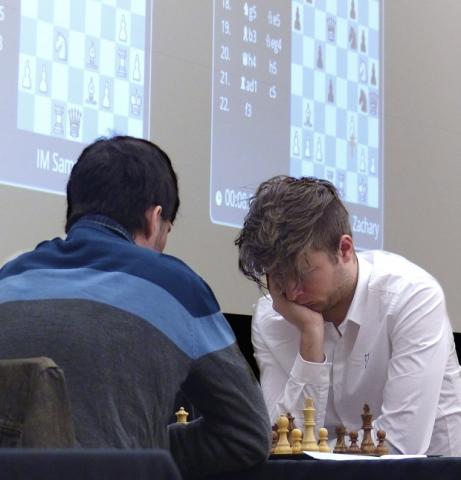
It was a 9 round Swiss in four sections: Zonal, U2200, U1900, and U1600. The top section attracted three GMs, three IMs, and six FMs. First place was won by GM Evgeny Bareev, who was playing his first Canadian Championship since moving to here in 2010. Bareev lost his first round game to Joshua Doknjas, then won his next seven before holding GM Aman Hambleton to a draw in the final round. Hambleton took second on tie-break (individual encounter) over IM Nikolay Noritsyn.
This was the first of a planned four-year series which will see Canadian Zonals (Open and Women's) played in Kingston during the Easter long weekend.
Our Canadian Game of the Week is penultimate round board two pairing at the 2019 Canadian Zonal between IM Nikolay Noritsyn and GM Aman Hambleton, annotated by Aman...
..
[Event "Canadian Zonal"]
[Site "Kingston"]
[Date "2019.04.22"]
[Round "8.2"]
[White "Noritsyn, Nikolay"]
[Black "Hambleton, Aman"]
[Result "0-1"]
[ECO "A22"]
[Annotator "Aman Hambleton"]
[PlyCount "80"]
[EventDate "2019.04.22"]
[EventType "swiss"]
[EventCountry "CAN"]

{In round 8 I was paired against IM Nikolay Noritsyn with the Black pieces.
Strangely, Nikolay is one of the few players I would rather play with Black
because he actually scores worse with White. In fact, because of how good
Nikolay is with the Black pieces it enables a lot of favourable lineups for
our Olympiad team! This was an important match for the tournament standings,
and if I wanted any shot at 1st place, I needed to beat Nikolay and then try
to beat Bareev in round 9.} 1. c4 e5 2. Nc3 Bb4 3. e4 (3. Nd5 Bc5 4. e3 Nf6 5.
d4 Nxd5 6. dxc5 Nf6 {is another variation entirely, with some clear imbalances
already.}) 3... Nf6 4. g3 {[#]} O-O $5 {I classify my own move as a small
inaccuracy. I don't think I should ever allow White to play Nge2 the way that
he did in this game. Black usually takes the chance to double the c-pawns when
possible and then launches a counter-attack in the center.} (4... Bxc3 5. bxc3
O-O 6. Bg2 Re8 7. Ne2 c6 (7... d6 $6 {is a solid move, but its known to be
quite bad for Black since there are no easy pawn breaks in the position.} 8.
O-O Nc6 9. d3 $14) 8. O-O d5 9. cxd5 cxd5 10. exd5 Nxd5 $13 {and this
theoretical position has been reached many times. White has the Bishop pair
and a completely open position but Black has very easy development and a long
term goal of trading light squared Bishops.}) 5. Nge2 d6 6. Bg2 Bg4 {I decided
to give away my Bishop pair in order to try to create a position where I could
play on the dark squares. I felt that I had already kind of messed up by
allowing Nge2 and so I was trying to come up with a plan.} (6... Nc6 7. h3 Bc5
8. O-O Nd4 9. d3 h6 10. Kh2 {is such an easy position to play with White.
Despite the computer's evaluation of equal or even slightly better for Black,
I disagree completely. In practice, White usually rolls over Black on the
Kingside with f4-f5.}) 7. h3 Bxe2 8. Nxe2 (8. Qxe2 Nc6 9. O-O a5 {is easy to
play for Black.}) 8... Bc5 9. d4 $1 {I had underestimated this move in my
calculations, mostly because it looks so crazy to think that White can open up
the middle of the board without being castled; but the variations seem to
suggest that White is tactically justified in doing so.} (9. O-O {is the
alternative, but it looks like easy play for Black.} Nc6 10. d3 Nd4 11. Kh2 a5
12. f4 Nxe2 13. Qxe2 Nd7 $11) 9... Bb6 (9... exd4 10. Nxd4 Re8 11. O-O Nxe4 12.
Re1 Bxd4 13. Rxe4 $18) 10. O-O Nc6 {[#]} 11. d5 {A strong move, but at least
it allows me to execute my plan of playing on the dark squares. White is
definitely better, there's no question about that, but Black's counterplay is
easy to locate.} (11. Be3 {was the move I expected, mostly because I don't see
any position where White doesn't emerge comfortably in a Maroczy Bind position.
} exd4 (11... Qe7 12. Re1 Rfe8 13. a3 $14) 12. Nxd4 Nxd4 13. Bxd4 Bxd4 14. Qxd4
Re8 15. Rfe1 $14) 11... Nd4 12. Nc3 c6 13. Kh2 cxd5 14. exd5 (14. cxd5 {
also looked like a very good move to me, since it does not allow any threats
whatsoever on the Queenside or the c-file, and still prepares f4 and a
Kingside attack.}) 14... Rc8 15. f4 Nd7 (15... Rxc4 16. fxe5 dxe5 17. Bg5 $14 {
and my Kingside will fall apart here.}) 16. b3 a6 {Mostly because Na4 is a
threat, but also to prepare to play ...b5 once the Bishop moves.} 17. fxe5 dxe5
18. Ba3 {During the game I had actually underestimated this move, and totally
missed that after ...Bc5 my opponent could just play b4 and c5. Luckily, the
tactics are just working for me!} Bc5 19. Bb2 (19. b4 $6 Be7 20. c5 a5 21. d6
Bxd6 $15 {and Black survives.}) 19... f5 {[#]} 20. a3 $2 {This move might
deserve more than a question mark. It's unfortunate for my opponent, who
played a nice game and was better in every moment up until now, but a3 is just
way too slow. After my quick reaction here, the position turned from great for
White to dead lost in a matter of 3 moves.} (20. d6 {I was convinced that
Nikolay would play this move, which is why I spent about 15 minutes on the
move ...f5. I wasn't sure how to deal with my pawn on b7 in a nice way.} Nf6
21. Bxb7 Rb8 22. Bg2 Qxd6 23. Na4 $13) 20... Bd6 $1 $17 21. Na2 (21. Ne2 {
absolutely had to be played, but I think Nikolay saw this was really
straightforward for me to play and in lieu of my time pressure, wanted to keep
more pieces on the board. This was the wrong idea, however!} Nxe2 22. Qxe2 e4
$17 {and White has no play; e.g.} 23. Qh5 g6 24. Qh6 Qe7 $19) 21... Qg5 {
Now ...e4 is a huge threat.} 22. Bc1 f4 {[#]} 23. g4 (23. Qg4 fxg3+ 24. Kh1
Rxf1+ 25. Bxf1 Qxg4 26. hxg4 Rf8 27. Bg2 Nxb3 28. Rb1 Nxc1 29. Nxc1 Nc5 $19)
23... Qh4 24. Qe1 Qxe1 25. Rxe1 Nc2 26. Bb2 {[#]} Nxa1 $2 {This move is
completely absurd.} ({There's no rush to take the material when two rooks are
still hanging, and as it turns out the Nc2 would have been extremely useful to
help push ...e3 later on in the variation:} 26... f3 27. Bf1 e4+ 28. Kh1 e3 $1
{is resignable.}) 27. Bxa1 f3 28. Bf1 e4+ 29. Kh1 Rce8 30. Bd4 Bg3 (30... Bc5
31. Be3 f2 32. Re2 Rf3 33. Bxc5 Nxc5 {was another much simpler way to win. My
technique in this game left a lot to be desired.}) 31. Re3 Bf2 32. Rxe4 {[#]}
Bxd4 (32... Rxe4 33. Bxf2 Re2 34. Bxe2 fxe2 35. Kg2 Ne5 36. Nc1 $1 {was a
variation that shocked me as I was calculating on increment. White's Nc1 hits
my pawn as well as stops ...Nd3, which I did not realize until the last second.
}) 33. Rxd4 Re3 34. b4 Ne5 35. d6 f2 36. Kg2 Nf3 37. Rd1 Nh4+ 38. Kh2 Nf3+ {[#]
} 39. Kh1 {I cannot explain this move really, since it seemed to me that the
obvious move was just repeating with Kg2. There are forced wins in all
variations here, but I think the most difficult one to spot is after Kg2. Kh1
as played in the game was a big relief as I approached move 40.} (39. Kg2 Ne1+
40. Kh2 Rff3 $1 {this move wins on the spot, but honestly I did not see it in
my preliminary calculations during the game. Maybe I would have noticed it had
Nikolay repeated moves with Kg2, but I can't say so for sure! Nevertheless, ...
Rff3 seemed like a much more difficult tactic than the one I had to find in
the game:} 41. d7 Rxh3+ 42. Bxh3 Rxh3+ 43. Kxh3 f1=Q+ {and White gets mated
before he can promote.}) 39... Re1 40. Nc3 Nd2 {This was my 40th move, but I
was also quite certain that it would be the final move of the game since it
appears to win on the spot. If the King were on g2, then the Bishop would be
protected in all the ensuing variations. This was a cruicial win for my
tournament, as it gave me a chance to fight for first place in the last round
against Evgeny Bareev.} 0-1
..