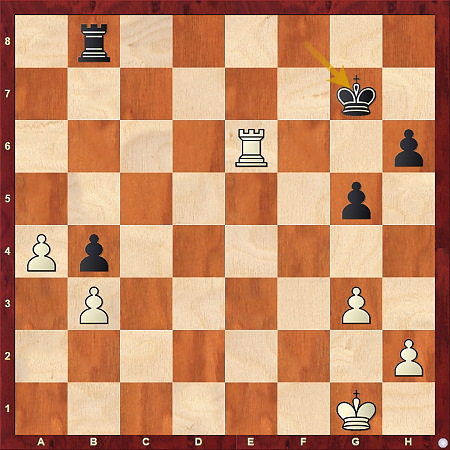
The big result from the Quebec Open was from current Canadian Women's Champion WIM Maili-Jade Ouellet, who finished 5th behind the four GMs who won. Our Canadian Game of the Week is WIM Maili-Jade Oullete vs GM Alexandre Le Siege from the second-last round at the 2019 Quebec Open. In the diagram, White has an extra pawn and the move, so it is "just a matter of technique". But which technique?
[Event "Quebec op"]
[Site "Longueuil CAN"]
[Date "2019.07.26"]
[Round "8.2"]
[White "Ouellet, Maili-Jade"]
[Black "Lesiege, Alexandre"]
[Result "1/2-1/2"]
[ECO "D31"]
[WhiteElo "2079"]
[BlackElo "2500"]
[Annotator "John Upper"]
[PlyCount "120"]
[EventDate "2019.07.20"]
[EventType "swiss"]
[EventRounds "9"]
[EventCountry "CAN"]

1. d4 d5 2. c4 e6 (2... c6 3. Nf3 e6 {1/2-1/2 (66) Juptner,J (2340)-Simacek,P
(2485) Czechia 2013}) 3. Nc3 c6 4. Nf3 dxc4 5. Bg5 $5 {Uncommon, but the best
scoring.} (5. a4 {is by far the most common, when} Bb4 6. e3 b5 {leads to the
Noteboom variation, which usually continues:} 7. Bd2 a5 8. axb5 Bxc3 9. Bxc3
cxb5 10. b3 Bb7 11. bxc4 b4 12. Bb2 {with an interesting and unbalanced
position.}) 5... Be7 {"Perhaps the strongest continuation. As a rule, the
exchange of these bishops is unfavourable for Black because the dark squares
in his camp become weak. However, in this case it deserves serious attention
as it gains time for development, giving Black reasonable chances to improve
his other bishop's scope with the thematic ...c6-c5. Besides, he still has an
extra pawn and White must spend time himself in getting it back." - Scherbakov,
The Triangle System, Everyman, 2012.} (5... Nf6 6. e4 b5 {Transposes to the
Botvinnik Semi-Slav. Both 5...Qc7 and 5...f6 are played here too.}) 6. Bxe7
Nxe7 7. e4 $5 {Again, uncommon but the best scoring.} (7. e3 b5 8. a4 Nd5 $1 9.
Be2 Nxc3 10. bxc3 Nd7 11. Qb1 a6 12. Nd2 Rb8 13. Bf3 c5 $15 {1/2-1/2 (30)
Beliavsky,A (2640)-Ivanchuk,V (2709) Lvov 2000}) 7... b5 8. a4 b4 9. Na2 a5 10.
Bxc4 Nd7 (10... Ba6 11. Qe2 O-O 12. O-O Qb6 13. Nc1 c5 14. dxc5 Qxc5 15. Bxa6
Rxa6 16. Nd3 $6 (16. Nb3 $1 $14) 16... Qa7 17. Rac1 Rc6 18. Nfe5 Rxc1 19. Rxc1
$11 {½-½ (66) Juptner,J (2340)-Simacek,P (2485) Czechia 2013:}) 11. O-O O-O
12. Nc1 {[#] This set of moves -- a2-a4, Nc3-a2-c1-b3 -- is a common maneuver
in QG positions where Black has advanced ...b7-b5: it gives White's minors
good squares and allows White to attack Black's (over)extended queenside with
minor pieces on light squares and Rs along the c-file.} c5 13. Nb3 Bb7 14. Re1
cxd4 15. Nfxd4 Nf6 16. Nc5 Bc8 (16... Qc7 17. Ndxe6 $5 fxe6 18. Rc1 $1 $13) (
16... Qb6 17. Nxb7 Qxb7 $14 {White's minors have better squares (b3 and b5)
than either of Black's Ns, and Black's a5-pawn will be a target.}) (16... e5 $2
17. Nxb7 Qc7 (17... Qxd4 $2 18. Qxd4 exd4 19. Rad1 $18) 18. Nf3 Qxc4 19. Rc1
$16) 17. Nb5 Ba6 18. Qxd8 {White could also keep more pieces on with Qe2.}
Rfxd8 19. Nxa6 Rxa6 20. Rad1 Raa8 21. f3 Nc6 22. Nd6 {[#]} g5 {to secure e5} (
22... Kf8 {, trying to oust the beast on d6 with ....Ne8, doesn't work because
White can nudge Black's loose pieces onto even worse squares; e.g.} 23. Bb5 Na7
24. Ba6 $1 Rab8 (24... Ne8 $2 25. Nc4 {attacking a5,} Nc6 {saving a5 loses to}
26. Bb7 $18) 25. Nb7 Rxd1 26. Rxd1 Nc6 27. Rc1 $16) 23. e5 Nh5 $6 {Black is
worse in any case, but trying to keep things complicated with this move just
makes it worse, since the N will be out of play after White's next move.} (
23... Nd7 $4 {drops an exchange to} 24. Nb7 $18) (23... Ne8 {was better, but
you have to see that after} 24. Bb5 Nxd6 25. Bxc6 {Black escapes with} Rac8 26.
Rxd6 Rxd6 27. exd6 Rxc6 28. Rd1 Rc8 $14 {with an ending Black should be able
to hold.}) 24. g3 $16 {[#]} Kf8 25. Bb5 Na7 26. Bd3 h6 (26... Nc6 27. Be4 Ra6
28. Nc4 $18) 27. Be4 Rab8 28. Nb7 $1 Rdc8 {[#] Black's pieces are terribly
inactive} 29. b3 (29. Rd6 $1 {threatens Ra6!} b3 30. Ra6 f5 31. exf6 Nxf6 32.
Rxa7 Nxe4 33. Rxe4 Rc7 34. Nxa5 Rxa7 35. Nc6 $18 {transposes to something like
the game.}) 29... f5 (29... Nc6 30. Nd6 Rc7 31. Rc1 {German might have a word
for how horrible Black's position is, but I don't know it.}) 30. exf6 Nxf6 31.
Nxa5 Rc3 32. Rd6 $1 Nxe4 33. Rxe4 $18 Rxf3 34. Rd7 (34. Rexe6 {also wins.})
34... Rf7 35. Rxa7 Rxa7 36. Nc6 Rab7 37. Nxb8 Rxb8 38. Rxe6 Kg7 {[#]White has
an extra pawn which is also an outside protected passed pawn... "and the rest
is a matter of technique".   But _which_ technique? 1) "Passed pawns must be
pushed." or 2) "Do not hurry".  Hilariously, there are (at least) two
conflicting maxims for every difficult decision.} 39. a5 $6 {3) "Time trouble
makes fools of us all." ?  With perfect play, this doesn't give up the win. In
fact, at 30 ply this is Stockfish 10's second choice, +4.1 and almost as good
as its top pick (Re4) -- but it turns out to require much more precise play
than the R moves in the note below.} (39. Re2 $2 {4) "Rooks belong behind
passed pawns."} Rc8 40. Ra2 $2 Rc3 $11 41. a5 Rxb3 42. a6 Rb1+ {Only move.} 43. Kf2 b3 {Only move.}
44. Ra3 Rb2+ 45. Kf3 Ra2 46. Rxb3 Rxa6 $11) (39. Kf2 {5) "Improve your worst
placed piece."} Rc8 40. Rb6 Rc2+ 41. Ke3 Rc3+ 42. Kd4 Rxb3 43. Kc4 $18) (39.
Re4 $1 {6) "Do not hurry."  This is the safe blitz-game move: keeping
advantages without committing. The white R keeps Black's R tied to the defence
of the b-pawn, and keeps the black K cut off from the queenside (White can
even go g4 to stop ...Kf5) long enough for White's K to get close to the
b-pawns, after which White can advance the a-pawn and (eventually) win Black's
b-pawn.}) (39. Re5 $1 {heads for b5 to either win the b-pawn or allow Black to
trade down to a lost pawn ending:} Kf6 (39... Rc8 {the counterplay is too slow}
40. Rb5 Rc1+ 41. Kg2 Rc2+ 42. Kh3 Kg6 43. Rxb4 h5 44. g4 $1 $18) 40. Rb5 Rxb5
41. axb5 {White wins this pawn ending.} Ke5 42. Kf2 (42. g4 $1) 42... Kd5 43.
g4 Kc5 44. Ke3 Kxb5 45. Kd4 $18 {White will win the b-pawn, then stalemate the
Black K on b8, forcing ...h5.}) 39... Rb5 40. a6 (40. Rb6 $2 Rxa5 41. Rxb4 Ra1+
42. Kg2 Ra2+ 43. Kh3 h5 $11) 40... Ra5 41. Rb6 $2 (41. Kf2 $1 Ra3 (41... Ra2+
42. Ke3 Rxh2 43. Kd4 Rg2 44. Kc5 $18) 42. Ke3 $1 Rxb3+ 43. Kd4 Ra3 44. Kc4 b3
45. Kc3 $18) 41... Ra3 42. Rb7+ Kf6 43. a7 Ra2 {[#]I think White can win this,
but only bringing her K to b1 immediately.} 44. g4 $2 (44. Kf1 $1 Ke5 (44...
Kf5 45. Ke1 Kg4 $2 46. Rxb4+ Kh3 47. Ra4 $18) 45. Ke1 Kd5 46. Kd1 Kc6 47. Rh7
$18 Kc5 48. Kc1 Kd4 49. Kb1 Ra3 50. Kb2 Ke5 51. h3 (51. h4 Kf5 52. Rxh6 Rxa7
53. Rh5 $18) 51... Kd4 (51... Kf5 52. Rb7) 52. Rxh6 Rxa7 53. Rb6 (53. Rh5 $4
Re7 $11) 53... Kc5 54. Rg6 $18) 44... Ke5 {Only move.} $11 45. Kf1 Kd5 (45... Kf4 $4 46.
Rxb4+ $18 {with check.}) 46. Ke1 (46. Rh7 Kd4 47. Rxh6 Rxa7 $11) 46... Kc6 {
dislodging the R from the b-file so the K can cross the 4th rank without
allowing Rxb4 with check.} 47. Rh7 (47. Rxb4 Rxa7 48. Kf2 Ra2+ $11) 47... Kc5
48. Kd1 Kd4 49. Rc7 Ke3 50. Rf7 ({According to the computer, White still has a
win, but it involves a long string of only moves:} 50. Kc1 {Only move.} Kf3 $5 51. Rb7 {Only move.}
Kg2 52. Kb1 {Only move.} Ra3 53. Kc2 {Only move.} Kxh2 (53... Kh3 $5) 54. Rd7 {Only move.} Kg3 55. Kd3 {Only move.}
Rxb3+ (55... Kxg4 56. Kc4 $18) 56. Ke4 $1 Ra3 57. Rd3+ $18) 50... Kd3 51. Kc1
Kc3 52. Kb1 Ra3 53. Rf3+ Kd4 54. Rh3 Rxa7 55. Rxh6 Re7 56. Rc6 Kd3 57. h3 Re1+
58. Kb2 (58. Rc1 $4 Rxc1+ 59. Kxc1 Kc3 $19) 58... Re2+ 59. Kb1 Re1+ 60. Kb2
Re2+ {Good middlegame from MJ to get a winning position, good endgame from
Alex to save it.} 1/2-1/2
..