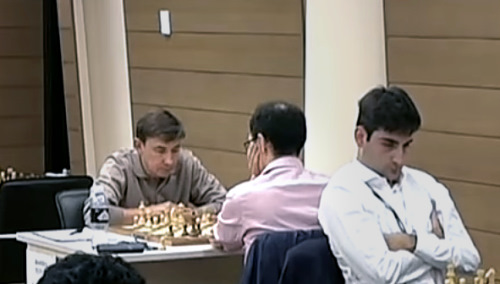
The 2019 World Cup runs September 10 - October 4 in Khanty-Mansiysk, Russia. 128 players from 47 countries compete in two-game knock-out matches for two places in the Candidates Tournament and a share of the $1,600,000 US prize fund.
photo: a screencap of the live video feed from round 1.2.
..
[Event "FIDE World Cup 2019"]
[Site "Khanty-Mansiysk"]
[Date "2019.09.10"]
[Round "1.58"]
[White "Kasimdzhanov, Rustam"]
[Black "Bareev, Evgeny"]
[Result "1-0"]
[ECO "C24"]
[WhiteElo "2657"]
[BlackElo "2643"]
[Annotator "John Upper"]
[PlyCount "65"]
[EventDate "2019.??.??"]

1. e4 e5 $5 {A surprise! Bareev has played this only 3% of his Black games,
almost exclusively playing the French or Caro-Kann.} 2. Bc4 Nf6 3. d3 c6 4. Nf3
d5 {[#]} 5. Bb3 (5. exd5 cxd5 {is regarded as harmless, though it is a way to
get a game with a lot less theory after} 6. Bb5+ (6. Bb3 Nc6 7. O-O $11) 6...
Bd7 7. Bxd7+ Nbxd7 8. O-O Bd6 9. Nh4 $5 Nc5 (9... g6 $1 10. Bh6 Bf8) 10. d4 Ne6
11. Nf5 exd4 12. Nxd4 O-O 13. Nc3 Rc8 $11 {1-0 (106) Wang,J (1919)-Matras,A
(2260) Montreal Zonal, 2017.}) 5... a5 6. a4 (6. a3 $5 {Stops ...Bb4 and can
help preserve the B.} Bd6 7. exd5 Nxd5 8. O-O O-O 9. Re1 Bg4 10. Nbd2 Nd7 11.
h3 Bh5 12. Ne4 Qc7 13. Ng3 Bg6 14. Nh4 Nc5 15. Ba2 Ne6 16. Nxg6 hxg6 17. h4 $14
{0-1 (35) Anand,V (2767)-Yu,Y (2738) Stavanger (rapid), 2019.}) ({The last
database game with Bareev in this position featured a well-known opponent:} 6.
Nc3 Bb4 7. a3 Bxc3+ 8. bxc3 Nbd7 9. exd5 Nxd5 10. O-O O-O 11. Re1 Re8 12. c4
Ne7 13. Ng5 h6 14. Ne4 a4 15. Ba2 c5 16. Nd6 Rf8 17. c3 Ng6 18. Bb1 Nf6 19.
Nxc8 Qxc8 20. Qf3 Re8 21. Bc2 Nh4 22. Qg3 g5 $1 23. d4 $1 (23. Bxg5 $4 Nf5 {Only move.}
$19) 23... Nf5 $1 {[#]Bareev is going toe-to-toe with the World Champion, and
finds a way to equality even with two Ns vs two Bs pointed at his kingside.}
24. Qh3 e4 (24... g4 $1 25. Qd3 e4 26. Qe2 cxd4 27. cxd4 b5 $1 {to play ...
Qxc4.}) 25. f3 exf3 26. Rxe8+ Qxe8 27. Bxg5 {guarding the back rank.} (27. Qxf5
$4 Qe1#) 27... hxg5 28. Qxf5 Qe3+ {Only move.} $11 29. Kh1 fxg2+ 30. Kxg2 Qe2+ (30... Ra6
$5 $13) 31. Kg1 Ng4 $4 {Aaargh! So close...} (31... Qe3+ $11) 32. Qh7+ $18 Kf8
33. Rf1 {Black has no checks and no good defence of f7.} f6 34. Bg6 {1-0
Kasparov,G (2805)-Bareev,E (2670) Linares 1993}) 6... Bd6 (6... Bb4+ $1 {
is probably better. Black gives a tempo to encourage c2-c3, which takes the c3
square from the N and so makes it harder for White to pressure d5. It was
recomemnded by Kortchnoi in his ChessBase notes to the Kasparov-Bareev game
above, and is also the move in the free Chessable course on the Petroff, IIRC.}
7. c3 Bd6 8. Bg5 dxe4 9. dxe4 h6 10. Bh4 O-O 11. O-O Na6 12. Nbd2 Qe7 13. Nc4
Bc7 {1/2-1/2 (30) Karjakin,S (2760)-Wei,Y (2739) Medias 2017}) 7. exd5 cxd5 8.
Nc3 Be6 9. Bg5 d4 10. Bxf6 {A Novelty.} (10. Bxe6 dxc3 11. Bc4 cxb2 (11... e4
$5) 12. Rb1 Bb4+ 13. Nd2 Nbd7 $11 {1/2-1/2 (42) Torre,E (2520)-Ye,R (2500)
Kuala Lumpur 1994} (13... O-O $11)) {[#]} 10... gxf6 $5 {Taking toward the
center, but mangling his kingside. There's nothing wrong with this dynamic
move, but it strikes me (perhaps wrongly) to not be in Bareev's natural style..
.. which may explain his less dynamic choices at moves 14 and 20, both of
which let him down.} (10... Qxf6 11. Ne4 Qe7 12. Nxd6+ Qxd6 13. Bxe6 Qxe6 14.
O-O Nc6 (14... f6 $4 15. Nxd4 $18) 15. Nxe5 Nxe5 16. Re1 $11) 11. Nb5 (11. Bxe6
dxc3 12. Bc4 cxb2 13. Rb1 (13. Ra2 e4 $5) 13... Bb4+ $11) 11... Bxb3 12. cxb3
Bb4+ 13. Nd2 Nc6 14. f4 $5 {[#]A very non-standard position. Black has several
reasonable tries.} Qe7 (14... f5 $3 {the most combative and enterprising.} 15.
O-O (15. fxe5 $2 Qg5 $1 16. Nc7+ $2 Kd8 17. Nxa8 Qxg2 18. Rf1 Re8 $19) 15... e4
16. dxe4 Bxd2 17. Qxd2 fxe4 18. Rad1 e3 $1 19. Qe2 (19. Qd3 O-O 20. Rfe1 Qb6
$15 21. Nxd4 $2 e2 $19) 19... O-O 20. f5 {Only move.} $13 {A line clearance so Qg4+
attacks d4. Anything else and Black goes ...Qf6 and ...Rad8 and the passers
can sleepwalk to the win.}) 15. O-O Bxd2 16. Qxd2 O-O-O {[#]} 17. Rae1 (17.
fxe5 $1 {undoubles the f-pawns but gives White play on the e and f-files.} fxe5
18. Qh6 $1 $16 {stopping ..f6 and making ...e4 tactically impossible after
which White can choose to pile up on the f-file or the e-file.} e4 $2 19. dxe4
Qxe4 20. Nd6+ $18) 17... Kb8 18. Na3 Qb4 19. Qd1 Rhe8 20. fxe5 {[#]} Rxe5 $6 {
One of the critical moments of the game.} (20... fxe5 $1 {this can cost Black
a pawn, but enables Black to create an advanced passer on d3.} 21. Rxf7 $6 (21.
Nc4 e4 $1 22. dxe4 d3 $15 {is similar to the main line, but the extra pieces
help Black.} 23. Rxf7 Nd4 $1 24. Rxh7 Nxb3 $19) (21. Re4 $5 {White can play to
blockade the e and f-pawns too:} Rf8 22. Rf6 Qe7 23. Qf3 Nb4 24. Nc4 Nd5 (24...
Nxd3 $2 25. Rf5 $1 $14) 25. Rf5 f6 $13 {with a balanced position.} 26. Nxa5 $6
Ne3 $15 27. Rh5 Qc7 $1 $17 {expelling the N before ...f5.}) 21... e4 $1 22.
Rxe4 Rxe4 23. dxe4 d3 24. Nc4 Ne5 25. Nxe5 Qd4+ 26. Rf2 Qxe5 {Black will win
the e-pawn and White will be tied to stopping the passed d-pawn.}) 21. Nc4 $1 {
and Black is left with four isolated pawns which can never go anywhere.} Rxe1
22. Rxe1 Ka7 {White's next few moves tie down Black to his long term
weaknesses while keeping his K safe from any annoying checks.} 23. h3 Rd7 24.
Rf1 Re7 25. Kh2 Re6 26. Rf5 Ne5 27. Na3 $1 (27. Nxe5 $2 Qd6 $1 $11) 27... Kb6
28. Nb5 Nc6 29. Qc2 Qe7 30. Qf2 Re3 31. Qf4 $18 Rxd3 32. Rxf6 (32. Nd6 {
is a computer improvement, but the move played is clearly winning too.}) 32...
Rxb3 33. Qxd4+ {Black is getting mated.} (33. Qxd4+ Qc5 (33... Ka6 34. Qa7#)
34. Qd8+ Ka6 35. Qa8+ Kb6 36. Qa7#) 1-0

[Event "FIDE World Cup 2019"]
[Site "Khanty-Mansiysk"]
[Date "2019.09.11"]
[Round "1.2"]
[White "Bareev, Evgeny"]
[Black "Kasimdzhanov, Rustam"]
[Result "1/2-1/2"]
[ECO "A22"]
[WhiteElo "2643"]
[BlackElo "2657"]
[Annotator "John Upper"]
[PlyCount "64"]
[EventDate "2019.??.??"]

1. c4 Nf6 2. Nc3 e5 3. g3 {[#] Another surprise? This is the most frequenly
played move here, but all of Bareev's previous games have continued with
either Nf3 (18x) or e3 (only once).} Bb4 (3... d5 {was Kasimdzhanov's only
previous game in this line, and it led to a horrible squashing by Karjakin:} 4.
cxd5 Nxd5 5. Bg2 Nb6 6. d3 Be7 7. Be3 O-O 8. Rc1 Re8 9. a3 Bf8 {Both sides
have been delaying developing their Ns on the a8-h1 diagonal, presumably
because of Bxc6.} 10. Nf3 N8d7 $5 11. O-O c6 12. Qb3 Nc5 13. Qc2 Bg4 14. b4
Ncd7 15. h3 Bf5 16. Nd2 h6 17. Rb1 Rc8 18. Rfc1 Nf6 19. Bc5 Nfd7 20. Nce4 $1
Qc7 21. a4 a6 22. Bxf8 Rxf8 23. Nc5 Nf6 24. Qb2 Qe7 25. a5 Na8 {[#] Yuck. But
this is only the first of four Black pieces to retreat to the back rank.} 26.
e4 Bh7 27. Nc4 Rfe8 28. f4 exf4 29. gxf4 Rb8 30. Qe5 Qf8 {2nd} 31. Qd6 Re7 32.
f5 $1 Nc7 33. Qf4 Nfe8 {3rd} 34. Kh2 Kh8 35. Bf3 Bg8 {[#] 4th If Black could
pick up his Ns and put them on d4 and e5, and move the f-pawn to f6... he
would be only slightly worse.} 36. Ne5 Nf6 37. Rg1 Nb5 38. Ne6 g5 39. Nxf8 gxf4
40. Nfg6+ fxg6 41. Nxg6+ {1-0 (41) Karjakin,S (2767)-Kasimdzhanov,R (2706)
Tashkent 2014}) 4. e4 Bxc3 5. bxc3 $5 (5. dxc3 $1 O-O (5... Nxe4 6. Qg4 $14) 6.
f3 $1 d6 {[#] computers rate this as about equal, but it is hard for me to
believe that White's B pair, and probably safer K, don't give White clearly
better chances. As a practical matter, it keeps more pieces on the board for a
lot longer, which might help create more chances for errors... though Bareev
hasn't played a lot recently, and might reasonably fear that he would be the
one to blunder.} 7. Nh3 h6 8. Nf2 Nbd7 9. Be3 Qe7 10. g4 Nc5 11. h4 Nfd7 12.
Rh2 Ne6 13. Qd2 Re8 14. O-O-O Ndf8 15. Nh1 $1 Ng6 16. Ng3 $16 Nxh4 $4 17. Qf2
$2 (17. Nf5 $1 {and Black is losing:} Nxf5 18. gxf5 Ng5 $5 {is the trickiest} (
18... Nc5 19. Bxh6 $18) (18... Nf4 19. Bxf4 (19. c5 $1) 19... exf4 20. Qxf4 Qe5
21. Qh4 $18) 19. c5 $1 Nxf3 20. Qg2 Nxh2 21. Bxh6 f6 (21... Qf8 22. f6 $18) 22.
Bc4+ $18) 17... Ng6 18. Nf5 {1/2-1/2 (18) Berkes,F (2678)-Lafuente,P (2565)
Khanty-Mansiysk 2010}) 5... O-O 6. Bg2 c6 7. Ne2 (7. Nf3 $5 {Is an interesting
try, and results in fast complications, though top GMs will have worked them
out by now, and Kasim would have seen the game below "second" hand when he
worked for Anand.} Nxe4 8. O-O d6 9. Nxe5 {[#]} Nc5 ({The first game in this
line continued:} 9... dxe5 10. Bxe4 Be6 $6 11. Ba3 Re8 12. Qb1 $1 Qxd2 $2 13.
Qxb7 {Black gives material to finish development, but can't get enough} Nd7 14.
Bxc6 Reb8 15. Qa6 Rb6 16. Qa4 Rc8 17. Rad1 Qxd1 {Only move.} 18. Rxd1 Rbxc6 19. Qxa7 $18
{1-0 (37) Giri,A (2798)-Anand,V (2803) Bilbao 2015}) 10. Ng4 f5 11. Ne3 f4 12.
d4 fxe3 13. dxc5 exf2+ 14. Rxf2 Rxf2 15. Kxf2 Qf8+ 16. Qf3 Qxf3+ 17. Bxf3 dxc5
18. Bf4 $14 {For the pawn, White has the B pair, a lead in development, and
queenside pressure. White got a queenside pawn back, and the game finished in
a drawn Rp ending in Svidler,P (2757)-Aronian,L (2786) Moscow Candidates, 2016
(½- ½, 41).}) 7... d5 $1 8. cxd5 cxd5 9. exd5 Nxd5 10. O-O Nc6 11. Rb1 {[#]}
Nb6 (11... Re8 12. d3 Nb6 (12... Bg4 $1 13. Bd2 (13. h3 $4 Nxc3 $19) 13... Qd7
$15) 13. Be3 Bg4 14. Qc2 Re7 15. Nc1 Be6 16. Rb5 Nd5 17. c4 Nxe3 18. fxe3 Rc8
19. Qb2 b6 20. Bxc6 Rxc6 21. Rxe5 f6 22. Re4 Bh3 23. Rff4 f5 24. Rxe7 Qxe7 25.
Kf2 Re6 26. Qd2 Qb7 {Black has enough play for the pawn, and won when White
avoided a repetition and blundered just before the time control in: Naiditsch,
A (2712)-Topalov,V (2768) Porto Carras 2011 0-1 (37)}) 12. d4 {Necessary,
White can't play with the small center:} (12. d3 $2 Bf5 $17) 12... Be6 (12...
exd4 $6 13. Nxd4 Nxd4 14. cxd4 $14 {The open center and passed pawn give
White's B pair something to play for.}) 13. Ba3 (13. a4 {is the thematic way
to help the Bg2, but Black kills the queenside pressure like this:} Bd5 14. Rb5
Bxg2 15. Kxg2 a6 $1 {1/2-1/2 (31) Li,C (2748)-Wang,H (2705) Zaozhuang 2015})
13... Re8 14. dxe5 {[#]} Bc4 {A good practical move when Black needs only a
draw to advance: it forces simplifications to an ending Black can hardly lose.}
(14... Nxe5 {may be a way to play for more.} 15. Qxd8 (15. Bxb7 $2 Bh3 $1 $17)
15... Raxd8 16. Bxb7 $2 Nec4 $1 {and a loose piece will drop off.}) 15. Re1
Rxe5 16. Nf4 Bxa2 17. Ra1 Qxd1 18. Rexd1 Bc4 19. Bd6 Ree8 20. Bc5 Rac8 {[#]}
21. h4 (21. Bxc6 Rxc6 22. Bxb6 axb6 23. Rd7 g6 24. Rxb7 b5 {and only Black can
be better with the minor piece that attacks and defends.}) 21... Ba6 22. h5 h6
23. Rdb1 Ne5 24. Bd4 Nc6 25. Bc5 Ne5 26. Bd4 Nc6 {Black had won the first game
and needed only a draw to clinch the match, so White must vary.} 27. Bxb6 axb6
28. Rxb6 Ne5 {White has recovered his pawn, but the weaknesses on c3 and b7
cancel each other out.} 29. Nd5 (29. Bxb7 Bxb7 30. Rxb7 Rxc3 31. Raa7 Rc2 {
this is not the sort of position any GM will lose...} {unless he tries to get
too clever...} 32. Nd3 $4 {this actually loses} (32. Re7 Rxe7 33. Rxe7 Ng4 $11
(33... Rc5 $11)) 32... Nxd3 33. Rxf7 Kh8 {Only move.} $19 {so that Rxg7 is not check,
and if White moves the R from the f-file he gets mated:} 34. Rxg7 Re1+ 35. Kg2
Rxf2+ 36. Kh3 Rh1+ 37. Kg4 Ne5#) 29... Kf8 30. Rb4 Rc5 31. Rd4 Bc4 32. Nf4 Ba6
1/2-1/2
..