..
[Event "Canada int."]
[Site "Longueuil CAN"]
[Date "2019.10.13"]
[Round "5.2"]
[White "Sambuev, Bator"]
[Black "Lesiege, Alexandre"]
[Result "0-1"]
[ECO "A03"]
[WhiteElo "2513"]
[BlackElo "2503"]
[Annotator "John Upper"]
[PlyCount "76"]
[EventDate "2019.10.11"]
[EventType "swiss"]
[EventRounds "5"]
[EventCountry "CAN"]

1. g3 d5 2. Bg2 g6 3. f4 {Look, up on the board. It's a Bird! It's a Polar
Bear! It's a reversed Lenningrad-Dutch! (with apologies to DC comics)} Bg7 4.
Nf3 Nf6 5. O-O O-O 6. d3 b6 $5 {[#] Black gets a grip on e4 before claiming
more space with ...c5. With the central pawn structure indeterminate, White
has a wide range of development schemes.} (6... c5 {is more common, when White
has a choice of developing schemes: c3 or Qe1 or even Nc3.}) 7. Nh4 $5 (7. e4
$5 {is critical, though Black seems to be OK after an exchange sac:} dxe4 8.
dxe4 Nxe4 9. Ng5 Bd4+ (9... Nxg5 10. Qxd8 Rxd8 11. Bxa8 Ne6 $13 {Black has
comp.}) 10. Kh1 Nxg5 11. c3 $13 {0-1 (42) Himanshu,S (2417)-Ganguly,S (2630)
Kolkata 2012}) (7. c3 {This is the highest-rated game from this opening; as a
blitz game it's interest is mainly in showing how poorly an excellent player
(Caruana) can play in an unfamiliar middlegame.} Bb7 8. Nbd2 c5 9. Qc2 Nc6 10.
e4 d4 $6 11. Re1 Rc8 12. c4 e5 13. Bh3 Rc7 $2 (13... exf4 $1 $17 14. Bxc8 (14.
gxf4 Nb4 15. Qb3 Nh5 $1 $17) 14... Qxc8 15. gxf4 Nb4 16. Qb3 Qg4+ $19) 14. f5
Bc8 15. g4 Ne8 16. Nf1 Nd6 17. Ng3 b5 $2 18. b3 a5 19. Bf1 a4 20. h4 Bd7 21. h5
Ra7 22. Bd2 Nb4 23. Qb2 Qa8 24. a3 Nc6 25. bxa4 $138 {1-0 (25) Nakamura,H
(2741)-Caruana,F (2709) Moscow blitz 2010}) (7. a4 Bb7 8. a5 $5 (8. Na3 $5)
8... c5 9. Ne5 Qc8 10. c3 e6 11. Nd2 Nbd7 12. Ndf3 Nxe5 13. Nxe5 Rd8 14. Bd2 b5
15. Qe1 a6 16. Qf2 Qc7 17. b4 Rac8 18. Rac1 Nd7 19. Be3 Nxe5 20. fxe5 Bxe5 (
20... d4 $5) 21. Bxc5 Rd7 22. Bb6 Qd6 23. Bc5 Qc7 {½-½ Dougherty,M (2297)
-Cheng,B (2548) Aurora, 2013.}) 7... e6 {A sensible Novelty, discouraging
f4-f5. White now plays to try to exploit the long diagonal, but f4 and Nh4
don't help this and soon Black is at least equal.} (7... Bb7 8. Nc3 Na6 9. a4
Nc5 10. b4 Ng4 (10... Nfe4 $1 $15) 11. Qe1 Ne6 12. h3 Nf6 13. a5 a6 14. Bb2 b5
15. Nd1 c5 $13 {(1-0, 54) Joksic,S (2320)-Polaczek,R (2420) Forli, 1990.}) (
7... Bb7 8. Qe1 c5 9. Kh1 Qc7 10. e4 e5 11. f5 $14 {Stockfish 10 prefers Black,
but White's play looks much easier; (1-0, 34) Neubauer,V (2033)-Pribyl,J (2061)
Nachod, 2006.}) 8. c4 Bb7 9. Nc3 c5 10. Bd2 $6 (10. e4 $5 dxc4 11. dxc4 Qd4+ $1
(11... Nc6 12. e5 $13) 12. Qxd4 cxd4 13. Nb5 Nxe4 $1 (13... Nc6 $4 14. Nd6 $18)
14. Nc7 Rc8 15. Nxa8 Bxa8 $13 {Black has only a pawn for the exchange, but it
is difficult for White to finish developing without giving up more.}) 10... Nc6
11. cxd5 Nxd5 $15 {[#] Black has a normal-looking double fianchetto, and might
continue with ...Ncd7 to keep a piece on d5. White's kingside is ragged, and
kicking the piece off d5 with e2-e4 would leave d3 fatally weak. White would
be about equal if he could play f4-f2 and Nh4-f3, but only pieces can go
backward.} 12. Nxd5 exd5 13. Bc3 {White continues to play provocatively, but
the extra center space will be a long-term trump for Black.} d4 14. Bd2 Qd7 (
14... Rb8 $5 15. f5 Ne5 $1 $15) 15. f5 Rfe8 16. h3 (16. g4 $2 Ne5 $1 17. g5 (
17. Bxb7 Qxb7 18. g5 c4 $1 {as in the mainline.}) 17... Bxg2 18. Kxg2 c4 $1 19.
f6 Bf8 $19 {White's K has no pawns defending it, while Black's K is defended
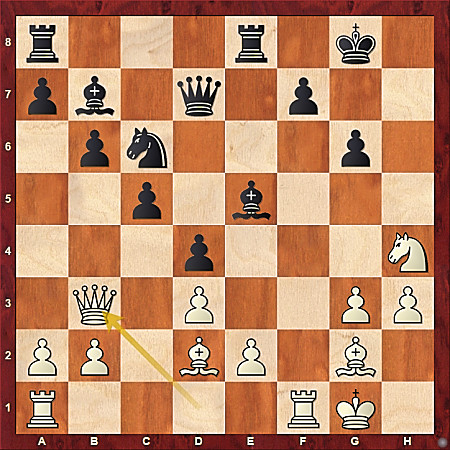
by pawns of both colours.}) 16... Be5 17. fxg6 hxg6 18. Qb3 {[#]Critical
Position: White is threatening both Rxf7 (then Bd5) and Nxg6.} Re6 $1 {Not
forced, but after this exchange sac offer White has absolutely no threats and
a very weak kingside.} (18... Kg7 $4 19. Rxf7+ {Only move.} $18 Qxf7 20. Bh6+ {Only move;
an essential deflection.} Kg8 21. Bd5 $18) (18... Na5 {also defends, but looks
messier:} 19. Bxa5 Bxg2 20. Kxg2 (20. Nxg2 bxa5 $19) 20... bxa5 21. Nxg6 $4
Qc6+ $19) 19. Bd5 (19. Nf3 Bf6 {Only move.} $17 (19... Bg7 $2 20. Ng5 $16) (19... Bxg3 $6
20. Ng5 $13)) 19... Nd8 $1 {supports e6 and f7 and forces White to make a
decision about the Bd5. Even so, Black had better.} (19... Rae8 $1 {is even
better, since the black N will get into play quicker than the game.} 20. Bxe6
Rxe6 21. Kh2 (21. Rf3 Nd8 $19) 21... Qc7 22. Rf3 Bxg3+ 23. Rxg3 Rxe2+ 24. Ng2
Rxd2 $19) 20. Bxb7 Nxb7 21. Rf3 Rf6 22. Kg2 Re8 23. Raf1 Kg7 24. R1f2 {[#]} Rh8
$1 {this freezes White's kingside, and prevents him from unscrambling, since,
among other things, Kh2 loses to ...Rxh4.} 25. a4 (25. Bg5 Rxf3 26. Rxf3 Rh5 $1
27. Bd2 Nd6 $19) 25... Rxf3 26. Rxf3 Bf6 27. Be1 (27. Rf4 {defends h4, but
Black improves the N with ...Nd8-c6-e7 and what can White do?} Nd8 28. Qd1 Ne6)
27... Nd6 {Black is spoiled for choice... which can sometimes be a problem in
time trouble, but Alex stays in control.} (27... Re8 {switches to the backward
e-pawn.} 28. Qc2 Qe6 29. Rf2 Bxh4 30. gxh4 Nd6 $19) 28. a5 (28. e4 $5 {Hoping
to induce more time trouble by forcing Black to make a big decision.
Unfortunately for White, almost any response from Black keeps a big advantage.}
c4 $1 (28... dxe3 $6 29. Bc3 $17) (28... Re8 $1 $17)) 28... g5 $1 29. axb6 axb6
$19 (29... Qb7 $142 $19 {pins the Rf3 and Pb6, and so doesn't allow White to
save the N or get any more pawns for the piece.}) 30. Qxb6 gxh4 31. Qxc5 Re8
32. g4 Rxe2+ 33. Bf2 Qe6 34. g5 Be5 35. Kf1 Rxb2 36. Bxd4 Rb5 $1 (36... Rb1+ $1
) 37. Qc3 Nf5 38. Bxe5+ Qxe5 0-1
..