All games were broadcast live thanks in part to the discount DGT purchase made available by FIDE through the CFC and Strategy Games.
..
[Event "2nd Ivy League Chess Challenge 2019"]
[Site "University of Toronto"]
[Date "2019.11.09"]
[Round "3.10"]
[White "Li, Ethan"]
[Black "Plotkin, Mark "]
[Result "0-1"]
[ECO "A25"]
[WhiteElo "2231"]
[BlackElo "2378"]
[Annotator "John Upper"]
[PlyCount "92"]
[EventType "swiss"]
[EventRounds "5"]
[EventCountry "CAN"]
[WhiteTeam "Princeton"]
[BlackTeam "UofT A"]


1. d4 g6 2. Nf3 Bg7 3. c4 d6 4. e3 e5 5. Nc3 Nc6 6. Be2 f5 {[#]If you're
trying to avoid theory, you could hardly do better than this position after
only six moves: there are only 84 games in the Megabase from here, and only
four between players over 2400.} 7. d5 ({David Cummings' "Opening Repertoire:
The English" -- which is based on 1.c4/Nc3/e3 -- continues:} 7. O-O Nf6 (7...
e4 8. Nd2 Nf6 9. b4 $1 O-O 10. b5 Ne7 11. a4 g5 {and White can choose to play
on the queenside or on the kingside:} 12. Ba3 $14 (12. f3 $14)) 8. d5 Ne7 9. b4
O-O 10. Bb2 Ne8 11. Qc2 e4 12. Nd2 $14 {1-0 (29) Chuchelov,V (2500)-Engelbert,
C (2270) Dresden 1993}) 7... Nce7 {Here, annotators often say something like
"if White ever plays e3-e4 it will be a KID with Black up a tempo", but it is
actually several tempi: a lost tempo for White to get the pawn to e4, and
Black achieving ...f5 without having to lose time removing and replacing the N
to f6.} 8. Rb1 {Natural, but not necessary.} (8. b4 $142 $1 {is more direct.}
a5 {might be the move that made White go for Rb1 before b3-b4, but White is OK
here too...} 9. Ba3 $2 {But not after this.} (9. bxa5 $1 Rxa5 10. a4 $14 {
and Ba3-b4 followed by a4-a5, when White has prospects on the Q-side.}) 9...
axb4 (9... e4 $1 {forces Ne4.} 10. Nd4 axb4 11. Bxb4 c5 $17) 10. Bxb4 {The
following game is particularly interesting when you know that the GM playing
White almost exclusively plays this 1...d6 2... g6 repertoire as Black....but
still gets blown off the board in this miniature as White.} e4 $1 11. Nd4 (11.
Nd2 $1 c5 12. dxc6 Nxc6 13. a3 $11) 11... c5 $1 $17 12. dxc6 {Only move.} bxc6 $17 {
If this was a Morphy anthology game for beginners then Black would get mated
for having fallen so far behind in development while leaving his K in the
center... It's not.} 13. Ncb5 $6 (13. Ndb5 $142 cxb5 14. Nxb5 Be5 $17) (13. c5
$2 dxc5 14. Bxc5 Qa5 $19) 13... c5 {Only move.} $19 14. Nc6 Nxc6 15. Qd5 Nxb4 $1 16.
Nxd6+ Ke7 17. Qf7+ Kxd6 18. O-O-O+ Bd4 $1 19. exd4 Qe7 20. dxc5+ Kc7 21. Qxe7+
Nxe7 {0-1 Svirjov,I (2503)-Kalinichev,A (2352) Tallinn 2005}) 8... Nf6 (8... a5
$5 {makes sense, though there are the customary warnings about moving pawns on
the side of the board where the opponent has play. No matter: Mark doesn't do
prophylaxis :)}) 9. b4 h6 10. Qa4+ {I don't understand this move. Did White
give a tempo to get Black to play ....Bd7 hoping to gain later from the B
blocking the black Q's defence of d6? In some KID lines it would help White,
since the Bd7 would block the Rf7's defence of c7.} Bd7 11. Qb3 O-O 12. O-O g5
13. c5 Ng6 14. Ba3 b6 {I'm not sure I understand this move: it stops the
immediate b4-b5, but that doesn't seem like much of a threat.} 15. Bb5 $6 {
Trading Black's good B, but leaving the light squares less well defended.} (15.
Nd2 $11) 15... Bxb5 $17 16. Nxb5 g4 17. Nd2 a6 18. Nc3 b5 $1 {The b4/b5 pawns
leave White's QB and Rb1 blocked, while Black's kingside pawnstorm remains
flexible.} 19. Bb2 Nh7 (19... Rb8 $5 20. a4 dxc5 21. bxc5 b4 $15) 20. Ra1 Qh4
21. a4 {[#]} f4 $6 {Conceding the e4 square and the b1-h7 diagonal makes it
much harder for Black to coordinate his attack.} (21... Ng5 $1 {aiming for ...
e4 and a sac on f3.}) 22. Qc2 $1 {Hitting the undefended Ng6.} (22. axb5 f3 $1
$17) 22... Rf6 23. Nde4 (23. axb5 $1 f3 24. Nce4 {Only move.} (24. Rxa6 $2 Rxa6 25. Nce4
Ra8 $17) (24. bxa6 $2 fxg2 25. Nce4 gxf1=Q+ $19) 24... fxg2 25. Nxf6+ Qxf6 {Only move.}
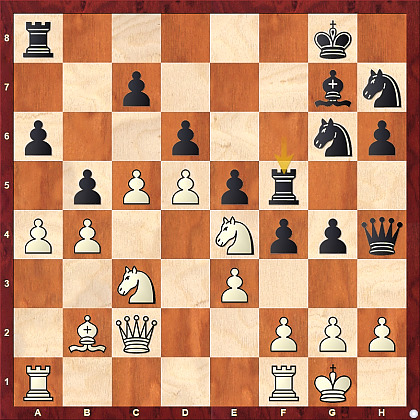
26. Kxg2 Nh4+ 27. Kg1 Ng5 {Black has chances.}) 23... Rf5 {Critical Position
} 24. g3 $2 {Probably the losing move, though there are lots of ways for White
to lose here.} (24. axb5 $2 Rh5 25. h3 f3 $19 {shows one way Black might win.})
(24. f3 $1 {preventing ...f3 and defending laterally.} Rh5 {Only move.} (24... g3 $2 25.
h3 $18 {when Black misses his LSB to play ....Bxh3.}) (24... gxf3 25. Rxf3 $18
{when Rh3 is an extra defensive option.}) 25. g3 {Only move.} {defending the second rank.
} fxg3 26. Nxg3 gxf3 {Only move.} 27. Nxh5 (27. Rxf3 Ng5 $1) 27... Qxh5 $13) 24... Qh3 $1
{Threatening ...f3.} 25. f3 {stopping ...f3 and defending laterally and
threatening Nf2.} gxf3 {Only move.} $19 (25... fxg3 $2 26. Nxg3 Rxf3 27. Qxg6 (27. Rxf3
$4 gxf3 $19 {and Black's Ns hop forward to support the f-pawn and continue the
attack.}) 27... Rxg3+ {Only move.} $11 {Black must force a draw.}) 26. axb5 (26. cxd6
cxd6 27. Nxd6 Rg5 $19) (26. Rxf3 $17 {is the toughest defence, but Black rules
if he finds} Nh4 $3 27. Rf2 (27. gxh4 Qxf3 $19) 27... fxg3 28. Nxg3 (28. Rxf5
Qxf5 29. hxg3 Nf3+ 30. Kg2 Nhg5 $19) 28... Rxf2 29. Qxf2 Rf8 $19 {Black has
more guys at the party.}) 26... fxe3 $1 $19 27. bxa6 {It looks like White
might be able to give up a N for Black's attacking pawns and then promote on
the queenside, but Black is faster, and the a6-pawn can even be taken since
White's Ra1 must defend the back rank.} Ng5 (27... Rxa6 $1 28. Rxa6 $2 e2 $19 {
either mating on g2 or promoting on e1.}) (27... f2+ $6 28. Nxf2 exf2+ 29. Rxf2
Rxf2 30. Qxf2 Ng5 $17) 28. Nxg5 hxg5 (28... f2+ {also wins now that there is
no Nxf2.}) 29. Ne4 g4 {Not the computer's top choice, but certainly a
fun move to play -- reemphasizing the opposite side pawn storms, ane even
allowing ...Bh6.} (29... Rxa6 $1 $19 {threatening ...e2.} 30. Rae1 (30. Rxa6 $2
e2 $19) 30... f2+ 31. Nxf2 exf2+ 32. Rxf2 Rxf2 33. Qxf2 Ra2) 30. b5 {This
stops the ...Rxa6 deflection tactics seen above.} (30. Rae1 $17 Nh4 $5 {
sets up a weird attacking sacrifice:} 31. Rxe3 (31. gxh4 $2 g3 {Only move.} $19) 31...
f2+ 32. Rxf2 Raf8 {Only move.} {threatening mate in two with ...Qg2+; here Black has
given up his pawn storm to break through on the f-file}) 30... Raf8 (30... e2
31. Rf2 $15) (30... dxc5 31. Rae1 $17) (30... Bh6 $3 {sets up ...e2 then ...
Be3.}) 31. a7 f2+ (31... e2 $2 32. Rf2 {Only move.} $18) 32. Nxf2 Rxf2 33. Rxf2 exf2+ 34.
Qxf2 Rxf2 35. a8=Q+ {[#]} Kh7 $5 (35... Rf8 $1 $19 {is simple, but the game
move is both fancy and keeps a winning initiative.}) 36. Kxf2 Qxh2+ 37. Kf1 (
37. Ke1 Qxg3+ 38. Kd2 Qf2+ 39. Kc1 g3 $19) 37... Qxb2 {winning, but Black had
yet another sac to win in the most spectacular manner:} (37... Nf4 $3 {White
is up a R for the N, but his pieces are all useless defenders against Black's
sacrifices.} 38. gxf4 g3 {Only move.} $19) 38. b6 Qb5+ 39. Kg2 Qe2+ (39... Qxc5 $4 40.
Rh1+ (40. b7 $13) 40... Bh6 41. Qc6 $13) 40. Kh1 Qf3+ 41. Kh2 cxb6 42. cxd6 (
42. cxb6 e4 43. Qa2 (43. b7 Qf2+ 44. Kh1 Nh4 $19 45. gxh4 Qf3+ 46. Kh2 Qh3+ 47.
Kg1 Bd4#) 43... Bxa1 44. b7 (44. Qxa1 Qf2+ $19 {snags the b-pawn.}) 44... Be5
45. b8=Q Qxg3+ 46. Kh1 Qe1+ 47. Kg2 Nh4#) 42... Qf2+ 43. Kh1 {[#]} Nf4 $1 $19
44. Rg1 (44. gxf4 g3 {and Black wins with a promotion double check.}) (44. Qa2
Ne2 $19 {wins the Q for N.}) (44. Ra2 {forces Black to make more moves, but
they're not hard to find:} Qf1+ 45. Kh2 Qh3+ 46. Kg1 Qxg3+ 47. Kf1 Qf3+ 48. Ke1
e4 {or ...g3 and Black will mate or promote one of his pawns.}) 44... Nh3 45.
Rg2 Qf1+ 46. Kh2 Ng5 {there's no good defence to ...Nf3+.} 0-1