[Event "Toronto Chess to Remember"]
[Site "Toronto"]
[Date "2019.12.08"]
[Round "4.1"]
[White "Noritsyn, Nikolay"]
[Black "Vettese, Nicholas"]
[Result "1-0"]
[ECO "A03"]
[WhiteElo "2504"]
[BlackElo "2315"]
[Annotator "John Upper"]
[PlyCount "79"]
[EventDate "2019.??.??"]
[EventType "swiss (rapid)"]
[EventRounds "5"]
[EventCountry "CAN"]
[WhiteTeam "Canada"]
[BlackTeam "Canada"]
[WhiteTeamCountry "CAN"]
[BlackTeamCountry "CAN"]

1. b3 d5 2. Bb2 Bf5 3. e3 e6 4. f4 Nf6 5. Nf3 {White is obviously playing to
control e5, but apart from that isn't putting any pressure on Black, who has
choices here, like ...h6 to keep the B, or the move played in the game...} Nbd7
{By delaying or avoiding ...c5 and ....Nc6 White does not have the common plan
to play Bb5 and continue like a reversed Nimzo.} 6. Be2 Bd6 7. O-O c5 (7... Qe7
8. c4 c5 9. Ne5 h5 10. cxd5 Bxe5 11. fxe5 Ng4 (11... Nxd5 $14) 12. dxe6 (12.
Qe1 $1 $16 {multi-purpose: preventing ...Qh4 and preparing tactics on the
e-file.} Ngxe5 13. e4 $1 $16) 12... fxe6 13. Bxg4 (13. h3 $1 Ngxe5 14. d4 Ng6 (
14... cxd4 15. exd4 Nc6 16. d5 $18) 15. Bb5 $16) 13... hxg4 14. g3 $2 Qg5 15.
Rf4 Qh5 16. Qe2 Bd3 $1 17. Qg2 O-O-O 18. Na3 Nxe5 19. Bxe5 Qxe5 20. Rd1 Rhf8
21. Rxg4 $4 Qh5 22. h3 Bf5 23. Rc1 Bxg4 24. hxg4 Qxg4 25. Rxc5+ Kb8 {0-1
Orlova,Y (1942)-Vistisen,L (2177) Leiden, 2013.}) 8. Ne5 (8. Nh4 $5) 8... h5 {
An interesting sign of Black's flexibility is that Leela rates two completely
different plans for Black as totally equal: 8... h5 followed by long castles,
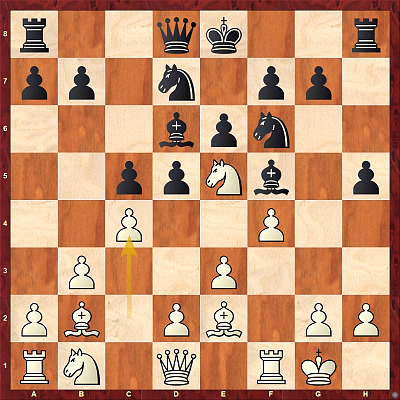
and 8...00.} 9. c4 {[#] The pawns make their first contact and it is arguably
the critical moment of the game. What should Black do?} dxc4 $2 {This and
Black's next moves concede the center to White's pawns and allow his Ns to
jump through. Instead, Black has tactical solutions which depend on kingside
threats to break up White's center: 9... Bxe5 and 9... d4. In both cases Black
has to be prepared to play down a pawn or two for an initiative that seems to be
worth more.} (9... Bxe5 $1 {Trading the DSB is not the
obvious try, but it seems to equalize by trading a pawn for initiative.} 10. fxe5 Ng4 {with a
double attack on e5 and an open line for ...Qh4.} 11. h3 (11. d4 $4 Nxe3 $19) (
11. Qe1 Ngxe5 12. cxd5 $11 O-O {unclear.} 13. Bxh5 $4 Nd3 $19) (11. cxd5 {looks
strong, since the Bf5 is loose, but Black gets a strong initiative after} Qh4
$1 12. h3 Qg3 $3 13. Bxg4 {Only move.} hxg4 14. dxe6 Bxe6) 11... Qg5 $1 (11... Ngxe5 12.
d4 {unclear.}) 12. Rxf5 $1 {unclear.}) (9... d4 $5 {A temporary pawn sac that shreds White's
center.} 10. exd4 cxd4 11. Bxd4 (11. Nxd7 Qxd7 12. Bxd4 Bc7 13. Be3 g5 $5 {unclear.}
14. fxg5 $140 $6 Ng4 {Black is temporarily down two pawns, but White has to
give at least one back immediately, e.g.} 15. h3 $2 (15. g3 $2 Be5 $17) 15...
Qd6 16. Bf4 Qd4+ $19) 11... Nxe5 12. fxe5 (12. Bxe5 $4 Bxe5 13. fxe5 Qd4+ $19)
12... Bc7 {attacking Bd4 and preparing to go to the b6-g1 diagonal} 13. Bb2 Ng4
$15 14. Bxg4 $2 {trying to keep the extra pawn} (14. Qe1 {preventing ...Qh4.}
Nxe5 $15) 14... hxg4 15. d4 (15. Qe1 Bb6+ $19) (15. g3 Qd3 $19) 15... Qh4 $19)
10. Nxc4 $1 Bc7 11. Nc3 Bg4 $2 (11... a6 $142 12. a4 Nb6 13. d3 $14) 12. e4 $1
{[#]} a6 (12... Nb6 13. Ne3 (13. Nb5 Nxc4 14. bxc4 Ba5 (14... Nxe4 $2 15. Bxg4
hxg4 16. Qxg4 $18) 15. e5 Ne4 16. d3 $16) 13... a6 14. a4 (14. e5 Bxe2 15. Qxe2
Nfd5 16. Ne4 $18) 14... e5 15. f5 Nbd7 16. d3 Ba5 $18) (12... e5 {stops White
from pushing, but leaves serious holes behind.} 13. Bxg4 Nxg4 14. h3 Ngf6 15.
Nb5 O-O 16. fxe5 $18) 13. e5 $1 Bxe2 14. Qxe2 Nd5 15. Ne4 $18 {[#] Nd6+ is
coming, followed by f5 and an attack on the K through f7. Black is lost:} g6 {
As good as anything -- it gives up the b7 pawn, but defends h5 and discourages
f5.} (15... O-O $2 16. Qxh5 $18) (15... b5 16. Ncd6+ Ke7 17. f5 {with threats
to invade on f7.}) (15... Rb8 {saves b7 but loses the K} 16. Ncd6+ Bxd6 17.
Nxd6+ Ke7 (17... Kf8 18. f5 $18) 18. f5 Rf8 19. Qxh5 $18) 16. Ncd6+ Bxd6 17.
Nxd6+ Kf8 18. Nxb7 Qb6 19. Nd6 c4+ 20. Kh1 cxb3 21. axb3 Qxb3 {[#]Material is
equal, Black has at least one good square for his Ns on d5, and maybe two if
he can use f5, White's B is nominally "bad" since it is blocked by its own
pawns on e5 and f4, and Black has an outside passed pawn... So why do
computers rate this position as +2? Does it have something to do with the
black K?} 22. Bd4 (22. Ba3 $1 Kg7 23. f5 $3 exf5 (23... gxf5 24. Rf3 $18) 24.
e6 $18 (24. Rfb1 $18)) 22... Ne7 (22... Qb8 23. Qe4 $1 Kg7 24. f5 gxf5 25. Rxf5
$1 $18) 23. Rf3 Qd5 24. Rd3 $1 {Good, and tricky -- it would be easy to burn a
lot of clock for Black here.} Nc5 (24... Nc6 25. Bf2 {traps the Q.}) 25. Ra5 $1
{There's no way to defend the Nc5.} Rb8 26. Qf1 (26. h3 Nxd3 27. Rxd5 Nxf4 {
is winning for White too.}) 26... Nxd3 27. Rxd5 Nxd5 28. Qxd3 {The rest needs
no comment.} a5 29. h3 Kg7 30. f5 gxf5 31. Qg3+ Kf8 32. Bc5 Ke7 33. Qg7 Kd7 34.
Qxf7+ Kc6 35. Ba7 Rbg8 36. Qxe6 {OK, two comments: 1) this was a rapid game; 2)
Qb7# was faster.} (36. Qb7# $142) 36... Nc7 37. Qc4+ Kd7 38. Bb6 Ne6 39. Nxf5
Rg6 40. Qd5+ 1-0