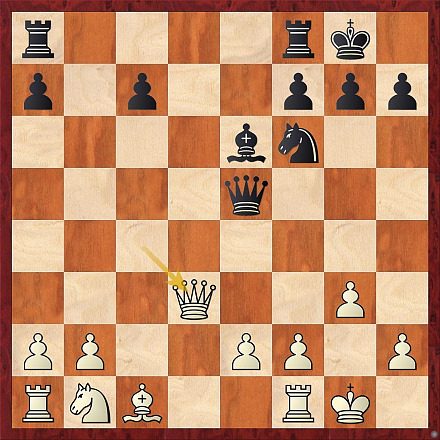
[Event "Pere Noel"]
[Site "Montreal CAN"]
[Date "2019.12.29"]
[Round "4.3"]
[White "Ouellet, Maili-Jade"]
[Black "Beaulieu, Eric"]
[Result "1-0"]
[ECO "E05"]
[WhiteElo "2346"]
[BlackElo "2225"]
[Annotator "John Upper"]
[PlyCount "51"]
[EventDate "2019.12.26"]
[EventType "swiss"]
[EventRounds "5"]
[EventCountry "CAN"]

1. d4 Nf6 2. c4 e6 3. Nf3 d5 4. g3 Be7 5. Bg2 O-O 6. O-O dxc4 7. Ne5 {This is
a forcing line where Black can (nearly?) equalize by giving up a pawn
immediately for the B-pair and faster devlopment. More common at the top level
is Qc2.} Nc6 {The most popular and best-scoring move.} 8. Bxc6 {This is the
main line. White gives up the Catalan bishop for the sake of winning a pawn.
In doing so, he relies on the lack of kingside weaknesses for neutralizing the
strong black light-squared bishop. - Marin, ChessBase} bxc6 9. Nxc6 (9. Nc3 c5
10. dxc5 Bxc5 11. Qa4 Nd5 $15 12. Ne4 Nb6 13. Qc2 Be7 14. Nxc4 Nxc4 15. Qxc4
Qd5 16. Qc2 Bb7 17. f3 Qd4+ 18. Kg2 Bxe4 19. Qxe4 Qxe4 20. fxe4 Rfb8 21. b3 Bd6
22. Bf4 {½-½ Kortschnoj,V (2645)-Petrosian,T (2645) Ciocco Candidates, 1977.}
) 9... Qe8 10. Nxe7+ Qxe7 {Material is equal, but Black cannot save the c-pawn.
Instead, Black will use the development lead to create pressure against
White's center.} 11. Qa4 (11. Na3 Rd8 12. Qc2 Ba6 13. Nxc4 c5 14. dxc5 Qxc5 15.
b3 Bxc4 16. Bb2 Rac8 17. Bxf6 gxf6 18. Rfc1 Qe5 19. bxc4 Rd4 $11 {the extra
pawn can't be saved.} 20. Rab1 (20. c5 Rd5 21. c6 Rd6 $11) 20... Rdxc4 21. Qxc4
{Only move.} Rxc4 22. Rxc4 Qxe2 {All of this has been played several times at the top
level, always ending in draws.} 23. Ra4 a6 24. Kg2 Qe5 25. Rd1 h5 26. Rd3 Qb5
27. Raa3 Qc6+ 28. Kg1 Qc1+ 29. Kg2 Qc6+ 30. Kg1 Qc1+ 31. Kg2 {½-½ Wei,Y
(2696)-So,W (2770) Bilbao, 2016.}) 11... e5 {Opening the e-file for pressure
on e2 and freeing the B scores better than ...c5.} 12. dxe5 Qxe5 13. Qxc4 Be6 14. Qd3
{Critical Position How should Black develop the Rooks?} (14. Qc2
Bf5 15. Qd2 Rfe8 (15... Bh3 16. Re1 Rad8 17. Qc3 Qd5 18. f3 Rfe8 19. Na3 $14 {
0-1 (33) Meier,G (2628)-Dominguez Perez,L (2739) chess.com INT (blitz), 2018.}
Ne4 $5 20. Qc4 $1 $14) 16. Re1 Bg4 17. Nc3 Ne4 18. Nxe4 Qxe4 19. Qc3 (19. f3 $4
Bxf3 $17) 19... Bxe2 20. Be3 Qf3 21. Rac1 a6 22. Bd4 Qg4 23. Be5 f6 24. Bxc7
Kh8 25. Qc6 Rac8 26. b3 h6 27. Rc4 Qh5 28. Rcc1 Bb5 (28... Re7 $1 $17) 29. Qd6
Be2 30. h4 Re4 31. Bd8 Rxc1 32. Rxc1 Qg6 33. Ba5 Kh7 34. Re1 Qg4 35. Qd2 Qf3
36. Qc3 Qf5 37. Qd2 Qg4 38. Bc3 $4 Qf3 $19 39. Bxf6 gxf6 40. Qd5 Bd3 $4 (40...
Qg4 $19) 41. Qf7+ $11 Kh8 42. Qf8+ Kh7 43. Qf7+ Kh8 44. Rc1 Bc2 45. Qf8+ Kh7
46. Qf7+ Kh8 47. Qf8+ {½-½ Kramnik,V (2790)-Leko,P (2734) Dortmund, 2010.})
14... Rfd8 $6 {It's natural to play this R here -- it's not doing much on f8
and the other R can go to b8, as it does in the game -- but it's a mistake.
Black's long-term compensation for the pawn is the pressure on the
light-squares around the e2-pawn, and so the Rs would be better on d8 and e8.
Here are some illustrative games with notes, featuring several of the best
players of the past 30 years:} (14... Rad8 $1 15. Qe3 Qh5 16. f3 {A
person who likes the initiative would prefer to be on the black side of the
argument, whereas a player who prefers being a pawn up albeit facing some
'aggro' would choose White. Incidentally, Georgiev used this line as White to
beat Karpov at the Dubai rapid tournament of 2002. The Bulgarian Grandmaster
rightly assumed that the former World Champion, who isn't renowned for
slashing attacks with the black pieces, wouldn't be entirely happy with having
the role of aggressor thrust upon him. Sure enough, Karpov allowed
simplification in return for getting his pawn back, but eventually perished
because of the weakness of the c7-pawn. - McDonald, "Giants of Power Play",
Everyman 2012.} Bc4 {Hitting e2 stops Qg5, and so gains aonther tempo against the white Q.}
(16... Rfe8 17. Qg5 Qh3 (17... Bc4 $6 {is the Karpov game
mentioned by McDonald: Black gets the pawn back but suffers because of the
c-file iso.} 18. Qxh5 Nxh5 19. Nc3 Bxe2 20. Rf2 Ba6 21. Bg5 f6 22. Bd2 f5 23.
Rc1 h6 24. Na4 {For the rest of the game White presses Black on the c-file
until he cracks:} Bb5 25. Nc5 Rd6 26. Ba5 Re7 27. Bb4 Re3 28. Nb3 Rc6 29. Rxc6
Bxc6 30. Nd4 Bd7 31. Rd2 Nf6 32. Kf2 Re5 33. Ne2 Rd5 34. Rc2 c6 35. Bc5 a6 36.
Nd4 g5 37. b4 g4 38. f4 a5 39. Ke3 axb4 40. Bxb4 $16 Rb5 $4 {touch move maybe?}
41. Nxb5 Nd5+ 42. Kd2 Nxb4 43. Rb2 {1-0 Georgiev,K (2655)-Karpov,A (2693)
Dubai, 2002.}) 18. Qc5 Bd5 19. e4 $1 $16 {Black is way ahead of White in
development, but sacs don't even suffice for a draw:} (19. Nc3 $4 Ng4 {Only move.} $19)
19... Rxe4 $6 (19... Nxe4 20. fxe4 Bxe4 21. Qf2 $18) 20. fxe4 Ng4 $6 (20...
Nxe4 $5 21. Qe7 Rf8 22. Qh4 Ng5 $5 23. Rf2 {Only move.} Re8 24. Bd2 {Only move.} Qxh4 25. gxh4 Nh3+
26. Kf1 Bc4+ 27. Kg2 Nxf2 28. Kxf2 Re2+ $16) 21. Rf2 {Only move.} Nxh2 (21... Nxf2 22.
Qxf2 Bxe4 23. Nc3 $18) 22. Qxc7 $1 {Gelfand plays a well-judged simplification.
} Rc8 23. Rxh2 Rxc7 24. Rxh3 Rxc1+ 25. Kf2 Bxe4 26. g4 $1 g5 27. Re3 Bxb1 28.
b4 $1 Kg7 29. b5 (29. Rb3 $4 Rc2+ 30. Kf3 Bxa2 $11) 29... h5 30. gxh5 f5 31. a4
f4 32. Re1 Rxe1 33. Kxe1 Be4 34. a5 Kh6 35. Ra4 Bh1 36. Rd4 Kxh5 37. Rd7 Be4
38. Rxa7 g4 39. Re7 Bg2 40. b6 g3 41. b7 {1-0 Gelfand,B (2510)-Timoscenko,G
(2490) Sverdlovsk, 1987.}) 17. Nc3 Rfe8 18. g4 $5 (18. Qxa7 $4 Bxe2 $19 {
White won't survive long enough to promote the passed a-pawn.}) (18. Qg5 Qh3
19. Be3 (19. Rf2 Bxe2 $11) 19... Bxe2 20. Nxe2 Rd5 21. Qf4 Rde5 {unclear.} {another
reminder of the power of the e-file attack.} 22. Bxa7 Rxe2 23. Bf2 Rxb2 24.
Qxc7 h6 $11 {(½-½, 33) Stupak,K (2527)-Barsov,A (2521) Beirut, 2011.}) (18.
Qf2 Nd5 19. Re1 Nxc3 20. bxc3 Qa5 {Black gets the pawn back or doubles on the
d-file with inititiative.}) 18... Qg6 $1 (18... Qa5 19. Qf2 h5 {unclear.}) 19. Qf2 Nd5
20. Nxd5 (20. Ne4 $2 h5 $17) 20... Rxd5 21. Re1 h5 22. g5 f6 (22... Bxe2 $1 23.
Rxe2 Rd1+ 24. Kg2 Rxe2 25. Qxe2 Rxc1 26. Rxc1 Qxg5+ $11) 23. h4 Rde5 24. e4 f5
25. Bf4 R5e7 26. Rac1 Bxa2 27. Qxa7 Bf7 28. Rxc7 Rxc7 29. Qxc7 fxe4 30. Rxe4
Rxe4 31. fxe4 Qxe4 32. Qe5 Qf3 33. Bg3 $4 (33. Qe3 $11) 33... Bd5 $19 34. Qe8+
Kh7 35. g6+ Kh6 36. Qh8+ Kxg6 37. Qe8+ Kh7 {0-1 Kramnik,V (2812)-Nakamura,H
(2787), Paris (blitz) 2016.}) 15. Qe3 $1 Qh5 {Keeping the Qs on and
threatening ...Ng4.} 16. f3 {Only move.} Bc4 {Keeping pressure on e2.} 17. Qf2 Nd5 18.
Nd2 Ba6 19. Ne4 $1 (19. Re1 $2 Nb4 $11) 19... Qe5 20. Re1 Rab8 21. Rb1 $18 {
White is up a pawn, and while Black is far ahead in development there's no way
for Black to turn that into compensation. If Black's Rs were on e8 and d8 it
would be possible to play ...f5 and take on e2. But here, White is close to
freeing her position with b3 and Bb2, when White not only has the extra pawn
(in the center) but the positional compensation against c7.} Rb6 (21... f5 22.
Nc5 {Only move.} Bc8 23. Bg5 Re8 24. e4 $18) 22. b3 Nb4 $2 {Allows the B to develop with
tempo, but Black is much worse in any case.} (22... f5 23. Bb2 $2 (23. Nc5)
23... Qe7 24. Nc5 Ne3 $14) 23. Bf4 $1 Qe7 24. Bg5 $1 f6 25. Be3 Nc2 (25... Rc6
26. Bc5 $18) (25... Rb7 26. Bxa7 Nxa2 27. Ra1 Ra8 28. Bc5 $18) 26. Bxb6 (26.
Bxb6 Nxe1 27. Bc5 $18 {safties the B before taking on e1 when White is up a
piece.}) 1-0