[Event "Ontario Jr Championship"]
[Site "Mississauga, Canada"]
[Date "2020.01.18"]
[Round "2.3"]
[White "Ajith, Aayush"]
[Black "Papneja, Arul"]
[Result "0-1"]
[ECO "D33"]
[Annotator "John Upper"]
[PlyCount "38"]
[EventDate "2020.??.??"]

1. d4 d5 2. c4 e6 3. Nc3 c5 $1 {The Tarrasch is playable at any level (see:
Aronian-Carlsen, 2019 below) and, IMHO, an excellent choice against juniors,
who are unlikely to have developed both the technique and the patience to turn
an IQP into a serious liability.} 4. cxd5 exd5 5. Nf3 Nf6 6. g3 Nc6 7. Bg2 cxd4
(7... Be7 {is more common. One reason is that} 8. dxc5 Bxc5 {is not really a
loss of tempo compared to the game, since here the Nf3 blocks the Bg2.}) 8.
Nxd4 Bc5 {[#]} 9. Nxc6 {White's first long think of the game. This is OK, but
the resulting pawn-structure gives Black a decent game.} (9. Nb3 $1 {is more
common and better-scoring} Bb4 10. O-O Bxc3 11. bxc3 O-O (11... h6 {prevents
the pin, but} 12. Ba3 $1 {prevents castling since} Ne7 13. c4 $1 $18 {blasts
open the center for White's pieces.}) 12. Bg5 Be6 {White's next force an
endgame with a clearly better structure.} 13. Nc5 $1 Qe7 14. Nxe6 fxe6 15. c4
$1 dxc4 16. Bxc6 $1 bxc6 17. Qd4 Qd8 18. Bxf6 Rxf6 19. Qxc4 $16 {If the
e6-pawn was back on f7 then White would have only a small advantage; but here
White has a clearly better structure, and the safer K. Rubinstein now gives a
model example of converting:} Qd5 20. Rac1 Raf8 21. e4 Qh5 22. f4 Qa5 23. e5
Rh6 24. Rc2 Qb6+ 25. Kg2 Rd8 26. Rff2 $1 (26. Qxc6 $4 Rd2+ $1 $11) 26... Rc8
27. Rfd2 Kh8 28. Rd6 Qb1 29. Rxc6 Rg8 30. Rc8 Qb7+ 31. Kg1 Qb6+ 32. Qc5 Qxc5+
33. R2xc5 g5 34. Rxg8+ Kxg8 35. fxg5 Rh5 36. h4 h6 37. gxh6 Rxh6 38. Rc8+ Kg7
39. Rc7+ Kg6 40. Rxa7 $18 {Absurdly, despite being down three pawns, Black
played another 16 moves against Rubinstein (!) in: Rubinstein-Marshall,
Breslau, 1912 (1-0, 56).}) 9... bxc6 10. O-O O-O 11. Qc2 (11. Bg5 Rb8 12. Rc1
h6 13. Bxf6 Qxf6 14. Nxd5 {a common tactic in this opening,} cxd5 15. Rxc5 Rxb2
16. Rc2 Be6 17. Rxb2 Qxb2 18. Bxd5 Rd8 19. Qb3 Qxb3 20. Bxb3 {½-½ Gruenfeld,
E-Spielmann,R Moravska Ostrava, 1923.}) 11... Bb6 {Black had been taking only
a few seconds per move up to here, but used several minutes for each of his
next moves.} (11... Bd6 12. Bg5 Be6 (12... h6) 13. Qa4 Bd7 14. Bxf6 Qxf6 15.
Bxd5 $1 Rab8 16. Bg2 Rxb2 17. Ne4 Qe7 18. Rad1 $2 (18. Nxd6 $1 Qxd6 19. Qxa7
$16 {Black has a bit less than nothing for the pawn.}) 18... Bb4 $1 $13 19.
Qxa7 Be6 20. Qxe7 Bxe7 21. Rd2 Rxd2 22. Nxd2 {White is up a pawn for the B
pair in an ending...} Rd8 23. Nb3 c5 24. e3 c4 25. Nd4 Ba3 26. Nc2 $6 (26. Nxe6
fxe6 27. Rb1 c3 28. Be4 Rd2 29. Rb3 $16) 26... Bb2 27. Rb1 c3 $15 {And White
couldn't find a way to stop the c-pawn, Ouennougui,Z-Bailey,D U20 Ch, Belfort
1983 (0-1, 55). As a side note, this was the World Junior where Doug beat
Bareev.}) 12. b3 (12. Na4 Bd7 13. b3 Re8 14. Bb2 h5 15. h4 Ne4 16. e3 Rc8 17.
Nxb6 axb6 18. Qd1 $1 Bf5 19. Qxh5 Qd7 20. Qd1 c5 $13 {Aronian,L (2775)-Carlsen,
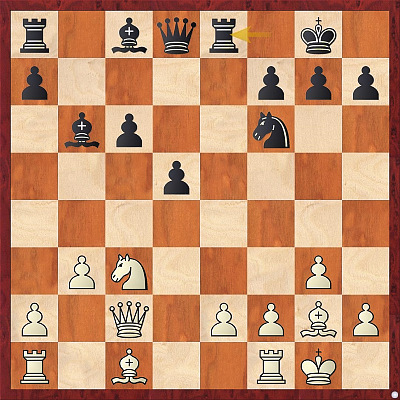
M (2872) Moscow 2019 (0-1, 41)}) 12... Re8 {[#] Critical Position: Should
White go Na4 to fight for c5, or develop the Rs with Rfd1, Bb2 and Rac1?} 13.
Rd1 $4 (13. Na4 $142 {is slightly better for White according to Stockfish 11,
and equal according to Leela after} Bd7 $11) 13... Bg4 (13... Bxf2+ $3 $19 {
SF11 instantly picks this as the winner, but Leela doesn't rate it as worth
calculating among its top three lines... until it is forced to see that after}
14. Kxf2 Qb6+ $1 {is winning for Black.} 15. e3 (15. Kf1 Ng4 $19) (15. Kf3 Bg4+
16. Kf4 Qc7+ {is mating too.}) 15... Rxe3 $1 16. Bxe3 (16. Na4 Ng4+ $19) 16...
Ng4+ $19) (13... Ng4 $1 $17 {Leela} 14. e3 Qf6 15. Qb2 (15. Bb2 Qh6 $1 $19 {
and ...Nxf2.}) 15... Ne5 $1 $17 {followed by ...Bg4 and something landing on
f3.} (15... Bc7 $5 {threatening ...Be5})) 14. Rd2 (14. Bf3 $5 {allows Black to
turn d5 into a passed pawn, but keeps the K safe and covers e4.}) 14... Qe7 (
14... d4 $5 $15) (14... Qc8 {keeps Black's options open: ...Bf5, ...h5, ...Bh3.
}) 15. Bb2 Rad8 16. Na4 $2 {[#]} (16. e3 $142 Qe6 $15) 16... Bxf2+ $1 $19 17.
Kxf2 Qe3+ 18. Kf1 Ne4 {Only move.} 19. Bxe4 dxe4 {Only move.} {There's no good defence to the
threat of ...Bh3+.} (19... dxe4 20. Rxd8 (20. Qc3 Bh3+ 21. Ke1 Qg1#) 20... Rxd8
$1 (20... Bh3+ 21. Ke1 Qg1+ 22. Kd2 Rxd8+ {wins the Q now and the game later.})
21. Kg2 Rd2 $19) 0-1