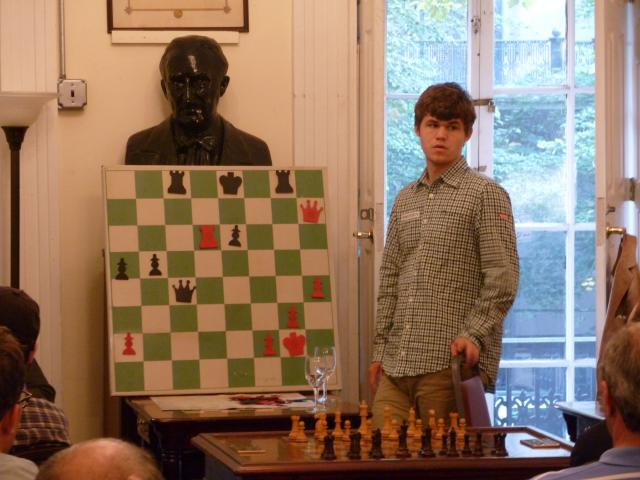
It's a bit of a stretch to call this week's game "Canadian", so I hope you'll all forgive me. Raven Sturt, my teammate on the McGill Chess Team, played in a simul at the Marshall Chess Club back in June of 2012. There, he faced the new World Champion, Magnus Carlsen, who was already world #1. The interesting thing about their game (other than the ludicrous opening) is that Raven was much better at various points! In fact, he would have been practically winning had he played 16...cxd5.
[Event "Magnus Carlsen Simul"]
[Site "New York"]
[Date "2012.06.24"]
[Round "?"]
[White "Carlsen, Magnus"]
[Black "Sturt, Raven"]
[Result "1-0"]
[ECO "C33"]
[WhiteElo "2835"]
[BlackElo "2246"]
[Annotator "MacKinnon,Keith"]
[PlyCount "83"]

{It might seem silly to analyze a simul game, but any game with the new World
Champion is probably worth looking at. I'm not going to overanalyze their
moves, however.} 1. e4 e5 2. f4 {The King's Gambit isn't 100% sound hence its
rarity in top-level tournaments. It's perfectly playable at club level though}
exf4 3. Nc3 $6 {Provocative, but since the game is a simul, why not?} (3. Nf3)
3... c6 (3... Qh4+ {I don't know if I would have been able to resist this move.
It puts white in a very awkward situation.} 4. Ke2 d5 $5 {Scores amazingly
well for black.} 5. Nxd5 Bd6 {and with ...Bg4 in the air and White's strange
King position, Black is clearly better}) 4. d4 d5 5. exd5 (5. Bxf4 {was
probably better. White would actually have a pretty nice position here}) 5...
Qh4+ {Raven finally gives the check which Magnus provoked with his third move.}
6. Kd2 Bg4 {aids white's development more than Black's} (6... Qd8 $1 $15 {
creates a very powerful x-ray on the d4 pawn}) 7. Nf3 (7. Qe1+ Qxe1+ 8. Kxe1
Nf6 $11) 7... Bxf3 (7... Qd8 {again, this would have been a strong option}) 8.
Qxf3 Nf6 9. Kd3 {I don't think I've ever seen the White King on d3 this early
in a game... The crazy thing is that it was the best move!} Bd6 10. Ne4 (10. g3
) 10... Nxe4 11. Qxe4+ Kd8 12. g3 {was more effective on the 10th move than
here} Qf6 13. Bxf4 Re8 14. Qf3 $2 {A mistake that Carlsen would never make in
a real game. Now Raven takes the advantage!} (14. Qg2 Bxf4 15. gxf4 Qxf4 16. c3
{apparently equal since Black cannot take advantage of the White King position}
(16. Kc3 c5 $1 $40)) 14... g5 15. Bxg5 $8 Qxg5 16. a3 $2 Qxd5 $2 {quite a bad
decision to try and trade off material here} (16... cxd5 $19 {It was much
better to keep the Queens on as White has real trouble coordinating his pieces.
}) 17. Qxd5 cxd5 18. Bg2 Nc6 19. Rhf1 {Magnus knows there's no rush in taking
d5} Ne7 20. Rxf7 h5 21. Rh7 Kc7 22. Re1 Kc6 $2 {Never a good idea to pin
yourself} (22... Kb6 $11 23. Re6 Rad8 24. Rxh5 Rf8 25. Bxd5 Nxd5 26. Rxd5 Kc7 {
and I find it unlikely that White could win this even with all his pawns if
Black were to play optimally}) 23. c4 b6 24. Re6 (24. b4 $16 {creates a
devastating threat of c5}) 24... Kd7 25. Bxd5 Rh8 26. Rg7 Raf8 27. b4 Rf5 28.
Ke4 (28. Re2 {an attacking move. e6 is now free for a nasty check if Black's
not careful}) 28... Rhf8 29. Rh6 Rxd5 (29... Rf1 {It might not have been
necessary to sac the exchange. Practically, it worked out pretty well though.})
30. cxd5 Rf2 31. Rxh5 Ra2 (31... Re2+ {This is stronger because then a capture
on a3 will be with check}) 32. b5 Re2+ 33. Kd3 Rb2 (33... Ra2 {It was more
important to go after a3 here before b5} 34. h4 Bxg3 {taking advantage of the
fork if the White rook takes back} (34... Rxa3+ 35. Ke4 Bxg3 36. Rhh7 Bd6 37.
h5 Rh3 38. h6 $16 {I think White is winning here, but it's tough to guarantee
that}) 35. Ke4 Bd6 36. Rhh7 Re2+ 37. Kd3 Ra2) 34. Rh8 Rxb5 35. Ra8 ({the game
score shows} 35. Rc8 $4 {but I'm going to assume that the move played was 35.
Ra8}) 35... Rb3+ 36. Ke4 Rxa3 37. h4 b5 $2 {It was already very tough, but now
Black has no chance.} (37... Ra4 38. h5 Bc5 {a creative way to defend the long
diagonal - with the Bishop!}) 38. h5 b4 39. h6 b3 40. Kd3 Ra1 41. Kc3 Rh1 42.
h7 1-0