

Tactics: Analysis First, Cliché Later

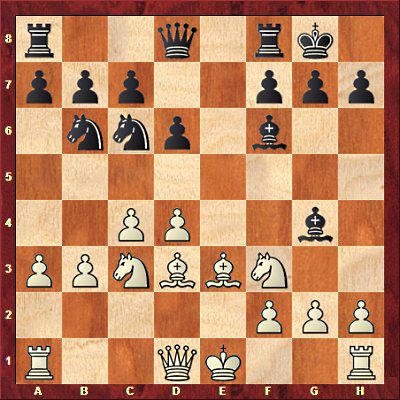
This week's tactic comes from the game Lépine - Liboiron, TORO U1500, 2014.06.07.
Whatever Black plays there are contradictory clichées ready-made for the occasion:
- "strike while the iron is hot" or "the threat is stronger than the execution"?
- "invite everyone to the party" or "three's a crowd"?
- "when you see a good move, look for a better one..." or "he who hesitates is lost"?
But knowing the clichées doesn't help you play chess: analysts can choose clichées, players have to choose moves.
Choose your move and the cliché will follow:
11...Nxd4 ("strike while the iron is hot"...?)
11...Re8 ("invite everyone to the party"...?)
11... something else !? ("when you see a good move, look for a better one...")
Answer: 11...Nxd4 ("strike while the iron is hot")
Spoiler: Highlight to view
11...Nxd4! 12.Bxd4 Bxd4 13.Bxh7+ Kxh7 14.Qxd4 Re8+ =/+
If White was already castled then the d4/h7 pawn trades would favour White as Black's K would be weaker and the half-open d-file is more useful to White than the half-open h-file is for Black (as in the note to move 12.0-0). But here White is a bit worse, as Kd2 leaves the White K exposed, and Kf1 leaves the Rh1 out of play.
Answer: 11...Re8 ("invite everyone to the party" because "the threat is stronger than the execution")
Spoiler: Highlight to view
11...Re8 isn't nearly as strong, since White can castle and the exchange of d4 for h7 pawns is good for White:
12.O-O! +/= and now executing either of the double-attacks on d4 actually leaves Black worse:
12...Bxf3 13.Qxf3 Nxd4 14.Bxh7+ Kxh7 15.Bxd4 Bxd4 16.Qd3+ +/=.
12...Bxd4 13.Bxd4 Nxd4 14.Bxh7+ Kxh7 15.Qxd4 Bxf3 16.Qd3+ +/=.
White has the advantage: Black's K is weaker and the half-open d-file is more useful to White than the half-open h-file is for Black.
Instead, after 11...Re8 the game continued 12.Be2?! Qc8
Better was: 12...Bxf3! 13.gxf3 (13.Bxf3? Bxd4 -+) 13...d5 -/+.
The game concluded:
13.Qd2 Bxf3! 14.gxf3 Qf5 (and here White could have kept the game balance by 15.000) 15.Ne4 Rxe4?! 16.fxe4 Qxe4 17.O-O-O d5 18.c5 Nd7 19.Qd3 Qe7 20.Bf3 Rd8 21.Rhg1 Nf8 22.b4 Ne6 23.Qc3 Ng5 24.Bh1 Ne4 25.Qb2 Bh4 26.Rg4 Nxf2?? 27.Bxf2 Bg5+ 28.Kb1 Qf6 29.Rdg1 Qf5+ 30.Ka1 Bf6 31.Bh4 h5 32.Bxf6 hxg4 33.Bxd8 Nxd8 34.Qe2 Ne6 35.Rxg4 Nxd4 36.Rxd4 1-0
Answer: 11... something else!? ("when you see a good move, look for a better one...")
Spoiler: Highlight to view
After analysis, I can't find a move which is clearly better than ...Nxd4, but the best alternative (11...d5) leads to a very different type of game, which may or may not suit Black's tastes:
11...d5!? 12.c5!
12.cxd5? Nxd5 is a bad IQP for White.
12...Bxf3!? leads to a very unbalanced game.
12...Nc8! planning ...N8-e7-f5 Xd4; with a closed position and a lot of maneuvering.
13.Qxf3 Bxd4! 14.Bxd4 Nxd4 and here White has a choice between defending a sharp middle game or a passive endgame:
15.Qh3?! Re8+ 16.Kf1 g6 17.cxb6 Nxb3 18.Rd1 axb6 19.Bc4 Rxa3 20.Bxd5 Qe7 Black already has PPP for the B and White's Rh1 is missing in action.
15.Bxh7+ Kxh7 16.Qd3+Kg8 17.Qxd4 Re8+ 18.Kf1 Nd7 19.Nxd5 c6 20.Ne3 Nf6! with compensation, Black has a lot of development for the P, and may be a bit better after the Q exchange.
The full game, along with a report by Marcel Laurin on the 2014 TORO event in Gatineau, and games annotated by IM Jean Hébert, Joey Qin, and Qiyu Zhou will appear in the next issue of Chess Canada, the CFC's monthly electronic newsletter.