

Tactics: Busy B

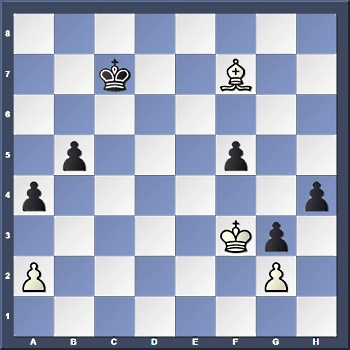
This week's Canadian Tactic comes from the game between IM Aman Hambleton and GM Bator Sambuev, from the 2014 Montreal Open.
Black sacrificed a piece for a dangerous attack -- with a guaranteed draw by perpetual -- but after he overpressed they reached the following endgame.
White to play...
Hint: One pawn stops two...?
Spoiler: Highlight to view
Nope.
43.a3? Kb6 44.Be6 b4 [only move]= 45.axb4 a3 [only move] 46.Bc4 [only move] Kc6=
It's a positional draw: White's K has to stay close to g3-pawn or ...h3 wins for Black, White's B is busy keeping out the Black King, so both sides will just move their Kings back and forth.
Hint: in the endgame the King is an active piece....?
Spoiler: Highlight to view
It's true that in the endgame the King should be an active piece, but here White's King is already doing as much as it can: stopping Black from creating a passer with ...h3. Trying to do more is a waste of a precious move.
43.Kf4? b4 44.Be6
44.Kxf5?? h3-+ creates a winning kingside passer. This is an essential, if obvious, tactic in all variations.
44.Be8?? b3-+.
44...h3 45.Kxg3 [only move] hxg2 46.Kxg2 b3:
47.Bxb3 axb3 48.axb3=.
47.a3 Kd6 48.Bxf5 Ke5 49.Bg6 Kd4= White will have to give up the B for the b-pawn.
Hint: Get Busy with the B.
Spoiler: Highlight to view
Both 43.Bg6? and 43.Be6? allow Black to draw:
43... b4 [only move] 44.Bxf5 b3 [only move] 45.axb3 h3 [only move]
Not 45...axb3? when 46.Kg4! wins by preventing Black from turning White's g-pawn into an unpromotable h-pawn.
46.gxh3 axb3 47.Kxg3 Kd6 48.Kf4 Ke7 [only move] Black's K gets to h8 for the draw.
Solution and another Question:
Spoiler: Highlight to view
Aman found the only winning move, and the game continued: 43.Be8 Kb6! best, forcing White to continue to find only moves.
What is White's next "only move"?
The Next Only Move:
Spoiler: Highlight to view
Aman again found the only winning move for White:
44.Bd7 [only move] +-
As in the variations above, both a3 and Kf4 are wrong:
44.a3?? b4 [only move, but now Black is winning!] 45.axb4 a3 46.Bf7 Kb5 47.Kf4 Kxb4 and Black will force White to give up his B to stop the a-pawn, and then walk across the board to win on the kingside. Once again, White can't take on f5 with the King because Black creates an unstoppable passer with ...h3.
44.Kf4? just loses a tempo, since White can't take on f5 with his K: 44...Ka5= 45.Bd7 b4 46.Bxf5 b3 [only move]. Here White has a couple of choices, but both lead to a draw (see Analysis Diagram below)

47.axb3 a3 [only move] 48.Bb1 h3! is the simplest way to draw, though 48...Kb4 will too.
47.a3 b2 48.Bb1 Kb5:
49.Kg4 Kc4 50.Ba2+ Kc3 51.Kxh4 Kc2 52.Kxg3 b1=Q 53.Bxb1+ Kxb1 and both players promote.
49.Ba2 h3 50.Kxg3 hxg2 51.Kxg2 Kc5 52.Kf2 Kd4 53.Ke2 Kc3 54.Kd1 b1=Q+ 55.Bxb1 Kb3= .
The game concluded:
44.Bd7 Kc5 45.Bxf5 b4!
The trickiest, though still losing.
Here we see the difference between 43.Bg6 (=) and 43.Be8 (+-): White is up one critical tempo, having captured f5 before Black had a chance to play ...b4. White won the tempo because after Be8 Black had to make two ultimately useless moves with his King to save his a- and b-pawns, and this gave White an extra move to prepare to take on f5 with his Bishop (since his K can't do it).
46.Bc2 h3 47.gxh3 [only move] b3 48.Bxb3 [only move] 1-0
The extra pawn is winning, an extra B is not: 48.axb3?? axb3 49.Bxb3 Kd6= and White's last pawn is in the wrong corner for the B.
The full game, along with others from the Montreal Open, will appear in the next issue of Chess Canada, the CFC's online newsletter.