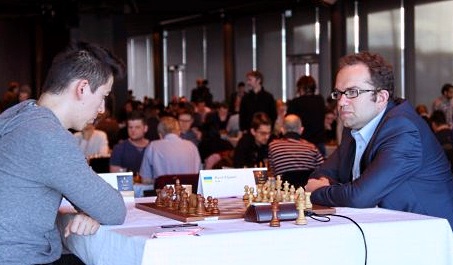
You can watch the playoffs, and the four game final match, on the World Cup website. Live games, with video and viewer's choice of GM commentary in English, Azeri, Spanish, or Russian, start at 3pm Baku time, 6am EST:
[Event "Reykjavik Open"]
[Site "Reykjavik"]
[Date "2015.03.17"]
[Round "9.2"]
[White "Eljanov, Pavel"]
[Black "Hansen, Eric"]
[Result "1/2-1/2"]
[ECO "A34"]
[WhiteElo "2727"]
[BlackElo "2566"]
[Annotator "Eric Hansen"]
[PlyCount "76"]
[EventDate "2015.??.??"]
[EventType "swiss"]
[EventRounds "9"]
[EventCountry "ISL"]
[Source "ChessBase"]
[SourceDate ""]

{Every game as Black vs a top GM is a serious struggle. This was no exception
with the circumstances: Pavel had White and needed a win to catch up to
surging L'ami. I had no idea what to expect due to his wide repertoire, so I
decided to avoid preparing and get some extra exercise in.} 1. c4 Nf6 2. Nc3 c5
3. g3 g6 4. Bg2 Bg7 5. d3 {Now I'm mainly out of book. It's not
standard to commit the pawn to d3 so early since you'd like to normally keep
the option of d4 early. The direction of White's setup is clear: he wants to
harass Black's fianchetto setup before castling. There are so many flexible
setups available from these English setups.} Nc6 6. Bf4 ({This game made me
think: could White have avoided my setup?} 6. Rb1 $5 O-O $2 (6... d6 7. a3 {
And now I have no time for ...Qd7 and ...b6 because of b4-b5. White can still
go Bf4 and Qd2 with a possible improvement over the game. All these move-order
nuances!!}) 7. a3 a6 8. Nf3 (8. b4 cxb4 9. axb4 b5 10. Nf3 bxc4 11. dxc4 Rb8
12. b5 axb5 13. cxb5 Na5 14. O-O Bb7) 8... b5 (8... Rb8 9. Bf4 d6 10. b4 cxb4
11. axb4 b5 12. cxb5 axb5 13. O-O $11) 9. cxb5 (9. O-O bxc4 10. dxc4 d6) 9...
axb5 10. Nxb5 Qb6 11. Nc3 d5 12. O-O) 6... d6 ({The internet premove} 6... O-O
{could leave Black with a pretty uncomfortable position after} 7. Qd2 d6 8. Bh6
$40) 7. Qc1 h6 8. Rb1 Qd7 {I've utilized this maneouver in the
anti-Grunfeld as a good way to develop my light bishop. White is doing well if
the diagonal is uncontested combined with an a3-b4 push.} (8... Bd7 9. a3) (
8... g5 9. Bd2 Qd7 (9... O-O $2 10. h4 $18) 10. Nf3 (10. h4 g4)) 9. Nd5 $5 {
After a long think. I enjoy playing fresh positions and it was clear we were
both on our own.} (9. a3 b6 10. b4 Bb7 11. Nf3 (11. b5 Nd4 $15) 11... Nd4 12.
O-O Rd8 $11) (9. Nf3 b6 10. O-O Bb7 $11 {If White tries to stop Black from
castling with} 11. h4 Rc8 12. a3 Nd4 {Playing in the center suits Black just
fine.}) 9... Nxd5 10. cxd5 (10. Bxd5 Nb4 $17) 10... Ne5 ({Almost
equally tempting was:} 10... Nd4 11. e3 (11. Nf3 Nxf3+ 12. Bxf3 Qa4 (12... Qh3)
) 11... e5 12. exd4 (12. dxe6 Nxe6 $17) 12... exf4 13. dxc5 O-O 14. Ne2 Re8 $17
) 11. Nf3 {An unfortunate necessity. Normally in English
structures White has many useful moves to exhaust. In this position it is
Black who has more ways to improve his position, which means already something
has gone wrong for White.} (11. b4 b6) (11. h4 Qa4 12. a3 Bg4 $15) 11... Nxf3+
12. Bxf3 Qa4 {Freeing up my bishop.} (12... g5 13. Bd2 Qh3 $13) (
{Better was} 12... Qh3 {I didn't like} 13. Rg1 O-O (13... b6 $5 14. Bg2 Qxh2
15. Kd2 $15) (13... g5 14. Bd2 O-O 15. Bc3 $11) 14. Bg2 Qxh2 15. Kd2 {and I
was worried about my Queen being trapped, which isn't the case:} b6 16. Qf1 Qh5
17. Rh1 Qf5 18. Be4 Qf6 $17) 13. O-O Bh3 (13... Qxa2 $5 {No way Jose} 14. b4 b6
15. bxc5 bxc5 (15... dxc5 $2 16. d6 $1 $18) 16. Qe3 $40) 14. Re1 (14. Bg2 Bxg2
15. Kxg2 Qxa2 $17) 14... Rc8 {In terms of structure and evaluation
this is quite an equal position but at the same time a greedy pawn grab or any
weakness will swing the momentum greatly.} 15. e4 {Threatening e4 and staying
consistent with White's aggressive intentions} g5 (15... b6 16. e5 g5 17. exd6
gxf4 18. Rxe7+ Kf8 19. Bh5 $13) 16. Bd2 O-O 17. Bc3 (17. g4 Qd7) (17. a3 c4 $1
18. dxc4 Qxc4 (18... Rxc4 19. Bc3 Rc7 20. Qd2 Bxc3 21. bxc3 Qxa3 $15) 19. Qd1
Bd7 {slightly preferable to Black for his better bishops.}) {[#]} 17... e5 {I
thought that closing the position up would be easier than always having to
worry about the e5 push from White.} (17... Bd4 18. Qd2 Kg7 19. Rbc1 e5 $11) (
17... Bxc3 $2 18. bxc3 b6 19. Bd1 Qd7 20. f4 $14) 18. dxe6 (18. Bd1 Qd7) (18.
a3 f5 $132) (18. g4 Qd7 19. Qd1 h5 20. gxh5 g4 21. Bg2 Bxg2 22. Kxg2 f5 23. Kh1
Qf7 24. Rg1 Qxh5 25. exf5 Rxf5 26. Qxg4 Qxg4 27. Rxg4 Rxf2 28. Rbg1 Rc7 29. Rg6
Rd7 30. R1g2 Rf1+ 31. Rg1 Rf2 $11) 18... fxe6 19. Bd1 (19. Bxg7 Kxg7 20. Bd1
Qd4 21. Qe3 e5 {pawns on the right color!} 22. g4 Rf4 $1 $17) 19... Qd7 20. Qe3 (20. e5 $4 Qc6 21. f3 (21. Re4 d5 $19) 21... g4

$19) 20...
e5 (20... Bxc3 21. bxc3 e5 22. d4 {is a bit loose for Black.}) 21. b4 b6 22. f3
Rf6 {I was really playing with fire by allowing White to play g4
and potentially trap my bishop.} (22... Be6 $11 23. a4 Rf7 24. a5 b5 25. Be2 a6
26. Rbc1 d5 27. exd5 Qxd5 28. bxc5 Rxc5 29. Bb4 Rc8 30. Rxc8+ Bxc8 31. Rc1 (31.
Qe4 Bb7 $15) 31... Bb7 $15) 23. bxc5 bxc5 24. Re2 (24. g4 $5 {I
told Pavel right after the game I was worried about this. Strongest, but not
what I had in mind, was:} h5 (24... Kh7 $1 25. Kh1 Rf4 (25... Rcf8 $2 26. Rg1
h5 27. f4 $1 Bxg4 28. Bxg4 hxg4 29. f5 $18) 26. Rg1 h5 27. Bd2 (27. gxh5 Bh6
$14) 27... Rcf8 (27... hxg4 $2 28. fxg4 Bxg4 29. Bxg4 Rxg4 30. Qh3+ $18) 28.
gxh5 Bh6 {Black is hanging on by a thread here..} 29. Qf2 $16 Rg4 (29... R4f7
30. Bxg5 $18) 30. Rg3 Rxg3 31. Qxg3 $16) 25. Qxg5 {position turns chaotic} (25.
gxh5 Bh6 26. Kh1 Kh7 $13 27. Rg1 $140 $2 g4 $17) 25... hxg4 26. fxg4 (26. f4
$13) 26... Rcf8 27. Be2 c4 28. dxc4 $13 Rf4 $13) 24... Rcf8 25. Rf2 Kh7 26.
Rbb2 {g4 is once again a possibility} (26. g4 $2 Bxg4 $19) 26... Be6 27. Bb3
Bh3 28. Bd1 {Both sides are moving back and forth. If it wasn't
for the f3 weakness then White would have an advantage because of the open
b-file and potential play on d6.} Be6 29. g4 {White clarifies the position to
the point where it should be easy enough to fully grasp. At this point I took
some time to to find a decent setup to hold.} R6f7 30. Bb3 Bxb3 31. axb3 Bf6 {
In time. Bf6,-Bd8-Bb6.} 32. Qe2 (32. b4 cxb4 33. Bxb4 Bd8 $17) 32... Bd8 33.
Bd2 Rxf3 {I was low on time and found a forced draw. Against
different opposition I would have played on, but I didn't think I had any
chances here with my pawns on the wrong color.} ({Objectively better is:} 33...
Qe6 34. Be3 (34. b4) 34... Ba5 35. Ra2 Bb4 36. Rb2 Kg6 37. Kg2 $15) 34. Rxf3
Qxg4+ 35. Kf2 Qh4+ 36. Kg2 Qg4+ 37. Kf2 Qh4+ 38. Kg2 (38. Ke3 $4
g4 $8 39. Rxf8 Bg5+ 40. Rf4 exf4#) (38. Kf1 Qh3+ $8 39. Kf2 $8 $11) 38... Qg4+
{An interesting struggle where the whole game I thought my position was OK,
but I found myself under psychological pressure. I took a bit too much time in
the middlegame, and hope with such a comfortable opening position I can push
better in future encounters.} 1/2-1/2