

Canadian Universities Chess Championships 2016: In form U of T claims the title, stops McGill’s win streak at 3
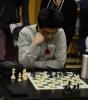
It is not easy for a University to be repeat champions for two or three years in a row. For that to happen, it needs many stars to align. First, it needs a strong core group of players similar in year and age. Then it needs these players to take engineering and give the school another year of their services, and more importantly, the players need to continue to stay in chess form. For the past three years, McGill had all of those conditions in favour. But alas, all good things must come to an end. After two of the star-studded, all-master team graduated, McGill entered the event with two A-team rookies and their seeding dropped just enough to open the door for the other universities.
Some photos by John Upper.
This year's showdown was held at Queen’s University in Kingston, Ontario. Given the name of the university and the city in which it is located, we could not have had a better location to play chess, except for perhaps King’s College in Queenston, Ontario.[1]
Aside from the pre-tournament delay so familiar to every chess player in the country, and the rounds that had to be pushed back due to intense and gruesomely long games (90+30 is a bit too much for a 2 day, 5 round tournament in my opinion) as well as the fading light in the playing hall after sunset (three factors that were really beyond their control) the host school did an impeccable job of accommodating the players and spectators. The tournament director Simon Gladstone and team did a great job organizing, particularly with sponsorships. Having PlayMagnus sponsor the event is pretty impressive in my opinion. Wallace Hall indeed was a thing of beauty with its dome, classic furnishing and marvelous portraits. Despite the inconvenience of low light, if given the choice between a more modern venue and a classic hall, I would prefer the latter.
From the getgo, top seed U of T A started strong, not losing a single match point after two rounds. They looked to be in trouble in round 3, however, with the top two boards falling to Ottawa’s[2]
2300+ tandem. Luckily for them, the bottom two boards anchored the team to save the match draw. The two aforementioned teams lead the pack after Day 1 (5pts) with three teams 1 point behind.
Day 2 was the moment of truth. Toronto passed the test with a close win vs second seed McGill A (2.5-1.5) and a strong showing against third seed Carleton (3.5-0.5) to claim the title. Ottawa could not maintain their pace, settling for a draw vs Queen’s A and losing in the last round. Waterloo A, who was two points behind after the first day, won their last two rounds and beat Queen’s A on tiebreaks for second place. Seeded 9th with an average rating of 1862, Waterloo relied on superb performances on its top and last board, who went 4.5/5 and 4/5 respectively. Speaking of the host team, it received a strong showing from Simon Gladstone. When he was not at the centre of attention delivering important speeches, he held his own on the board, scoring 3/5. His teammates say that he needs to host more CUCC’s, as according to them he has not scored significantly the years he did not host. The defending champs started the first day with promise, scoring 4 points and within striking distance after the first day; but they lost their final two matches by two identical scores of 1.5-2.5. It marks the end of NM Keith MacKinnon’s service at McGill, a veteran who has played in 5 different CUCC’s and who has been part of three championship teams. Though Mcgill will miss him dearly, we must congratulate him for completing his long journey of as an engineering undergrad student. How Team McGill recovers from the elite players who can’t seem to stop graduating is a noteworthy story to follow for the upcoming years.
Meanwhile in the Reserves section, first seed Toronto C stole the show, only conceding a draw to McGill C in the final round. The team was lead by expert Alex Ferreira, who scored 4/5 on the top board. Having a strong player on top board was not uncommon in the Reserves section, as we can see Chris Pace (rtg 2208) backstopping his team to a 2W-1L-2D performance with his individual 4.5/5. And we cannot forget Regina-Veronicka Kalaydina (rtg 1940), whose 5/5 accounted for two thirds of Queen’s E’s team points (1W-4L; 7.5/20).
The event saw many scintillating and gruelling battles. My personal favourite was Allard-Cormier (R4; McGill B-McMaster A) where both sides were aiming at the opposing king in a razor-sharp Najdorf English Attack. White outhustled black, got both his h- and g-pawns to the 6th rank, crashing through with some lethal sacrifices. The tournament was also known for the interesting endgames that arose. It was more intense given that these complicated positions had to be played in extreme time conditions. I had the opportunity to be experience it first hand in my round 3 game with the ever-quick James Fu. After hours of grinding and using the significant time advantage that he had, he managed to out-manoeuver me in a Q vs R+B (with pawns) ending. Marinkovic-Kleinman also featured a Q vs R+B battle, but with the R+B side being in a better position yet having to settle for a perpetual. Kleinman (McGill A) did overtime for the entire tournament, ending last or close to last for four of the five rounds (the exception being my rd. 3 game). Though the scoresheets were not carbon copied, many the games are in the hands of the hosts and have been uploaded here. They will also be available on Canbase soon with the help of Hugh Brodie.
This year, a total of 24 teams participated from 11 schools, one up from last year. U of T and Queen’s lead the pack with 5 teams each. Interestingly, the number of teams sent by the respective schools is more than the number of non-Ontario teams combined (4). Also of note is the presence of Professor Jeroen Struben (McGill B) as the only faculty player. Six girls also competed, 2 of whom were on the same team (played for Université de Montréal).
Of course, how can I conclude the recap without mentioning the electric atmosphere in the tournament venue? The atmosphere was most noticeable at the conclusion of a round, where everyone is just watching a single game. Personally, I particularly enjoy the team chess aspect as it adds the companionship that often the sport of chess lacks. Regardless of win or lose, our delegation sure bonded together and discovered the many talents that the players hid under their chess pedigree. The event was nicely documented in media with John Upper taking photos and a cameraman shooting live footage of the rounds on day 1.
Championship Standings
Link: http://chess-results.com/tnr203157.aspx?lan=1
U of T (A) 9 pts
Waterloo (A) 7 pts
Queen’s University (A) 7 pts
Top player on each board
Board 1: Owen Qian (Waterloo A) & Mihnea Voloaca (Ottawa) 4.5/5
Board 2: James Fu (U of T B) 4/5
Board 3: Mike Ivanov (U of T A) 5/5
Board 4: Chris Knox (U of T A) 4.5/5
Reserves (U1800)
Link: http://chess-results.com/tnr203162.aspx?lan=1
U of T (C) 9 pts
Ottawa (B) 7 pts
McGill (C) 7 pts
Top player on each board
Board 1: Regina-Veronicka Kalaydina (Queen’s E) 5/5
Board 2: John Venner (U of T C), Tony (Western A) & Deparse Cottrell (U of T D) 4/5
Board 3: James Lakatosh (McMaster B) 5/5
Board 4: Matthew Rowe (McGill C) 4.5/5
**Note: For the team standings, a win counts as 2pts, draw 1pts, loss 0 pts
Next year’s contest will be hosted at Western. I am looking forward to it :)