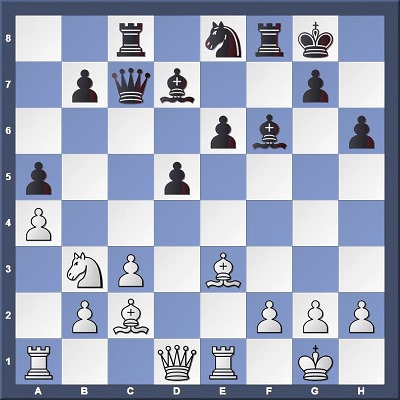
[Event "Gatineau Open"]
[Site "?"]
[Date "2016.03.06"]
[Round "5"]
[White "Sambuev, Bator"]
[Black "Rodrigue-Lemieux, Shawn"]
[Result "1-0"]
[ECO "B13"]
[WhiteElo "2641"]
[BlackElo "2069"]
[Annotator "Upper,John"]
[PlyCount "71"]

1. e4 c6 2. d4 d5 3. exd5 cxd5 4. Bd3 {Diagram [#]} e6 $6 {This leaves the Bc8
shut in. The main line goes:} (4... Nc6 5. c3 Nf6 6. Bf4 Bg4 7. Qb3 {when
Black has several reasonable moves: ...Qd7, ...Qc8, ...Nh5!? and ...Na5.}) 5.
Nf3 Bd6 6. O-O Nf6 7. Re1 O-O 8. c3 Nc6 9. Bg5 Bd7 10. Nbd2 h6 11. Bh4 Be7 12.
Ne5 Nxe5 13. dxe5 Ne8 14. Bg3 Qb6 15. Nb3 {White has a space
advantage, the d4 outpost, a weakened b1-h7 diagonal to attack the Black King,
and no weaknesses for Black to target.} a5 {Black would like to trade his bad
Bd7, but that doesn't seem to equalize.} (15... Bb5 16. Bc2) (15... Ba4 16. Qh5
$5 (16. Bc2 {is less energetic, but OK.}) 16... Bxb3 17. axb3 Qxb3 18. Bf4 $16
{threatening Bxh6.}) 16. a4 Rc8 17. Bf4 f5 18. exf6 Bxf6 (18... Nxf6 19. h3 {
and White's minor pieces get to use the central dark squares now that his
pawns are no longer on them.}) 19. Be3 Qc7 20. Bc2 {White is
preparing Qd3-h7, driving the Black K into the center. What should Black do?}
Be7 $6 (20... Be5 $142 $1 {Frees f6 for the N and recycles the B to d6 with a
tempo gain on h2.} 21. g3 $1 $14 {White has pressure on Black's center pawns,
but by forcing a pawn move in front of the White K (with g3 or h3) Black stops
attacking options with R lifts along the third rank and creates some
weaknesses in White's Kingside.} (21. Qd3 $2 {It's complex, but White gives up
the advantage by letting Black take on h2:} Bxh2+ 22. Kh1 Nf6 23. g3 (23. Bxh6
Bf4 $13) 23... Bxg3 24. fxg3 Qxg3 $11) (21. Qh5 $6 Nf6 22. Qh4 (22. Qg6 $2 Be8
$17) 22... Bd6 {Black's Bd6 (rather than Be7) leaves him much better
coordinated than in the game. Importantly,} 23. Bxh6 $2 {is now just bad:} gxh6
24. Qxh6 Rf7 $17) (21. h3 Bh2+ 22. Kh1 Bf4 $14)) 21. Qd3 Nf6 (
21... Rf6 22. Qh7+ Kf8 (22... Kf7 23. Bd4 $18) 23. Bg6 (23. Bd4 Bd6 24. g3 e5)
23... Bd6 24. h4 $16 {or Kh1!?}) 22. Bxh6 $1 Ne4 (22... Ng4 {attacking h2 and
h6 is too slow:} 23. Qh7+ Kf7 24. Qg6+ Kg8 25. Qxg7#) (22... gxh6 {gets mated
to a classic pattern:} 23. Qg6+ Kh8 24. Qxh6+ Kg8 25. Qg6+ Kh8 26. Re3 e5 {
Stopping Rh3, but after} 27. Rg3 {there's no defence to both Qg7 and Qh6.}) (
22... e5 23. Qg6 Rf7 24. Be3 $16 {White is up a pawn for free, and Black's K
is still not safe; for example,} d4 25. Nxd4 $3 exd4 26. Bxd4 Bc6 27. Bxf6 Rxf6
28. Qh7+ Kf8 29. Bb3 $18) 23. Rxe4 $1 (23. f3 {is good, but not as forcing.})
23... dxe4 24. Qxe4 Rf5 {Blocking the diagonal is Black's best hope.} (24...
Rf6 25. Qh7+ Kf7 26. Bxg7 $18) 25. Nd4 Qd6 {Defending e6 and e7.} (25... gxh6
26. Nxf5 {White will be up two pawns with a huge attack.}) 26. Rd1 {White has
many winning moves, but choses to "invite everyone to the party" as GM Yasser
Seriawan says.} (26. Bb3 Re5 27. Qg4 Bf6 28. Bf4 $18) (26. g4 gxh6 27. gxf5
exf5 28. Qxb7 $18) 26... Bc6 (26... gxh6 27. Nxf5 exf5 28. Rxd6 fxe4 29. Rxd7
$18 {White will be up three pawns in an endgame.}) 27. Qg4 Qe5 28. Bxf5 {
White cashes in.} (28. Nxe6 $1 {keeps the attack going.}) 28... exf5 29. Nxf5
Rf8 30. Nxe7+ Qxe7 31. Be3 Re8 32. Rd4 Qf7 33. h4 b5 34. axb5 Bxb5 35. Qg5 Bc6
36. Qxa5 1-0
..