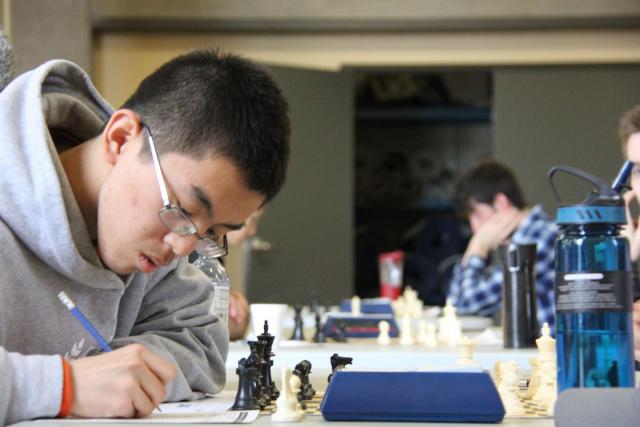
From the final round of the 2016 McGill Open, I present you with an attacking masterpiece that is worthy of books on how to play the English Attack. The tournament situation was such that FM Valerian Hirschberg was on 4/4 - having beaten yours truly in the second round - playing his nearest competitor, FM Zong Yang Yu, with 3.5/4 (who took a first round bye). Zong Yang, needing a win, capitalized on one or two mistakes by Valerian in a complex opening leading to a quick 25-move win. Be sure to have a look!
[Event "McGill op"]
[Site "Montreal CAN"]
[Date "2016.05.01"]
[Round "5.1"]
[White "Yu, Zong Yang"]
[Black "Hirschberg, Valerian"]
[Result "1-0"]
[ECO "A34"]
[WhiteElo "2342"]
[BlackElo "2317"]
[Annotator "MacKinnon,Keith"]
[PlyCount "49"]
[EventDate "2016.04.28"]
[EventRounds "5"]
[EventCountry "CAN"]

{The crucial game of the tournament - Hirschberg with a perfect 4/4 and Zong
Yang close behind with 3.5, it was clear that this would not be a dull
encounter!} 1. Nf3 c5 2. c4 Nf6 3. Nc3 d5 {a principled decision to counter in
the centre; however, sharp lines may ensue. The game continuation demonstrates
that the English isn't always such a boring opening} (3... Nc6) 4. cxd5 Nxd5 5.
e4 {a bold move leading to dynamic play} (5. d4 {is a high scoring alternative
(60%)}) (5. g3 Nc6 6. Bg2 Nc7 7. O-O e5 8. d3 {is a quieter continuation}) 5...
Nb4 6. Bc4 (6. Bb5+ {a less successful alternative} N8c6 7. d4 cxd4 8. a3 dxc3
9. Qxd8+ Kxd8 10. axb4 $11) 6... Nd3+ 7. Ke2 {One should only play openings
like this after careful preparation!} Nf4+ (7... Nxc1+ 8. Rxc1 Nc6 {is pretty
reasonable too}) 8. Kf1 Ne6 9. b4 $1 {The correct way to follow up - White
must continue with enterprising play, as otherwise Black will consolidate
control of d4, and White will feel silly as he will need to castle manually}
cxb4 10. Nd5 Nc6 {the first deviation from the main move, yet still played by
strong players} (10... g6 11. Bb2 Bg7 {and the advantage of having the Knight
on e6 can be appreciated. Black scores well here, but White's position shows
promise as he will recover the pawn on b4 and then push d4 with strong central
control. One major proponent of this system was GM Yasser Seirawan who won the
following instructive game:} 12. Bxg7 Nxg7 13. Nxb4 Nd7 14. d4 Nb6 15. Bb3 a5
16. Nd3 a4 17. Bc2 O-O 18. h3 Qc7 19. Rc1 Bd7 20. g3 Nc4 21. Kg2 Bb5 22. Nc5
Qb8 23. Rb1 Na3 24. Rb2 b6 25. Nxa4 Rc8 26. Bb3 Qa7 27. Qd2 Bxa4 28. Qh6 Bxb3
29. Ng5 f6 30. Qxh7+ Kf8 31. Rxb3 fxg5 32. d5 Nc4 33. Qh8+ Kf7 34. Rf3+ Nf5 35.
Qh7+ Kf6 36. exf5 Ne5 37. Re1 g4 38. hxg4 Qd7 39. g5+ {1-0 Seirawan,Y (2600)
-Kuligowski,A (2435)/Wijk aan Zee 1983/MCD}) 11. Bb2 (11. d4 g6 12. Be3 Bg7 13.
Qd2 O-O 14. Rd1 a5 15. h4 h5 16. Bh6 Kh7 17. Bxg7 Nxg7 18. Ng5+ Kg8 19. Qf4 {
1/2-1/2 Piket,J (2605)-Van Wely,L (2635)/Escaldes 1998/ CBM 068}) 11... Nc5
$146 12. Qc2 ({The computer points out a crazy looking move} 12. Be5 $1 {and
after the natural looking} Nxe5 $2 (12... Ne6 {Black would do best to go back
and cover c7} 13. Rb1 {and perhaps play d4 and drop the Bishop back to g3 if
attacked with ...f6}) 13. Nxe5 e6 14. Qh5 $18 {the game will be over after} g6
15. Qf3 f5 16. Bb5+ Bd7 17. Nxd7 Nxd7 18. exf5 exd5 19. Re1+ Be7 20. f6) 12...
e6 13. d4 $1 b3 $2 {I don't really understand the idea behind this intermezzo.
It seems to be a mistake which begins Black's relatively quick decline from
this point on} (13... Nd7 14. Ne3 $14) 14. axb3 Nd7 15. Ne3 (15. Nf4 {is
marginally more active and would likely have been my preference} Qc7 16. g3 Na5
17. Kg2 Nxc4 18. bxc4 $16) 15... Be7 $2 16. d5 {opening up White's dangerous
b2 Bishop. The end is near} exd5 17. exd5 Nb4 18. Qe4 Nf6 {one of only two
moves which doesn't lose immediately} (18... O-O {a hard move to make when I'm
sure he saw} 19. Bxg7 $1 {and now if} Kxg7 (19... Nf6 {prolongs the battle
somewhat and was likely Black's best} 20. Bxf6 Bxf6 21. Rd1 Qd6 22. h4 {and
White's attack continues}) 20. Nf5+ Kh8 21. Nxe7 {which is easily winning for
White}) (18... Nc5 $2 19. Bb5+ $18 {picks up the b4 Knight}) 19. Bxf6 gxf6 20.
Rd1 (20. Nd4 {targeting f5 was likely a little easier, as it prevents Black
from castling due to the devastation of either Knight going to f5. But after
seeing what White had planned, what he did was equally good} Kf8 $8 (20... O-O
21. Nef5 Bxf5 22. Nxf5 $18)) 20... O-O 21. d6 $1 {a beautiful move which adds
to White's attacking potential and forces Black's Bishop to d6 (where it will
be in trouble once a Knight gets to f5)} (21. Nh4 {does not quite have the
same power due to} Bd6 22. Nhf5 Kh8 {and White is clearly better, but the win
is a long way off}) 21... Bxd6 22. Nh4 {and again, it is getting a Knight to
f5 that matters} Qc7 23. Nhf5 Bf4 24. Ne7+ Kh8 25. N7d5 {winning a full piece.
An exemplary display by FM Zong Yang Yu who is the deserving champion of the
2016 McGill Open!} 1-0