

You are here
GOTW: Sambuev - Le Siège, Quebec Open, 2016.

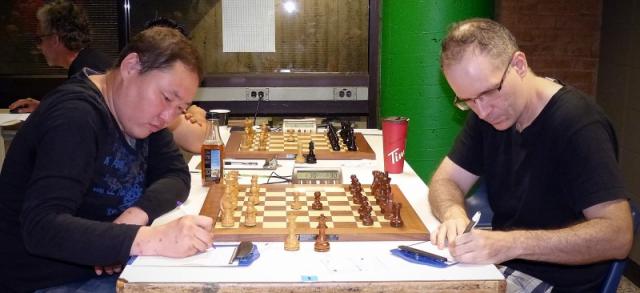
GM Alexandre Le Siège won the 2016 Championnat Ouvert du Québec (23-29 juillet) in Montreal. He won his first seven games -- including wins over GM Bator Sambuev in round 5 and GM Thomas Roussel-Roozmon in round 6 -- before clinching with a draw against Steve Bolduc in the final round. Sambuev was clear second with 7/8, followed by Roussel-Roozmon and Bolduc with 6/8.
The Newsfeed is happy to welcome GM Alexandre Le Siège, who annotates his round 5 win over GM Sambuev.
.
() - ()
Round: Result:
Round: Result:
[Event "COQ 2016"]
[Site "?"]
[Date "2016.07.26"]
[Round "5"]
[White "Sambuev, Bator"]
[Black "Le Siège, Alexandre"]
[Result "0-1"]
[ECO "C54"]
[WhiteElo "2536"]
[BlackElo "2497"]
[Annotator "Alexandre Le Siège"]
[PlyCount "80"]
[EventDate "2016.??.??"]
[SourceDate "2016.08.08"]

{Bator Sambuev has an uncompromising style. He calculated variations well and
always plays for the win. When you play someone like him, you have to remain
calm and alert because he's going to force you to find good defensive moves.
This game is no exception with Bator going early for a somewhat dangerous but
speculative attack. Our personal score up to this game was 2-0 for him, so I
was hoping to put up a good fight and stop the slippery slope. At that point
in the tournament we both had 4 out of 4 so this was a very important game for
the final result.} 1. e4 (1. d4 d5 2. Nf3 Nf6 3. e3 {From time to time, Bator
also likes to play his pet system: the Colle.}) 1... e5 2. Nf3 Nc6 3. Bc4 {
First time we met Bator opted for:} (3. Bb5 a6 4. Bxc6 dxc6 5. Nc3 f6 6. d4
exd4 7. Nxd4 c5 8. Nde2 Qxd1+ 9. Nxd1 Be6 10. Bf4 O-O-O 11. Ne3 Ne7 12. h4 {
going straight to a typical exchange Ruy-Lopez endgame that theory doesn't
consider very dangerous: Sambuev,B (2554)-Lesiege,A (2542) Varennes, 2015 (1-0,
39).}) 3... Bc5 (3... Nf6 4. Ng5 d5 {is an old line that is still debated at
the top level.}) 4. c3 Nf6 5. d3 (5. d4 $5 exd4 6. cxd4 Bb4+ 7. Nc3 Nxe4 8. O-O
{This old gambit brought many quick White victories after:} Nxc3 $6 9. bxc3
Bxc3 $2 10. Ba3 $1 d5 11. Bb5 Bxa1 12. Re1+ Be6 13. Qc2 $18 {Nowadays 8...
Bxc3! has taken much of the strain out of this early assault.}) 5... O-O {
There are basically two ways to play this position for Black. Either with a
quick ...0-0, which gives Black the extra option of a quick ...d5; or by
delaying castling by playing ...d6, ...a6, ...Ba7. This second method is more
prophylactic in nature, preventing ideas based on d4 and b4. Also, by delaying
castling Black never has to fear the annoying pin Bg5 because he can simply
push ...h6 and ...g5 with impunity.} 6. Bg5 {With 6.Bg5 my opponent wants to
give an independent twist to the position, even though the move has been
played frequently.} (6. O-O d5 $5 {is an ambitious option played by the likes
of Aronian.}) ({Just yesterday (Aug. 7) at the 2016 Sinquefield Cup, an
interesting struggle developed after Aronian tried another option against
Wesley So:} 6. O-O h6 7. d4 Bb6 8. dxe5 Nxe4 9. Bd5 Nxf2 $1 $13 {So-Aronian,
St.Louis 2016 (1/2-1/2, 29).}) 6... h6 {It's useful to force the white bishop
to commit.} 7. Bh4 Be7 (7... d6 {Tolerating the pin is quite OK and was played
for instance, recently by the strong Grandmaster Pavel Eljanov. At some point
in the future, Black intends to play ...g5, ...g4 and ...Nh5. On the other
hand, the possible sacrifices on g5 are quite scary at every junction and I
don't have that 2700 level of preparation yet to know the right moment to push
...g5. Even the computers get confused and it requires very deep analysis of
many complicated line to play this way confidently. 7...Be7 is a simpler
option that is quite sound. Even though I am losing a tempo, the possibility
to exchange the dark-square bishop allows me to free my position.}) 8. Nbd2 {
A flexible move that keeps both castling options available.} d6 9. Bb3 Kh8 (
9... Nh5 10. Bxe7 Qxe7 {with a balanced position is more principled, but there
is nothing wrong with my king move that prepares an eventual ...f5.}) (9... Na5
10. Bc2 c5 {leads to some hybrid d3 Ruy-Lopez.}) 10. Qe2 {This looks a little
artificial.} (10. O-O) 10... a5 {At this point, I was pretty sure Bator was
going to long castle, and ...a5 prepares counterplay on that sector of the
board.} 11. a4 {Of course this natural move prevents Black from gaining space.
But now 0-0-0 has became more risky in view of ...b5.} Qe8 12. Bxf6 Bxf6 13.
Rg1 $5 {Typical Bator: he rejects the equilibrium offered by the normal 13.0-0
and is instead planning to mate my king! This plan is reminiscent of some
modern lines in the anti-Berlin, where white plays Bxc6, d3, Qe2, g4. The
motivation in such a direct attack lies in the position of my h-pawn. It
offers a clear way for White to open my king side with g4-g5. If the pawn was
on its original square such an attack would be ill advised. Objectively, up to
this point, Black hasn't made any serious mistake and should feel confident to
beat off the attack. In practice, White's position is much easier to play.} Nd8
$5 {it makes sense to reroute the knight to the king side. The idea is simply .
..Ne6-f4. The only downside of this move is the possible exchange on e6.
Another safer route was possible with:} (13... Ne7 {but I rejected it because
after} 14. h4 $1 Ng6 15. g3 {my knight is paralysed while White can still
improve his position with Nf1-e3 or squeeze with h5 and g4.}) 14. Nf1 $2 {
too slow. This will be a recurrent theme in Bator's mistakes in this game: he
tries to maximise his advantage instead of simply taking what's offered in the
position. Such a strategy is prone to backfire against correct play, but on
the other hand it puts you in some kind of urgency to refute your opponent's
optimism before he controls the whole board. Here, Bator wants to improve his
knight's position before launching the pawn avalanche. Nevertheless:} (14. g4
$1 {was the way to go. Black has two completely different ways to react to
this advance.} Ne6 (14... g6 $5 15. h4 Bg7 16. h5 g5 {with a complicated
struggle ahead.}) 15. Bxe6 Bxe6 16. g5 hxg5 17. Nxg5 Bxg5 18. Rxg5 f6 19. Rg2
g5 $1 {planning ...Rf7-h7; White has to play precisely to secure the draw.} 20.
O-O-O Rf7 21. h4 gxh4 22. f4 $1 Rh7 23. f5 Bf7 24. Qf2 Qxa4 25. Rh2 $11 {
and Black has nothing better than perpetual check.}) 14... b5 15. Ne3 Ne6 16.
Bxe6 {The knight can't be allowed to reach f4.} Bxe6 17. g4 g6 {not the most
precise, I should simply ignore whites treats and play:} (17... bxa4 $1 18. g5
(18. h4 Be7 19. g5 f5 $1 $17) 18... hxg5 19. Nxg5 Bxg5 20. Rxg5 g6 $17 {
and White's position looks more menacing than it really is.}) 18. g5 Bg7 19.
gxh6 Bxh6 20. h4 bxa4 21. h5 g5 $2 {Too frisky. This move is an enormous
positional concession to safeguard my king. A simple calculation reveals that
the attack is not dangerous:} (21... Rb8 $1 22. Nh4 Rg8 $17 {Black is clearly
better, but in practice its scary to let white open the h-file, you don't have
the reassuring evaluation of the computer that is telling you that everything
is going to be OK. Still, a grave misjudgment from my part, because with the
white king stuck in the center I should have been confident in my defensive
and counter-attacking chances.}) 22. Nh2 (22. Nxg5 $2 {going after the
material makes no sense because after} Rg8 23. Nf3 Rxg1+ 24. Nxg1 {my black
bishop is back to life while White lost one of his main attacking piece.})
22... f6 $1 {At least my king side is super solid now.} 23. Nhf1 $2 {Once
again Bator is not satisfied with what the position offered after 23.Nhg4. He
wants the complete domination of the f5 square. This is way too optimistic
with his queenside about to fall apart.} Qb5 24. f3 {A subtle move to defend
b2 with Rg2.} Rab8 25. Rg2 Rb7 $2 {What do you know? The simple plan of
tripling on the b-file doesn't get computer's approval! But in a way this
turned out to be a great practical mistake versus Bator's plan of Ng3-f5.
The essence of the position is that White needs to tie up some of my pieces
with Ng4 as soon as possible. That's why 23.Nhf1 wasn't best and why the
computer is now suggesting:} (25... f5 $1 26. exf5 Bxf5 27. Nxf5 Rxf5 $17) 26.
Ng3 $2 {This allows my bishop to drop back on the perfect f8 square.} (26. Ng4
$1) 26... Rfb8 27. Ngf5 Bf8 $17 {Black is close to winning. Any positional
advantage gained on the kingside doesn't mean much with White's king stuck in
the center.} 28. Qd1 $6 {The human move.} Bb3 $6 {There is no need to block
the b-file. 28...Bd7 keeping an eye on a4 and f5 was more principled. I was
under the false impression that White had to repeat the position, allowing me
to gain some time on the clock. Nevertheless the counter-intuitive:} (28... a3
$1 {was even stronger.} 29. bxa3 d5 $19 {white got rid of his weak b-pawn, but
also lost his counterplay on the a-file. The material is not so important in
this kind of position, the initiative is.}) 29. Qc1 $1 Qxd3 $1 {Brave and
correct.} 30. Rd2 {Bator had a very good practical chance to complicate the
game} (30. c4 $5 d5 $8 31. cxd5 {Forcing me to find an incredible move -- with
little time -- to keep a decisive advantage.} g4 $3 {a brilliant diversion out
of the blue. All three recaptures come with shortcomings:} 32. Rxg4 $1 (32.
Nxg4 $2 Qxf3 $19) (32. fxg4 $2 Qxe4 $19) 32... Bxd5 $1 33. Qd1 (33. exd5 $2
Rxb2 $19) (33. Nxd5 $2 Rxb2 $19) 33... Qxd1+ 34. Nxd1 Bf7 35. Rxa4 Rd8 $19 {
the white king is still under enormous pressure.}) 30... Qa6 31. c4 $2 {
A bad move in a difficult position.} Rb4 32. Rg2 Bxc4 33. Ng4 d5 34. Nxe5 {
Bator goes all in, the best practical decision as we were getting low on time.}
fxe5 35. Qxg5 dxe4 {covers g8} 36. Rd1 Qe6 {Prevents Rd8 or Rd6.} 37. Ng7 (37.
Nh4 Kh7 $19) (37. Rd8 Rxd8 38. Qxd8 Qxf5 $19) 37... Qb6 {Repositioning my
queen on a more dangerous diagonal. The unusual ...Qg8 was equally strong.} 38.
Nf5 Rb3 $4 {We were both on our 30 seconds increment and probably too focused
only on Rd8, so we both missed the interception Rd6!} (38... exf3 $1 39. Rd8 (
39. Rd6 Qxd6 40. Nxd6 fxg2 $19) 39... Rxd8 40. Qxd8 Bg8 $1 {I overlooked this
move} 41. Qxf8 Re4+ $19) 39. Rd8 $4 (39. Rd6 $1 {saves the day} Qb4+ 40. Kd1
Rd3+ 41. Rxd3 Bb3+ $8 42. Rxb3 Qxb3+ 43. Kc1 Qf7 44. fxe4 a3 45. Kb1 a4 46. Qg6
$1 Qxg6 47. hxg6 Rxb2+ 48. Rxb2 axb2 49. Kxb2 {despite the Black material
advantage the ending is drawn.}) 39... Rxd8 40. Qxd8 Re3+ {Mate follows
shortly.} 0-1
merida
46
.
photo by: John Upper
Category:
© 2013-20 CFC & McGill Students' Chess Club
Designed by Shao Hang He.