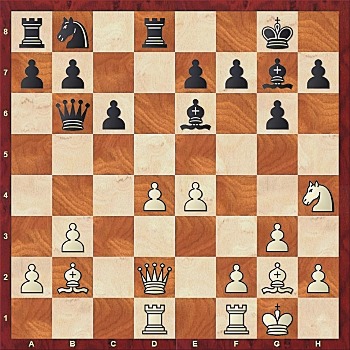
[Event "Maritime Open"]
[Site "?"]
[Date "2016.08.01"]
[Round "4"]
[White "Bleau, John"]
[Black "Hamilton, Robert"]
[Result "0-1"]
[ECO "E62"]
[WhiteElo "1938"]
[BlackElo "2232"]
[Annotator "Upper,John"]
[PlyCount "44"]

1. d4 Nf6 2. Nf3 g6 3. g3 Bg7 4. Bg2 O-O 5. O-O d6 6. c4 c6 7. Nc3 Bf5 {
Botvinnik writes:  "More common is ...Qa5 or ...a6, immediately preparing the
counterblow ...b7-b5. Continuations such as that chosen by Black in the game
have only one point: the opponent may turn out to be insufficiently prepared
for them. Since White should not allow the knight jump ...Nf6-e4, and the
moves 8.Nd2 or 8.Ne1 have a less forcing character, White's next move is
fairly obvious."   Botvinnik-Smyslov (New in Chess, 2009).} 8. Nh4 {Since
Botvinnik wrote that in the late 1950s, top GMs have tried less obvious moves:}
(8. b3 $5 Ne4 9. Bb2 Nxc3 10. Bxc3 Be4 11. Rc1 Nd7 12. e3 e6 13. Qe2 d5 14. Bh3
Bxf3 15. Qxf3 {and White has the Bishop pair, but Black is as solid as a rock;
Matlakov,M (2693)-Berkes,F (2636) Gjakova, 2016 (½-½, 40).}) (8. Qb3 $5 Qb6 (
8... Qc8 9. Re1 Ne4 $2 10. Nh4 $1 {(1-0, 29) Fressinet,L (2718)-Czebe,A (2479)
Bastia, 2010.}) 9. Re1 Na6 (9... Ne4 $2 10. Nh4 $1) 10. h3 Qxb3 11. axb3 Nb4
12. Ra4 a5 13. e4 $13 {½-½ (106) Jumabayev,R (2618)-Utegaliev,A (2485)
Almaty, 2016.}) 8... Be6 (8... Bd7 9. e4 e5 10. d5 cxd5 11. Nxd5 Nxd5 12. Qxd5
Bc6 13. Qd2 Bf6 14. Rd1 $1 {A funny mirror of the Spassky-Fischer game where
Fischer let Spassky mangle his kingside with BxNh5, and went on to score his
first win.} Nd7 15. Qxd6 Bxh4 16. gxh4 Qxh4 17. Rd3 a5 (17... Rfd8 $1 18. Rh3
Nb6 $17) 18. Rg3 Qf6 $13 {Sloth,J (2380)-Spassky,B (2605) Denmark, 1983 (0-1,
50).}) 9. b3 (9. d5 cxd5 10. cxd5 Bd7 11. Be3 Na6 12. Bd4 Qa5 (12... Nc7 $5 13.
a4 (13. e4 b5 $1) 13... e5 14. dxe6 Nxe6 15. Nf3 Bc6 16. h3 Re8 17. e3 Qd7 18.
Kh2 b6 19. b4 Rac8 20. Rc1 {½-½ Dautov,R (2601)-Baklan,V (2636) Magdeburg,
2014.}) 13. Re1 Nc5 14. e4 Na4 15. Nxa4 Qxa4 16. b3 Qa3 17. f4 $14 {Botvinnik,
M-Smyslov,V WCh g9, Moscow, 1957 (½-½, 40).}) 9... d5 10. cxd5 Nxd5 (10...
cxd5 {is not the way a higher-rated player can create winning chances needed
in a weekend Swiss.}) 11. Nxd5 Bxd5 12. e4 Be6 13. Bb2 {Natural, but maybe not
best.} (13. Be3 $1 c5 $6 {would be the move that might scare someone from
playing Be3, but White can keep an edge with dynamic play:} 14. d5 $1 (14. e5
cxd4 $1 15. Bxb7 $6 dxe3 16. Qxd8 Rxd8 17. Bxa8 Nd7 18. Be4 Bxe5 $15) 14...
Bxa1 15. Qxa1 Bg4 16. Bh6 $16 {White gets the exchange back with more space
and a lead in development and few good squares for Black's minors.}) 13... Qb6
(13... Qd6 14. Qd2 Rd8 15. Rad1 Bg4 16. f3 Be6 17. Rf2 (17. Bc3 Bxd4+ 18. Qxd4)
) (13... c5 14. e5 Bd5 15. dxc5 Bxg2 16. Nxg2 Qc7 17. Rc1 Bxe5 18. Bxe5 Qxe5
19. Re1 {with a nice development advantage and queenside majority for White.})
14. Qd2 Rd8 15. Rad1 {White is definitely a little better, with the extra
space provided by his nice center. But Black is solid, with no particular
weaknesses.} Bg4 $1 {Probing, and giving White a difficult choice between very
different middlegames.} (15... Bxd4 $2 {is a recurring motif, but is too early
here:} 16. Bxd4 c5 17. Bxc5 Rxd2 18. Bxb6 Rxd1 19. Rxd1 axb6 20. Rd8+ Kg7 {
and Black's R and N can't get out, though it's worth working out the whole
line after 21.Nf3 Rxa2.}) 16. f3 (16. Nf3 e5 $5 {Not Black's only move, but
good and complicated.} 17. d5 cxd5 18. exd5 e4 19. Ne5 $1 (19. Bxg7 exf3 $2 (
19... Kxg7 $1 $15) 20. Bd4 fxg2 21. Bxb6 gxf1=Q+ 22. Rxf1 axb6 23. Qg5 $18 {
the fork wins a piece and the game.}) 19... Bxd1 20. Rxd1 $13 {with a
complicated mess that computers evaluate as 0.00}) 16... Be6 17. Bc3 (17. Qf2 {
breaks both the diagonal the file pins on the d4-pawn and threatens f3-f4-f5
now that ...Bg4 can be met by Rd2.} Qa5 {requires a bold response from White:}
18. d5 (18. Ba1 g5 $1) 18... cxd5 19. Bxg7 Kxg7 20. f4 $1 dxe4 21. b4 $1 Qc7
22. f5 $1 {with a strong initiative for White.}) (17. f4 {threatens f4-f5, but
after} Bg4 18. Bf3 $1 (18. Nf3 Bxd4+ 19. Bxd4 c5 20. Bxc5 Qxc5+ 21. Qf2 Qxf2+
22. Kxf2 Nc6 {White still has more space, but with so few pieces it's no
advantage.}) 18... Bh3 19. Rf2 $1 (19. Bg2 Bg4 20. Bf3 $11 {shows how hard it
can be to play for a win as Black.}) 19... Bxd4 20. Bxd4 c5 21. Bxc5 Rxd2 22.
Bxb6 Rxd1+ 23. Bxd1 axb6 24. Rd2 $14 {White has better development and
structure.}) 17... a5 $1 {Activating the Ra8 without developing the N. Note
that ...Nd7 not only releases pressure on d4, it gets skewered by Ba5.} (17...
Bxd4+ {is possible, but simplifies to equality after:} 18. Bxd4 (18. Kh1 Rd7 $1
$13 {defending the R and side-stepping the skewer on Ba5.}) 18... c5 19. Bxc5
Qxc5+ 20. Qf2 $11) 18. Kh1 (18. f4 Bg4 19. Nf3 Bxd4+ 20. Bxd4 c5 21. Bxc5 Qxc5+
22. Qf2 Qxf2+ 23. Kxf2 Nc6 $11) 18... a4 $40 {Suddenly White's position is
creaking, with weak pawns on d4 and b3.} 19. b4 $2 {Compare the activity of
the Bishops.} (19. f4 $142 axb3 20. axb3 (20. f5 $2 Bc4 $19) 20... Qxb3 (20...
Bxb3 $6 21. Rb1) 21. Rb1 $11) 19... Na6 $1 (19... Bc4 $1 {is also strong.} 20.
Rfe1 e5 $1 $17) (19... a3 {mechanically isolating the b4-pawn is reasonable,
but not as strong as the game line.}) 20. Qb2 (20. a3 Bb3 {and Black wins the
exchange or the d4-pawn.}) 20... Nc7 $1 $19 21. Rd2 (21. a3 Nb5 {and White can
resign.}) 21... Nb5 {Attacks the d4-pawn and pins it to the Bc3.} 22. Rfd1 Bxa2
$1 {wins a pawn and renews the threat of ...Bb3.} 0-1