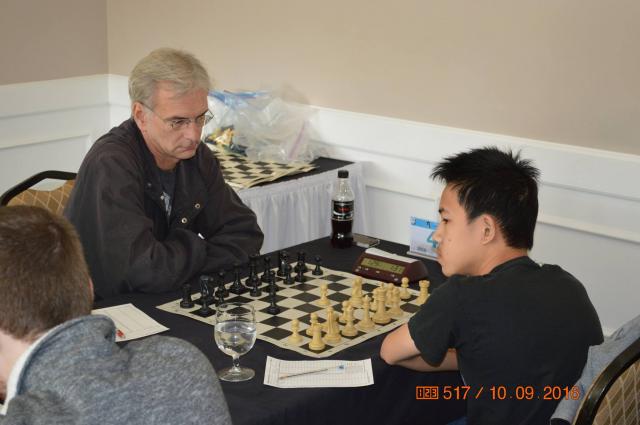
The top performer at this year's Battle of Alberta, held annually in Red Deer, was the South's board 4 player, NM Diwen Shi, with a score of 2-0 against his higher-rated opponent from the North of the province, Jeff Reeve. Diwen's first-round win with the White pieces was out of the ordinary due to an enterprising (and somewhat unsound - but I'll let you see for yourself!) Bishop sac on the twelfth move. Eventually, an equal ending was reached, but a mistake late in the game by his experienced opponent led to the 1-0 score. For those interested, the North won the title for the third consecutive year. Results at: http://www.albertachess.org/2016BOA.html
[Event "2016 Battle of Alberta "]
[Site "Red Deer"]
[Date "2016.09.10"]
[Round "1.4"]
[White "Shi, Diwen"]
[Black "Reeve, Jeff"]
[Result "1-0"]
[ECO "B67"]
[WhiteElo "2259"]
[BlackElo "2329"]
[PlyCount "101"]
[EventDate "2016.09.10"]
[EventRounds "2"]
[EventCountry "CAN"]
[WhiteTeam "South"]
[BlackTeam "North"]

1. e4 c5 2. Nf3 d6 3. d4 cxd4 4. Nxd4 Nf6 5. Nc3 Nc6 6. Bg5 e6 7. Qd2 a6 8.
O-O-O Bd7 9. f4 {Main line Classical Sicilian. The database tells me this
opening hit its peak in popularity in the mid-to-late 70s.} b5 {The most
common (and it should be noted that Black scores excellently) - other major
variations include:} (9... Be7 10. Nf3 b5 11. Bxf6 gxf6 12. Kb1 Qb6 13. f5) (
9... h6 10. Bh4 g5 $5 11. fxg5 Ng4) 10. a3 {Scoring only 47% and not the most
common. GM Ftacnik wrote that the advance of this pawn has "the flair of
intentional provocation". White gets a small edge after:} (10. Bxf6 gxf6 11.
Kb1 Qb6 12. Nxc6 Bxc6 13. Qe1 (13. f5 {the thematic idea in this opening}) (13.
Bd3)) 10... Qb6 11. Bxf6 (11. e5 $5 h6 (11... dxe5 12. Nf3 $16 {puts some
pretty serious pressure on Black} Nd5 13. Nxe5 Nxe5 14. Nxd5 Qb7 15. fxe5 exd5
16. Qxd5 Qxd5 17. Rxd5 Bc6 18. Rd3 Rc8 19. Be2 {1-0 (54) Brkic,A (2541)
-Jankovic,A (2533) Kutina 2006}) (11... Qxd4 12. Qe1 Qa7 13. exf6 g6 14. Nd5
Kd8 15. Ne7 $13) 12. Bxf6 Qxd4 13. Qxd4 Nxd4 14. Rxd4 gxf6 $11) 11... gxf6 12.
Bxb5 $6 $146 {A crazy sacrifice - let's see how it plays out} axb5 13. Ndxb5
Na5 $6 {This doesn't appear to be the best way to handle White's speculative
sacrifice, but Black should still be doing quite well here} (13... O-O-O $15) (
{After analyzing the position with the computer, it appears Black is almost
winning after} 13... Rb8 $1 {with a serious threat of ...Na7} 14. b3 $8 (14.
Qe2 Na7 $19) 14... d5 $5 15. exd5 Na7 {taking advantage of the weak pawn on a3}
16. dxe6 Bxb5 17. Nxb5 Qxb5 18. exf7+ Kxf7 19. Qd7+ Be7 20. Qxa7 Rb7 21. a4 (
21. Qe3 Bxa3+ 22. Kb1 Ra8 $17) (21. Qd4 Bxa3+ 22. Kb1 Ra8 $17) 21... Qc6 22.
Qe3 Rc8 $17) 14. Nxd6+ Qxd6 15. Qxd6 Bxd6 16. Rxd6 Ke7 (16... Nb7 {This move
comes up a few times over the next several move} 17. Rd4 Ke7 $15) 17. Rhd1 Rhd8
18. R6d4 Bc6 $6 {Black relinquishes his advantage here. With the rooks on, it
is tougher for White to effectively use his pawn advantage, as he needs to be
cautious in pushing them up the board. Now, White can simplify and end up in
an equal ending where realistically he's the only one with winning chances.} (
18... Rac8 19. R1d3 Nc6 20. Ra4 h5) (18... Nb7) 19. b3 $6 (19. Rxd8 Rxd8 20.
Rxd8 Kxd8 21. b3 $11) 19... Rxd4 20. Rxd4 Rd8 $6 {I don't really understand
this move unless Black thought the game would soon end in a draw. He has a
much easier time preventing White's pawns from advancing with the Rooks on the
board} (20... Nb7 $15 {getting the Knight to d6 should help Black keep White's
pawns at bay}) 21. Rxd8 Kxd8 22. Kd2 Kc7 23. g4 {White can start to think
about playing for a win} Nb7 24. Kd3 Nd6 (24... e5 $11 {Stops White from
making real progress, as the e4 pawn will become a target. Here, the game
would be very close to a draw}) 25. b4 (25. a4 f5 26. exf5 exf5 27. g5) 25...
f5 (25... Nb5 26. Nxb5+ Bxb5+ 27. c4 Ba4 $11) 26. gxf5 (26. exf5 $1 exf5 27. g5
{White takes the advantage, as Black will need to keep a close eye on his
doubled f5 pawn}) 26... exf5 27. e5 Ne8 (27... Nb5 {After the exchange of
Knights, the Bishop will do a good job of protecting Black's remaining pawns})
28. Ne2 Ng7 29. Ng3 (29. c4 Ne6 30. Ke3 Ba4 31. Nc3 Bb3 32. Nd5+ Kb7 33. Kd3
$14) 29... Bf3 30. Ke3 Bg4 31. Ne2 Bxe2 32. Kxe2 {Now the game should
definitely end as a draw barring a major blunder} Ne6 33. Ke3 Nf8 34. c4 Nd7
35. Kd4 Nf8 36. Ke3 Kc6 37. a4 Ne6 38. a5 Nc7 39. Kd4 Ne6+ 40. Ke3 Nc7 41. Kf3
Ne6 42. Kg3 h6 43. a6 Kb6 44. b5 {Both players have made sensible moves for
the last dozen moves or so, and the position is still completely equal} Kc5 $4
{We all make mistakes like this once in a while - I'm sure Jeff Reeve would
like that one back. The game ended after} (44... Ka7 45. h3 Kb6 46. Kf3 Ka7 47.
Ke3 Kb6 48. Kf3 Ka7 {and it's clear White can't make progress}) 45. Kh4 {Now
it's all over. The point is Black can't take on f4 due to the passed a-pawn}
Kb6 46. Kh5 Nxf4+ 47. Kxh6 Ne6 48. Kh5 Kc5 49. a7 Nc7 50. Kg5 Na8 51. h4 {The
game turned out to be a successful outing for 12.Bxb5, but I can't imagine
there will be too many followers. Diwen took a big risk, and it paid off!} 1-0