

You are here
GOTW: Cunningham - Oussedik, NC Open.

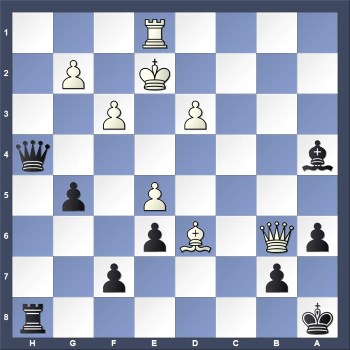
The Canadian Game of the Week comes from the North Carolina Open, where Elias Oussedik is working, and playing, and annotating.
It's opposite-coloured Bishops and opposite-side castling, so you know it's going to be all about the attack.
From the diagram it is Black to play. Solution at move 35.
Elias Oussedik annotates his round 4 game against Robin Cunningham.
..
() - ()
Round: Result:
Round: Result:
[Event "2016 NC Open"]
[Site "Board 2"]
[Date "2016.08.28"]
[Round "4"]
[White "Cunningham, Robin"]
[Black "Oussedik, Elias"]
[Result "1-0"]
[ECO "C11"]
[WhiteElo "2286"]
[BlackElo "2234"]
[Annotator "Elias Oussedik"]
[PlyCount "83"]
[EventDate "8.??.??"]

{This game was played in Greensboro, North Carolina. The tournament was held
in conjunction with the US Masters, a strong norm tournament. This year, there
were two Canadians playing, Raja Panjwani and myself. Raja was playing in the
US Masters (2200+ FIDE only) and I was playing in the NC Open. Even though I
was invited to play in the US Masters, the time commitment only allowed me to
partake in the NC Open. Being a five round tournament, there are no
opportunities for hickups. I was seeded #3 for this tournament. #1 was IM
Irine Sukandar from Indonesia and #2 was FM Robert Cunningham, a statistics
professor at UNC Chapel Hill.} 1. e4 {Robin is known as a positional e4 player.
He reminds me of Michael Adams. Robin was on 2.5/3 and so was I. IM Sukandar
was leading the tournament with 3/3. We were both playing for the win.} e6 2.
Nf3 {This move caught me by surprise. I was expecting my opponent to follow
Adam's repertoire a la Nd2.} (2. d4 d5 3. Nd2 $14 {The Tarrasch is a solid
positional approach vs the French. I've noticed many of England's top
Grandmasters prefer this setup as White.}) 2... d5 3. Nc3 {Sidelines! I am not
too familiar with this opening and hadn't looked at it recently. For a slight
second, I thought I was playing FM Hans Jung as he tends to play these kind of
openings albeit with 1.Nc3.} Nf6 {Timid! I should be challenging White and be
playing the critical 3...d4. However, I wasn't too familiar with the ensuing
positions so decided to play it safe.} (3... d4 4. Ne2 c5 5. c3 Nf6 $1 {
This is a critical move that Berg in his Grandmaster Repertoire series
advocates. Black sacks the d4 pawn for great compensation.} 6. cxd4 cxd4 7.
Nexd4 Nxe4 8. Nxe6 {The point!} Bxe6 9. Qa4+ Nc6 10. Qxe4 Qd5 $1 {Berg's
suggestion.}) 4. e5 Nfd7 5. d4 c5 6. dxc5 Nc6 7. Bf4 Bxc5 8. Bd3 {We have now
transposed to a sideline of the 3.Nc3 French. This position can be very tricky
to play for Black. Ian Nepomniachtchi is a practicioner of this line.} a6 {
This is a sideline I like. The main move is ...f6, but I didn't want to enter
my opponent's theory.} (8... f6 9. exf6 Nxf6 10. Qe2 O-O 11. O-O-O a6 12. Ne5
$14 {This position is known to be quite good for White. He usually continues
with g4 and mounts a Kingside attack.}) 9. Qe2 h6 {The idea of the moves ...a6
and ...h6 are to continue with ...g5 and ...b5. I don't know where White
intends to castle, so I don't hurry with a move like ...b5 yet. I first want
to see where White intends to put his king.} 10. h4 {Preventing ...g5 - a
typical move in these structures. If Black can play ...g5, he can sometimes
play ...g4 and remove a defender of the e5-pawn.} Nd4 {A strong thematic move.
The move Nd4 has the same effect as the move "Nh4" in the advanced French.
Black is happy to exchange the f3-knight, the defender of the e5 pawn.} 11.
Nxd4 Bxd4 12. Kf1 Qc7 {Putting pressure on e5 and c3.} 13. Re1 Bxc3 $6 {
A dubious decision, giving up the key dark squared bishop. However, as
mentioned earlier, I felt this was a must win game so I was eager to create
some imbalances. The conservative approach would have me continue 13...b5.} (
13... b5 14. Rh3 Kf8 15. Kg1 Bb7 $13) 14. bxc3 Nc5 {I need to exchange White's
bishop, if not, I might be in big trouble. I plan here to develop my pieces as
fast as possible and long castle.} (14... Qxc3 $2 15. Qg4 Kf8 16. Rh3 $16 {
For the pawn, White has tremendous kingside pressure.}) 15. Qg4 {Surprinsingly
enough, White offered me a draw here. He told me after the game he felt as if
he was a little worst. I would consider this position dynamically equal.} Nxd3
{The point of this move is to remove White's powerful light squared bishop.
Thing could get murky if White were able to swing his rook to h3-g3 and have
the light squared bishop help him mount a kingside attack.} 16. cxd3 (16. Qxg7
Nxf4 17. Qxh8+ Kd7 18. Qxh6 Qc4+ 19. Kg1 Ne2+ 20. Kh2 Kc7 $17) 16... g6 $5 {
In hindsight, such a move might be a mistake and ...Rg8 might be better. g6
weakens my dark squares. However, by playing ...g6 myself, I prevent White
from playing h5 and fixing my g7 weakness.} (16... Qxc3 $2 17. Qxg7 Qxd3+ 18.
Kg1 Qh7 19. Qf6 $16) (16... Rg8 17. Bxh6 Qxc3 $13 {Double-edged - with bishops
of opposite color, the position is unclear.}) 17. Bd2 Bd7 {My idea is to long
castle as Black and then try to control the c-file or break with ...g5.} 18.
Qf4 Bb5 19. Rh3 O-O-O 20. Rc1 Qe7 {A one-threat move in a way. I want to bring
my queen to a3. If my queen can get to a3, it might hinder White's queenside
attack that starts with a4.} (20... g5 $6 21. Qe3 g4 22. Rg3 h5 $14 {This was
another possible variation. However, Black's pwan structure becomes static.})
21. c4 dxc4 22. a4 Bc6 (22... Bxa4 $2 23. Bb4 Qd7 (23... Qxb4 24. Rxc4+ Qxc4
25. Qxc4+ Bc6 {As Black, I might be able to hold this, but it's uncomfortable.}
) 24. Bd6 $16) 23. Rxc4 Kb8 (23... Qa3 $2 24. Qxf7 Rxd3 25. Qxe6+ Kb8 $16) 24.
Bb4 Qd7 25. Bd6+ Ka8 {A critical position to understand and quite a complex
one. White has a powerful bishop on d6 which is restricting Black's pieces.
However, Black has a nice bishop himself on c6. The a4 pawn will always be a
weakness for White, while the f7 pawn is a weakness for Black. Black's
queenside pawn majority is also something to look out for. Overall, this is a
dynamically equal position with chances for both sides. The perfect position
one wants when they are playing for a win with either side.} 26. Re3 {White is
trying to activate his rook and bring it to c1 or b1.} Rc8 {I was getting low
on time here. I had about 15 minutes while my opponent had 30 minutes. The
time control also included a 5 second delay. These American tournaments are
quite interesting considering they prefer a delay rather than an increment.} (
26... g5 $5 27. Qd4 (27. Qg4 f5) (27. Qg3 f5) 27... Bd5 28. Rc7 (28. Rc2 Rc8)
28... Qxc7 29. Bxc7 Bxg2+ 30. Kxg2 Rxd4) 27. Re1 g5 {And so I try to break!}
28. Qe3 (28. hxg5 hxg5 29. Qxg5 Rcg8 30. Qe7 Bxa4 $11 {This position is
probably equal.}) 28... Bxa4 {After taking the a4-pawn, I knew there would be
a decisive result - no draws. Either Black would win with his passed pawns, or
White would be able to breakthrough and checkmate me with his rooks and bishop.
As Black, I was ready for a fight!} 29. hxg5 hxg5 30. Rxc8+ Qxc8 $6 {The start
of a risky plan. I had ideas of swinging my Queen over and checkmating the
White king. I was vacationing in fantasy land. With White's dark squared
bishop, he has his own threats too! The conservative 30...Rxc8 would have been
the better approach.} (30... Rxc8 31. Qxg5 Qb5 32. Qd2 Bc2 33. Re3 $17 {
Black has tremendous winning chances here thanks to his connected passed pawns
on the queenside.}) 31. Kg1 Qg8 $2 {Terrible plan! Albeit not losing, Black
shouldn't be leaving his queenside bare.} 32. Qb6 $1 {We each had around five
minutes left with a 5 second delay. Kudos to my opponent for finding the most
critical moves.} Qh7 $2 (32... Qd8 $1 {The only move that gives me a chance to
keep on fighting.}) 33. f3 Qh2+ 34. Kf2 Qh4+ 35. Ke2 Qg3 $2 (35... g4 {only
move that saves the day!} 36. Bc5 gxf3+ 37. Kd2 (37. Kxf3 Bc6+ 38. Ke2 Kb8 39.
Bd6+ Ka8 40. Bc5 $11) 37... Kb8 $1 38. Qa7+ Kc8 39. Bd6 Bc6 {If White isn't
careful he might get into some trouble himself.} 40. Rb1 (40. Qb8+ $2 Kd7 41.
Qc7+ Ke8 42. Qc8+ Qd8 43. Qxd8+ Kxd8 44. gxf3 Bxf3 $17) 40... fxg2 41. Qb8+ Kd7
42. Rxb7+ Bxb7 43. Qxb7+ Kd8 44. Qb8+ Kd7 45. Qb7+ $11) (35... Rc8 36. Bc5 Rxc5
37. Qxc5 g4 {I had this option to sacrifice the exchange, and it was probably
something I should have done. However, I decided to gamble with 35...Qg3
hoping it would lead to something. I call this HopeChess - not recommended at
any age.}) 36. Bc5 $18 Qxe5+ 37. Kf2 Qb8 {For a split second I though I was in
time to play Rc8 and Rc6...} 38. Ra1 $3 {Only move and a crushing blow.} Bb5 (
38... Rh4 {Doesn't change anything.} 39. d4 $18) (38... Bc6 39. Rxa6+ $18) 39.
Qxb5 Qc8 40. Qb6 Kb8 41. Rxa6 Rd8 42. Ra8+ {Kudos to Robin - he played a nice
game. I learned a lot from this game. With bishops of opposite color, don't
keep your king naked! I ended up finishing the tournament with 3.5/5 which was
good enough for =7th and some Benjamins. IM Irine for Indonesia lived up to
expectations and captured clear first with a fantastic 5/5.} 1-0
merida
46
..
Category:
© 2013-20 CFC & McGill Students' Chess Club
Designed by Shao Hang He.