

You are here
GOTW: Le Siège - Massé, Varennes 2016

GM Alexandre Le Siège continues to improve in his comeback from a 10-year absence from tournament chess. His results in 2015 were shakey, but his 2016 results show him finding the form that made him a dangerous and respected GrandMaster.
Our Canadian Game of the Week is Alexandre Le Siège's annotations to his win over Hugues Massé at October's Varennes Open, which Alexandre won with 4.5/5.
When I saw this game, I complemented Alexandre on his "Ulf Andersson-like" technique. He disagreed, saying his play was far from the near-perfect technical play of the Swedish GM. I thought he was just being humble, but now that I've read his annotations I see what he means... and I see why he keeps getting better.
This game and notes give two excellent chess lessons. One is in how to press to convert a small advantage in a simplified position. The second is as an example of how an experienced GM analyzes his own games to continue to improve his technique.
..
() - ()
Round: Result:
Round: Result:
[Event "Varennes 2016"]
[Site "?"]
[Date "2016.10.08"]
[Round "3"]
[White "Le Siège, Alexandre"]
[Black "Massé, Hugues"]
[Result "1-0"]
[ECO "D41"]
[WhiteElo "2559"]
[BlackElo "2280"]
[Annotator "Alexandre Le Siège"]
[PlyCount "109"]
[EventDate "2016.??.??"]
[EventType "swiss"]
[EventRounds "5"]
[EventCountry "CAN"]

{Last time we played - a long time ago - Hugues played a Grunfeld. I didn't
feel like playing against it, hence my opening choice. I've been playing 1.Nf3
on a regular basis lately, but I feel I should switch back to 1.d4 as my main
weapon as it generally gives rise to more complicated positions. I also plan
to add 1.e4 to my repertoire in 2017, but there is an insane amount of theory
to learn. It's great to have many options in your toolbox to face a different
opponent or different tournament situation. Some players, for example, are
extremely hard to beat with 1.d4, but are a little more shaky against 1.e4} 1.
Nf3 Nf6 2. c4 c5 3. Nc3 ({Against Daniel Trahan in the 2016 Quebec Open I chose
} 3. g3 Nc6 4. d4 cxd4 5. Nxd4 Qb6 $1 6. Nb3 Ne5 7. c5 Qc6 {and ended up in a
difficult position after only 7 moves! You can see the full analysis of this
game in the current issue of Échec+ if you're interested.}) 3... Nc6 4. g3 (4.
d4 cxd4 5. Nxd4 e6 {leads to the most important tabyia of the symmetrical
English. White has been having problems proving any sort of opening advantage
after either 6.g3, 6.a3 or 6.Ndb5.}) 4... d5 5. d4 (5. cxd5 Nxd5 6. Bg2 {
brings the reverse Maroczy bind.}) 5... e6 (5... dxc4 $6 6. d5 Nb4 7. e4 Bg4 8.
Bxc4 Bxf3 9. Qxf3 Nc2+ 10. Kf1 {is a dubious variation seen in my game Ftacnik
vs Le Siège, Montréal 2002. The funny thing is, I did prepare for this game
planning to take the rook, but at the board decided to finally play 10... Nd4.
This was clearly a case of irrational preparation since this line is supposed
to be bad for Black.}) 6. cxd5 (6. Bg2 $6 dxc4 $1 {with a Catalan-like
position where White usually has castled instead of having his knight on c3.})
6... Nxd5 7. Bg2 cxd4 8. Nxd4 Nxc3 {Black has to release the tension in the
center because} (8... Bb4 $2 9. O-O $1 Nxc3 10. bxc3 Bxc3 11. Nxc6 Qxd1 12.
Rxd1 Bd7 13. Rb1 Bxc6 14. Ba3 $1 {is simply bad.}) 9. bxc3 Nxd4 10. Qxd4 Qxd4
11. cxd4 Bb4+ {This is the old main line. Nowadays, top players like Caruana
prefer to defend the slightly worse position that arrises after 11... Bd6. A
recent example is the game Kovalyov vs Nakamura from the 2016 Olympiad.} 12.
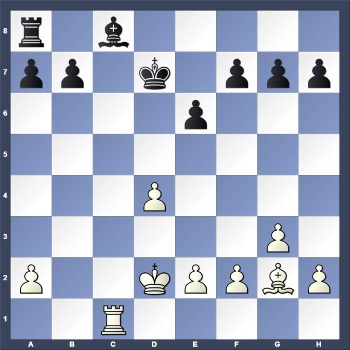
Bd2 Bxd2+ 13. Kxd2 Ke7 14. Rac1 Rd8 15. Rc7+ Rd7 16. Rhc1 Kd8 17. Rxd7+ Kxd7 {
This is the critical position to evaluate the validity of Black's whole
concept. There are about 30 games in Megabase 2016, many played by very strong
players from both colors. The only advantage White has is a slight lead in
development. Black threatens to play ...Rb8, ...b6 and ...Bb7 to completely
level the position. The question is how White can best use those extra tempos
to gain some positional advantage. There is no definite answer to that
question, but certainly the advance of White's kingside pawns to gain space is
a natural try. Planning for the future, many different endings are possible:
rook endings, bishop endings, or king endings. White's goal is to gain a
favorable version of those endgames by arranging his pawns in a favorable way.
To illustrate my point, check the top level example in the next note.} 18. f4 (
18. g4 h6 19. h4 Rb8 20. f4 b6 21. Bc6+ Kd8 22. e4 Bd7 23. h5 {was Gelfand vs
Leko, 2014. Here Leko played ...b5 and went on to lose the Rook ending. But
the alternative,} Rc8 24. Bxd7 Rxc1 25. Kxc1 Kxd7 26. e5 {probably leads to a
winning endgame for White, at least according to Ftacnik. According to the
computer Black can defend with perfect play, but that's beside the point. It
mainly shows what White is trying to accomplish: get a favorable position that
may or may not be winning but that will at least give him some practical
chance. I have no doubt that after 17...Kxd7 Black has a theoretical draw, but
he faces great practical discomfort and a lots of endgames are impossible to
evaluate accurately in a regular game.}) ({Another plan is that White can also
use his extra time to harass black kingside pawns. A couple of games have
continued with} 18. Rc5 Rb8 19. Ra5 a6 20. Rh5 h6 21. g4 {with the idea g4-g5.
But even in that case Black can put up a successful defense.}) 18... Rb8 19. d5
$5 {My idea is to gain some space for my bishop and create weakness on the
white squares. After} (19. e4 b6 20. Ke3 Bb7 {White has a nice space advantage,
but the problem is that after a subsequent exchange of rooks on the c-file the
bishop endgame should be an easy draw. By the way, bishop endgames are
probably the configuration where White has the most difficulty converting a
space advantage.}) 19... exd5 20. Bxd5 f6 21. Be4 (21. Ke3 {Centralising the
king looks natural, but after} Kd6 22. Kd4 (22. Rd1 Ke7 $1 {followed by ...Be6
is about the same.}) 22... Be6 (22... Bg4 $5 23. e4 Rc8 $11 {if Black is
afraid of the king endgame this is a simpler draw.}) 23. Bxe6 Kxe6 24. Rc7 Rd8+
25. Ke4 Rd7 26. f5+ Ke7 27. Rxd7+ Kxd7 28. Kd5 h5 {Black's position look lost,
but it's only a draw. editor - Stockfish rates this as high as +4, but at 36
ply it switches to 0.00. I'll leave it to readers to work out the details for
themselves.}) 21... h6 $1 (21... g6 $6 22. f5 g5 23. h4 gxh4 24. gxh4 {is
highly unpleasant for Black as White can now use the g-file to invade.}) 22.
Bf5+ Kd8 23. g4 $1 {The only practical chance to create an illusion of
pressure.} (23. Rxc8+ Rxc8 24. Bxc8 Kxc8 25. Kd3 Kd7 26. Kd4 Kd6 27. e4 {
is a draw. I can't say I worked out all these variations during the game, but
my general feeling that Black could hold is backed up by computer analysis.
Normally, the side with the outside pawn pawn (Black here) has the advantage
in these types of endgames. But in this case Black is unable to safely create
an outside passed pawn and lacks a clear entry point to attack my pawns. He
actually has to be careful not to lose both of his queenside pawns when my
a-pawn could prove decisive. A sample line could be:} b6 28. g4 a6 29. h4 b5
30. h5 a5 {and now} 31. e5+ fxe5+ 32. fxe5+ Ke6 33. Kc5 Kxe5 34. Kxb5 Kf4 35.
Kxa5 Kxg4 36. Kb4 Kxh5 $11 {leads nowhere for White.}) 23... Bd7 (23... g5 $5
$11) (23... Bxf5 24. gxf5 Rc8 $2 25. Rxc8+ Kxc8 {shows the main point of 23.
g4! The pawn endgame is now easily won for White because he can create a
supported passed e-pawn. For example:} 26. e4 Kd7 27. Kd3 Kd6 28. Kd4 b6 29.
e5+ Kc6 (29... fxe5+ 30. fxe5+ Ke7 31. Kd5 b5 32. Kc5 $18) 30. Kc4 b5+ 31. Kd4
h5 32. h4 a5 33. e6 Kd6 {Black has the opposition, but White can triangulate
to break through:} 34. Kd3 Kc6 35. Ke4 Kd6 36. Kd4 Kc6 37. e7 Kd7 38. Kc5 $18 {
Now White will capture both queenside pawns and either queen his a-pawn before
Black can promote, or use the a-pawn to decoy the Black's K away from his
kingside pawns.}) 24. Ke3 Bxf5 (24... Bc6 $5 25. Be4 Kd7 26. Bxc6+ bxc6 {
is objectively drawn, but White still has some practical chance to create some
problems with his better pawn structure and a clear route for his king to g6.})
25. gxf5 Kd7 $2 {A natural move, but a clear mistake. After this Black is on
the verge of defeat. White has many plusses: a more active king and rook, a
potential passed pawn on the e-file, a nice target on g7. On top of that, as
we've seen, Black can never trade rooks.} (25... Ke7 $3 {is extremely
counterintuitive, but lead to equality according to the computer.} 26. Rc7+ {
seems deadly at first sight, but things are not so simple} Kf8 {and Black's
plan is simple: try to trade the pawns on the queenside or activate his rook.}
27. Kf3 a5 $1 28. e4 b5 29. Ra7 (29. e5 b4 30. Ra7 b3 $11) 29... a4 30. e5 Rc8
$1 31. Ke4 Rc4+ $11 {If you compare this variation to what happens in the game,
one of the main points is while Black is trying to gain counterplay he is also
actively defending his 8th rank. This is really a key point and renders the
e5-e6 advance less effective.}) 26. Kd4 $16 Rd8 27. e4 Ke8+ $6 28. Ke3 $18 Rd7
29. h4 {The human way to play and following the classic endgame principle: Do
not hurry! First, I want to lock the kingside to ensure all kinds of endgames
will be clearly winning. This doesn't spoil the win, but a more direct
approach is offered by the computer:} (29. Rc8+ Ke7 30. e5 Rd5 31. Rc7+ Kf8 32.
e6 Rxf5 33. Rf7+ Ke8 34. Rxg7 $18 {but even this final position doesn't appear
completely clear to the human eye, even if the eventual fall of the f-pawn
should decide.}) 29... Re7 30. h5 $6 (30. Rc8+ $142 $1 Kd7 (30... Kf7 31. h5 {
now this move! once the black king is locked up}) 31. Ra8 a6 32. Kd4 {is the
clear win according to the computer; e5 is on the agenda and Black's K and R
are getting in each other's way.}) 30... b6 $1 {The problem I now face is how
to make progress. The black rook is ideally placed on e7 preventing the
advance of the e-pawn while defending the vulnerable a7 and g7 pawns. If I
play 31.Kd4, Black simply gives a check on d7 forcing me to go back.} 31. Rc4 {
I am defending my e4 pawn so my king can start heading to Black queenside.
Ideally I would like to provoke a pawn move. Once a pawn moves, the black rook
will become overload preventing both e5 and protecting its own army.} (31. Rc8+
{This check that was so strong on move 30 is not so effective now.The
difference is that after} Kd7 32. Ra8 {Black is not force to move his a pawn
but can activate his king instead with} Kc6 $1) 31... Kd8 32. Kd4 Rd7+ 33. Kc3
Ke8 $2 {Now White implements his plan of successfully attacking black pawn
while threatening e4-e5. 33... Re7! preventing e5 while guarding c8 was much
more logical. White is much better, but it's unclear how to further progress.}
34. Rc8+ $1 Ke7 35. Kc4 $18 a6 (35... Rd2 36. Rc7+ Kf8 37. Rxa7 Rf2 38. Kb5
Rxf4 39. Kxb6 Rxe4 40. a4 {and the passed a pawn decides}) 36. Ra8 Rc7+ 37. Kd3
Rd7+ 38. Ke3 a5 39. Rb8 $2 {I was very short on time and didn't want to alter
the nature of the position before making time control. Turned out that this
mistake lets the win slip away.} (39. e5 $1 Rd5 40. Ra7+ Kf8 41. Ke4 Rb5 42. e6
Rb2 43. Rf7+ Kg8 {I saw this position but failed to see how I could make
progress...but there's a way!} 44. Kd5 $1 Rxa2 45. Kd6 a4 46. Ke7 a3 47. Rf8+
Kh7 48. Kf7 $18) 39... Rd6 $2 {Once again Hugues make the same kind of mistake
he's been doing the whole endgame: playing too passively. What Dvoretsky has
shown in his excellent endgame manuals is that rook activity is paramount in
rook endings even at the cost of material.} (39... Rc7 $3 {Very hard to find
as Hugues was on his 30 second increment at that point} 40. Rxb6 Rc2 41. Rb7+
Kf8 42. e5 (42. Kd4 Rxa2 43. Kd5 Rf2 $11) 42... Rxa2 43. e6 a4 $11 {White's
king dosen't have time to penetrate the enemy camp.}) 40. Rb7+ Kf8 41. a3 (41.
e5 $1 {is more incisive. Somehow I was very cautious with this pawn advance
the whole endgame.}) 41... a4 (41... Rd1 {is more stubborn, but after} 42. Rxb6
Ra1 43. Rb3 {White is still winning. I will eventually pick up the a-pawn,
probably giving a couple of my kingside pawns in the process. The fact that I
have a complete bind with f5 and h5 means that Black won't be in time to gain
enough counterplay.}) 42. e5 Rd1 (42... Rd5 43. Rb8+ Kf7 (43... Ke7 44. Rxb6
fxe5 45. Re6+ Kf8 46. fxe5 $18) 44. e6+ Ke7 45. Rb7+ Kf8 46. Ke4 Rb5 47. Rf7+
Kg8 48. Ra7 Kf8 49. Rxa4 $18 {This variation is why I played 41.a3 thus
provoking ...a4.}) 43. Ke4 Ra1 44. Kd5 fxe5 45. fxe5 Rxa3 46. Ke6 {It's all
over. The Black king is boxed and my e-pawn is unstoppable.} Kg8 47. Rxb6 Rb3
48. Ra6 a3 49. Ra8+ Kh7 50. Kd6 Rd3+ 51. Ke7 Rf3 52. e6 Rxf5 53. Kd6 Rf3 54. e7
Rd3+ 55. Kc5 1-0
merida
46
..
Category:
© 2013-20 CFC & McGill Students' Chess Club
Designed by Shao Hang He.