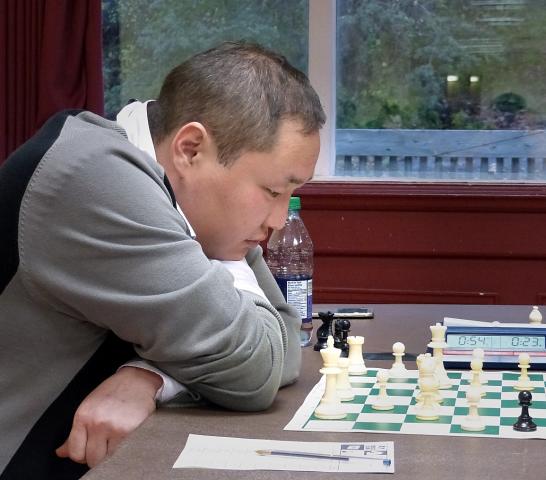
..
[Event "National Capital Open"]
[Site "Ottawa (Canada)"]
[Date "2016.10.29"]
[Round "2"]
[White "Marin, Sam"]
[Black "Sambuev, Bator"]
[Result "0-1"]
[ECO "C02"]
[WhiteElo "2136"]
[BlackElo "2598"]
[Annotator "Elias Oussedik"]
[PlyCount "128"]
[EventDate "2016.??.??"]
[SourceTitle "CFC Newsfeed"]

{Here we go again. Another terrorizing Sambuev game where he outrates his
opponent by 450 points. Sambuev is a fix on the Canadian circuit and
usually has no trouble with those lower rated than him.} 1. e4 e6 {Sambuev
trusts his French defense.} 2. d4 d5 3. e5 c5 4. c3 Nc6 5. Nf3 Qb6 6. a3 Nh6 {
All well known and thematic. The idea with ...Nh6 is to reroute the knight to
f5 and pressure the d4 pawn. Black encourages a move like Bxh6 where Black
will continue ...Qxb2!} 7. b4 (7. Bxh6 $1 Qxb2 $17) 7... cxd4 8. cxd4 Nf5 9.
Be3 {The second most common move. More common is Bb2, although Be3 has been
fashionable of late.} (9. Bb2 Bd7 10. g4 Nfe7 11. Nc3 Na5 $1 {The key cute
move. This is the main tabiya of this position. Games are very dynamic.}) 9...
Bd7 (9... f6 {was also possible. There are a multitude of moves. ...Bd7 is a
normal developing move - absolutely nothing wrong with developing.}) 10. Nc3 $2
(10. Bd3 Nxe3 11. fxe3 Be7 12. O-O Rc8 $14) 10... Nxe3 11. fxe3 Nxb4 $1 {
Sambuev knows his theory! This is well known. A similar idea was played by
Sambuev vs Noritsyn a couple of years ago where Noritsyn as White managed to
fight back vs Sambuev and almost won the game a pawn down!} 12. Na4 (12. axb4
Bxb4 13. Rc1 Rc8 14. Qb3 Qa5 15. Kd2 O-O {The pressure of the pin is extremely
strong.} 16. Bd3 Ba4 17. Qb2 Bb5 18. Bxb5 Qxb5 19. Qa1 a5 $17 {WIth two
connected passed pawns, a safe king, active rooks and a poor White king, Black
has more than enough compensation for the piece.}) 12... Bxa4 13. Qxa4+ Nc6 {
Black has found himself up a pawn. A relatively safe and harmless opening.} 14.
Bb5 Be7 15. Rc1 Rc8 16. O-O O-O $17 {Black has no problems. The only thing he
should be worried about is the possibility of opposite squared bishops. Other
than this, Black is up a clear pawn and the rest is a matter of technique.} 17.
Rb1 a6 18. Bd3 Qa5 {Black is content with exchanging pieces.} 19. Qd1 b5 20. h4
Qd8 {Sambuev is a practical player, although objectively taking on a3 might be
best, he recognizes White's plan of attacking his king and he would rather
stop all that nonsense instead of grabbing a pawn on a3.} (20... Qxa3 21. Ra1
Qc3 22. Rxa6 Nb4 {Sambuev might have missed this idea attacking the rook on a6
and the bishop on d3.} 23. Ra7 Bxh4 24. Nxh4 Nxd3 $19) 21. a4 Bxh4 22. Nxh4
Qxh4 23. axb5 axb5 24. Rf3 {With a clear idea of Rh3 and attacking the h7 pawn.
Rxb5 would have been completely normal.} (24. Rxb5 Qg5 $15) 24... f5 $2 {
A logical move, but the computer doesn't like it. The idea is logical, but
tactically it doesn't work. Black played ...f5 to blunt White's bishop, which
is logical. However, White will most likely take en passant. Bator probably
thought the open f-file would benefit him.} 25. exf6 (25. Bxb5 Nd8 {And the
knight reroutes to f7-g5-e4.}) 25... Rxf6 26. Rh3 Qf2+ 27. Kh2 g6 {This was
Bator's initial plan when he played ...f5. He was hoping the open f-file would
give him play to end this game quickly. However, what Bator missed is that his
opponent is also able to muster an attack against his king.} 28. Qg4 $1 {
With the cheeky threat of Rf1!} Nd8 {The only move to protect the e6 pawn!
Black is forced to give up his queen. A fascinating game considering Black
outrates his opponent by nearly 600 points!} (28... Rcf8 $2 {While this may
seem logical, to protect the f6-rook, it loses -- by force!} 29. Rf1 Qd2 30.
Qh4 $1 R6f7 31. Bxg6 $1 $18) 29. Rf1 Qxf1 30. Bxf1 Rxf1 31. Qe2 Rf6 32. Qxb5 {
This is a good time to stop and analyze the position. Black has a
rook+knight+pawn for the queen. Although White has the extra queen, this is
most likely objectively drawn as Black should be able to create a fortress. A
struggle ensues. Knowing Bator, he was trying to win, hoping to bring his
knight to e4 and start threats against White's king.} Nf7 33. Rf3 {Exchanging
a pair of rooks is logical, to minimize losing chances, but dynamically
speaking, keeping a pair of rooks, might be the best decision for White. By
exchanging a pair of rooks, Black has an easy fortress such as Ne4 and Rf6
where White won't be able to break through.} Kg7 $1 {Bator recognizes the
fortress starting with Ne4 and Rf6 and doesn't take White's rook on f3 which
would prevent the fortress by taking e4 from the N.} 34. Rxf6 Kxf6 35. Qf1+ Ke7
$11 36. e4 {Sam recognizes Bator's fortress with Ne4 and Rf6 and tries to
prevent the idea. However, this move doesn't objectively lead to anything.
Objectively speaking, this position is probably a draw.} dxe4 37. Qf4 Rd8 38.
Qh4+ (38. Qxe4 Rd5 {A fortress is reached. Knowing Bator, he would try to win
the d-pawn with ...Nd6-f5 and try to prove his advantage.}) 38... g5 39. Qxe4
h5 40. Qb7+ Rd7 41. Qb4+ Kf6 42. Kg3 Rd5 43. Kf3 Rf5+ 44. Ke3 h4 {I don't know
the clock times, but I imagine Sam was running short on time which probably
explains some of his moves. Practically speaking, one could argue this
position might be easier to play as Black if he can create a passed pawn on
the kingside and confuse White.} 45. Qf8 Rb5 46. Qa3 Rf5 47. Qf8 Rf4 $1 {
Bator the tricky Open tournament warrior. He could have repeated with ...Rb5,
but he is going for blood. He sees the weak d4 pawn and wants to win it!} 48.
Qa8 Kg7 49. Qc8 Rf6 50. Qc7 g4 {Bator is trying to get a passed pawn. This
shouldn't be an issue as White should be able to win the pawn or perpetual
check Black's king.} 51. Qd7 h3 52. gxh3 gxh3 53. Qc7 Kg6 $1 {A strong move.
After Qg3+, Black intends to continue ...Ng5, protecting the h3 pawn.} 54. Qc2+
(54. Qg3+ Ng5 55. Qb8 Rf5 56. Qe8+ Kg7 57. Qd8 Rf2 (57... h2 $4 58. Qc7+ Kg6
59. Qxh2 $11) (57... Rf3+ 58. Ke2 Kg6 59. Qb8 {This is objectively drawn.
Although one could argue that Black could push in this position, his loose
pieces make it a risky decision. Bator is an extremely tactical player and
open warrior, risky decisions are part of his everyday life.})) 54... Rf5 55.
Qc6 Kf6 56. Qe4 (56. Qc7 Ng5 57. Qb8 {Staying on the dark squares and
preventing Black from pushing the h2-pawn is the easiest way to draw.}) 56...
Ng5 57. Qh4 Kg6 58. Ke2 Rf7 59. Qg3 Rf3 60. Qg1 Rf4 61. Qb1+ Kh5 62. Qb8 $2 {
Sam has been playing with fire. Checking Black's king with no clear plan
allowing his king to slowly advance.} ({editor -} 62. Qa1 Ne4 63. Ke3 Rg4 64.
d5 $11) 62... Kg4 $17 63. Qh8 Rf5 64. Qh6 $2 (64. Qb8 {Again, Qb8 is necessary,
keeping a bind on the dark squares where pushing the h2 pawn is not possible.}
e5 65. dxe5 h2 66. Qb1 Nf3 67. Ke3 Nxe5 $17 {A position like this is extremely
interesting. Unbelievable how 20 moves ago, we had a benign position where Sam
Marin was able to win Bator's queen and now we have a technical position where
only Black can play for the win.}) 64... Kg3 {And the h-pawn runs.   An
extremely odd game by Sambuev. He lost a queen, declined a draw by repetition,
and still managed to win against a 2100+ player. Fascinating!} 0-1
..