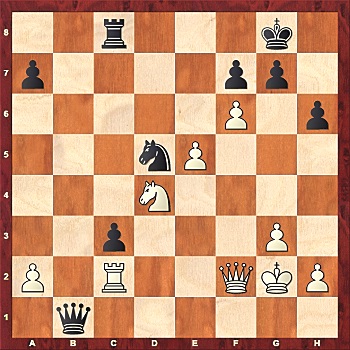
The Canadian Game of the Week comes from round 7 of the 2016 Women's Olympiad in Baku. In the diagram, Canada's Maili-Jade Ouellet has Black against Slovenia's Caterina Leonardi. What's better: ...Rc4 or ...Nb4. One wins, the other allows an incredible draw.
..
..
[Event "Women's Olympiad"]
[Site "Baku"]
[Date "2016.09.09"]
[Round "7.4"]
[White "Leonardi, Caterina"]
[Black "Ouellet, Maili-Jade"]
[Result "0-1"]
[ECO "E17"]
[WhiteElo "2024"]
[BlackElo "1992"]
[Annotator "John Upper"]
[PlyCount "68"]
[EventDate "2016.09.02"]
[EventType "team-swiss"]
[EventRounds "11"]
[EventCountry "AZE"]
[SourceTitle "Chess Canada 2016Olympia"]
[Source "CFC"]
[SourceDate "2016.10.25"]
[WhiteTeam "Slovenia (W)"]
[BlackTeam "Canada (W)"]
[WhiteTeamCountry "SLO"]
[BlackTeamCountry "CAN"]

1. d4 d5 2. c4 e6 3. Nf3 Nf6 4. g3 Be7 5. Bg2 O-O 6. O-O {[#]} b6 (6... dxc4 7.
Qc2 a6 {is the start of the main-line in the open Catalan.}) 7. Qc2 {White
continues to play in Catalan style, ensuring the safety of the c4 pawn; but
now that Black has played ...b6 White doesn't have to worry about getting the
pawn back after ...dxc4 -- since Ne5 would be strong -- so here Nc3 is a more
testing move.} Bb7 8. b3 c5 9. Bb2 Qc7 10. Nbd2 Nbd7 11. Rac1 Rac8 12. cxd5
exd5 13. Ne5 {[#]} Nxe5 $5 {Not the safest move -- ...Rfe8 or ...Qd6 -- but
definitely the most interesting, as the resulting pawn structure is very
unbalanced. After the exchange on e5 the game follows its normal strategic
course: Black pushes her queenside majority to create a passed pawn while
White pushes her central majority to create attacking chances.} 14. dxe5 Nd7
15. f4 (15. Nf3 Qc6 {and ...Qe6 to attack e5.}) 15... b5 $1 {Black gets her
queenside majority started. White has more than one reasonable way to play,
and chooses to trade center pawns, giving her pieces the use of e4.} 16. e4 (
16. Bh3 $5 {hits d7 and c8, and gives White another way to undermine Black's
pawns; e.g. e5-e6.}) (16. e3 {and Nf3 to restrain Black's center pawns also
makes sense.}) 16... c4 $1 (16... d4 $2 17. Bxd4 $16) {[#]} 17. exd5 (17. Rfd1
$6 Nc5 $1 18. exd5 Nd3 19. Qxd3 (19. d6 $2 Qc5+ {and there's a smothered mate.}
) 19... Bc5+ 20. Bd4 $1 cxd3 21. Bxc5 Rfd8 22. d6 Qd7 23. Bxb7 Qxb7 24. b4 {
Black is better, but it would be an interesting challenge to find a way to
effectively open lines for her majors.}) 17... Bxd5 18. bxc4 (18. Bxd5 Qc5+ 19.
Rf2 Qxd5 20. bxc4 bxc4 21. Qe4 Nb6 $13 {It's hard to tell if Black's passed
pawn is strong or weak.}) 18... bxc4 19. Bd4 Bxg2 20. Kxg2 Nb6 21. Qe4 Rfd8 22.
Nf3 {[#]} Bc5 (22... Nd5 $5 23. f5 (23. Ng5 $5) 23... f6 $1 (23... Qc6 $5) 24.
e6 $140 c3 25. Rc2 Qa5 $15 {threatening ...Qa4 and ...Rc4.}) 23. Rfd1 h6 24. f5
Qc6 25. Qh4 $6 (25. Qxc6 $11) 25... Bxd4 26. Rxd4 Rxd4 27. Qxd4 c3 $15 28. f6
Qb5 {[#]} 29. Rc2 $2 (29. Rxc3 $4 Qb2+ $19) (29. Qe4 $142 $15) 29... Qb1 $1 30.
Qf2 (30. Qe4 Rc4 $1 31. Qd3 Nd5 $1 {is similar to the game.}) 30... Nd5 {
Setting up tactics with ...Ne3+.} 31. Nd4 {[#]Critical Position What's better:
...Rc4 or ...Nb4} Rc4 $1 (31... Nb4 $4 {This actually throws away all of
Black's advantage as now White's f6-pawn and Q give enough play to draw,
though the full line has to be seen to be believed:} 32. Qf5 {Only move.} Rc7 $1 33. Qg4
{Only move.} g6 34. Qf3 $11 Nxc2 35. Qa8+ Kh7 36. Qf8 Ne3+ {Only move.} 37. Kf3 Qf5+ $5 (37... Qf1+
38. Kxe3 Qg1+ $11) 38. Nxf5 $4 (38. Ke2 {Only move.} Qf1+ 39. Kxe3 Qg1+ {Only move.} $11 {Black
has to give a perpetual.}) (38. Kxe3 $4 Qxe5+ $19 {White loes her f6 pawn next
and the game soon after.}) 38... Nxf5 39. Qd8 Nd4+ {Only move.} 40. Ke3 (40. Qxd4 c2 $19)
40... Ne6 $19 {The N defends everything and White's Q will be stuck doing
blockade duty on c1.}) 32. e6 (32. Nf5 {defends e3,} gxf6 (32... g6 $2 33. Ne7+
{Only move.} Nxe7 34. fxe7 Qb7+ 35. Qf3 Qxe7 36. Rxc3 $15) 33. exf6 Kh7 $1 $19 {and
White has no tactics and no defence to ...Rc6xf6 or ...Nb4.}) 32... Rxd4 $1 33.
exf7+ (33. fxg7 f6 $1 $19 {and White has no more tricks.}) 33... Kxf7 (33...
Kf8 $4 34. fxg7+ $18) 34. fxg7+ Nf4+ $1 (34... Nf4+ $1 35. gxf4 (35. Kf3 Qb7+ {
is mating.}) 35... Qxc2 36. Qxc2 Rd2+ $19) 0-1
..