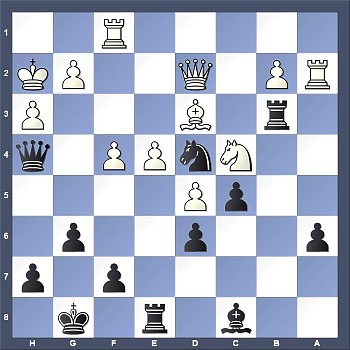
This week's Canadian Tactic comes from the final round board 1 game of the 2017 Ottawa Winter Open between Svitlana Demchenko and David Gordon.
White has just played 26.Nc4, going after Black's backward d6-pawn. What should Black do?
..
[Event "Ottawa Winter Open"]
[Site "Ottawa (Canada)"]
[Date "2017.01.15"]
[Round "5"]
[White "Demchenko, Svitlana"]
[Black "Gordon, David"]
[Result "1/2-1/2"]
[ECO "A60"]
[WhiteElo "2086"]
[BlackElo "2310"]
[Annotator "John Upper"]
[PlyCount "66"]
[EventDate "2017.??.??"]

1. d4 Nf6 2. Nf3 c5 3. d5 e6 4. c4 exd5 5. cxd5 d6 6. Nc3 Nbd7 $5 {[#] unusual
Benoni move-order, which can help if White goes for an early Nd2-c4, but rules
out an equalizing option after 7.e4 then ...Bg4. But since most White players
don't allow ....Bg4 pinning the Nf3 but play h3 anyway, maybe Black is not
losing anything here!?} 7. e4 g6 8. Bd3 (8. h3 Bg7 9. Bd3 O-O 10. O-O Qe7 11.
Re1 Rb8 12. a4 a6 13. Bf4 Ne8 14. Qd2 Nc7 15. Bf1 Rd8 16. Rad1 Ne8 17. Bg5 f6
18. Be3 Ne5 19. Nxe5 fxe5 20. a5 b5 21. axb6 Rxb6 $14 {1-0 (59) Borovikov,V
(2595)-Kononenko,D (2430) Rivne 2005}) (8. Bf4 Nh5 9. Bg5 Be7 10. Bh6 Bf8 11.
Be3 a6 12. a4 Bg7 13. Be2 O-O 14. O-O Re8 15. Nd2 $14 {1-0 (46) Aleksandrov,A
(2604)-Idrisov,T (2262) Nakhchivan 2012}) 8... a6 9. a4 Bg7 10. Bf4 (10. O-O
O-O 11. h3 h6 12. Re1 g5 $1 13. Ne2 g4 $1 14. hxg4 Nxg4 15. Ng3 Nde5 16. Be2 f5
17. exf5 Bxf5 18. Nxf5 Rxf5 19. Rf1 $14 {1-0 (31) Psakhis,L (2605)-Manor,I
(2475) Israel 1992}) 10... Qe7 {Natural, but Black might be able to develop
without protecting the d6-pawn.} (10... Ng4 $5 11. Bxd6 $140 $6 Qb6 $132 12. e5
Ndxe5 13. Bxe5 Nxe5 14. Nxe5 {and Black has model dark-square play after either
} Qxb2 $5 ({or} 14... Bxe5 15. Qe2 Qf6 $15 16. Ne4 Qd8 17. Nxc5 O-O)) 11. O-O
O-O 12. h3 {The game has transposed to a common position. If White has to play
this (to keep the B on the h2-d6 diagonal when Black plays ...Nh5) then the
early ...Nbd7 is just fine.} Rb8 (12... Nh5 13. Bh2 Bh6 14. Re1 Bf4 (14... f6
15. a5 Ne5 16. Na4 Bf4 17. Nb6 Rb8 18. Bf1 $14 {0-1 (34) Piket,J (2615)
-Romanishin,O (2595) Manila 1992}) 15. g3 Bh6 16. Bf1 Ne5 17. Nxe5 Qxe5 18. f4
Qd4+ 19. Kg2 Qb4 20. Qd2 f5 21. e5 $6 (21. exf5 Bxf5 $14) 21... dxe5 22. Rxe5
Bg7 $13 {1-0 (44) Shirov,A (2675)-Dubov,D (2629) Moscow 2014}) 13. a5 $146 Ne8
14. Qb3 b5 15. axb6 Rxb6 {[#] The position of Black's Rb6 could almost stand
for the whole Benoni opening: it's precarious but dynamic. It is lost if White
can organize central play (Nc4 or e4-e5) but makes up for it with
counter-attacking chances on the dark squares.  It might be worth mentioning
that with White pawns on d5, e4 and h3 all covering light-squares, Black must
either aim for piece play on the dark squares, or a pawn break on the light
squares (with ...f5). Count how many of Black's next moves are on the dark
squares.} 16. Qc2 Ne5 17. Bxe5 Bxe5 18. Nxe5 Qxe5 19. Ra2 {Both players now
aim their Ns at their best squares (c4 and d4).} Nc7 20. Nd1 Nb5 (20... f5 $5 {
would be a different way to play, developing the Rf8 and trying to make the
d5-pawn a target.} 21. Ne3 fxe4 22. Bxe4 Rb4 $13) 21. Ne3 Nd4 22. Qd1 (22. Nc4
Nxc2 23. Nxe5 Nb4 24. Nc4 {Only move.} Rb8 25. Ra3 Nxd3 $1 26. Rxd3 a5 27. Ra1 Ba6 $11)
22... Qg5 23. Kh2 (23. f4 $6 Qg3 $36 24. Qe1 $4 Nf3+ $19) 23... Rb3 24. f4 Qh4
25. Qd2 Re8 26. Nc4 $13 {[#]} (26. Ra3 $11) 26... Bxh3 $3 {The Bc8 had been
developed the whole time!  Of course, this line requires lots of correct
caluculation, but the clue to finding it comes from Vukovic's "Art of Attack
in Chess", which said something like: when your pieces control one colour
complex, sacrifice on the other colour so you can attack on both.} 27. gxh3
Rxe4 $1 {The point: Black not only gets a second pawn, but threatens ...Re2+,
which brings the Rb3 into play.} 28. Bxe4 $4 (28. Nxd6 $2 Re2+ $1 $19) (28. Ne3
$142 Rxf4 $2 (28... Re8 $17 {threatening ...c4. Black has two pawns, and an
attack for the piece.}) 29. Ng2 {Only move.} Rxd3 $1 30. Qxd3 {Only move.} Rf2 {Only move.} 31. Rxa6 (31.
Rxf2 Qxf2 32. Ra3 $1) 31... Qf4+ $6 32. Kg1 Ne2+ $140 $2 33. Qxe2 $18) (28. Ra3
$142 $1 $11 Re2+ {Only move.} (28... Ne2 $2 29. Qe1 {Only move.} $18) 29. Bxe2 {Only move.} (29. Qxe2 $2 Nxe2
30. Bxe2 Qxh3+ 31. Kg1 Qg3+ 32. Kh1 Rxa3 33. bxa3 {White has more pieces and
they are very well coordinated, but her K is exposed and h5-h4-h3 will break
their coordination.} h5 34. Rf3 Qe1+ 35. Bf1 Qe4 $19) 29... Qg3+ 30. Kh1 Qxh3+
31. Kg1 Qg3+ $11) 28... Rxh3+ {Only move.} $19 (28... Qxh3+ $4 29. Kg1 Rg3+ 30. Bg2 $18)
29. Kg1 Qg3+ {Only move.} 30. Bg2 (30. Qg2 Ne2#) 30... Qh2+ {Only move.} 31. Kf2 Qg3+ $11 {Black
needed only a draw to clinch first place, but would have enjoyed his
tournament more if he had found:} (31... Rg3 $1 $18 32. Ne3 (32. Rg1 Rf3+ $1
33. Ke1 Qxg1+ 34. Bf1 Qxf1#) 32... Rf3+ $1 33. Ke1 Rxe3+ {Only move.} 34. Qxe3 (34. Kd1
Re2 $19) 34... Nc2+ {Only move.} 35. Kd2 Nxe3 36. Kxe3 Qxg2 37. Rd1 h5 $19) 32. Kg1 Qh2+
33. Kf2 Qg3+ $2 $11 1/2-1/2
..