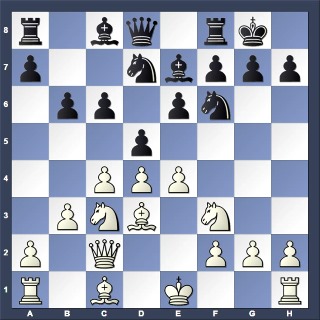
..
[Event "Hart House Reading Week Open 2017"]
[Site "Toronto"]
[Date "2017.02.19"]
[Round "3"]
[White "Yang, Kaiqi"]
[Black "Plotkin, Victor"]
[Result "1-0"]
[ECO "D45"]
[WhiteElo "2432"]
[BlackElo "2401"]
[Annotator "Upper,John"]
[PlyCount "156"]
[EventDate "2017.??.??"]
[EventCountry "CAN"]

1. c4 Nf6 2. Nc3 e6 3. d4 d5 4. Nf3 c6 5. e3 Nbd7 6. Qc2 {The most popular
anti-Meran move. The Q goes to a useful square without conceding a tempo to
Black after Bd3 dxc4.} (6. Bd3 dxc4 7. Bxc4 b5 {is the start of the very
complicated Meran variation of the semi-Slav. Black's reources seem to be at
least enough for equality, and so 6.Qc2 has actually become the main move
among top players, with only Mamedyarov showing a clear preference for Bd3.})
6... Be7 {This is not the most popular, but it has been played by Kortchnoi,
Vallejo Pons, and other 2600+ GMs. Pros: it's less exposed to attack than on
d6 (from e4-e5, or cxd5 then Nb5). Cons: It doesn't help support ...e5, it
occupies a decent square for Black's Q, and (as we'll see in this game) it can
be exposed on the e-file after e3-e4 and d4-d5!} (6... Bd6 {is far-and-away
the main move; it and}) (6... a6) (6... b6 {all score better than Be7.}) 7. b3
O-O 8. Bd3 b6 9. e4 $5 {Before playing this thematic break White usually
castles and plays Bb2... but maybe there's no need to prepare it when Black is
so far from being able to strike back in the center!?} ({Here are some
examples of more typical play by White:} 9. O-O Bb7 10. Bb2 c5 $1 11. Qe2 Rc8
12. Rac1 (12. Rfd1 cxd4 13. exd4 Qc7 14. Nb5 Qb8 15. Ne5 Rfd8 16. f4 Nf8 $11 {
0-1 (39) Sambuev,B (2523)-Zhigalko,S (2667) Istanbul Ol, 2012.}) 12... Qc7 (
12... Bd6 13. Rfd1 Qe7 14. cxd5 Nxd5 15. Ne4 cxd4 16. Nxd6 Qxd6 17. Nxd4 $14 {
White has the Bishop pair on a semi-open board; Weiss,M-Schlechter,C Vienna,
1896.}) 13. Rfd1 Qb8 14. cxd5 Nxd5 15. Nxd5 Bxd5 16. Bb5 Rfd8 17. e4 Bb7 18. d5
$1 exd5 (18... Nf8 19. dxe6 $14 fxe6 (19... Nxe6 20. Bd7 $16) 20. Be5 Qa8 21.
Qb2 $16) 19. exd5 Bd6 20. Qe4 Nf8 $14 {White has more space, and eventually
squeezed out some concessions from Black in Spraggett,K (2571)-Santos,A (2326)
Figueira da Foz, 2010.}) 9... dxe4 10. Nxe4 Bb7 11. Bb2 h6 (11... Nxe4 12. Bxe4
Nf6 13. Bd3 c5 14. dxc5 Bxc5 15. Rd1 Bb4+ 16. Kf1 Qe7 (16... Kh8 17. Bxh7 $14)
17. Bxf6 $1 Qxf6 18. Bxh7+ Kh8 19. Be4 Bxe4 20. Qxe4 Rad8 21. Rxd8 Rxd8 22. g3
$16 Rd1+ 23. Kg2 Rxh1 24. Kxh1 $16 {In Adamski,J (2410)-Georgievski,V (2320)
Rzeszow, 1980, Black has only a little development for the pawn, since the
following tactic doesn't work:} Qa1+ $2 25. Kg2 Qxa2 26. Ng5 $1 $18 {with a
forced mate.}) 12. O-O-O $5 {Unusual. White normally castles short, as you can
see from the embedded games. But unless Black can force open the b or c-files,
the white K isn't in much danger; and Black's Bs don't make much of an
impression. On the other hand, Black's Ph6 gives White a hook to aim at, and
his two Bs are already pointed at the Black K.} Qc7 (12... b5 $5 {is the
obvious way to create some play, when} 13. c5 {concedes d5 but still seems to
keep an advantage:} b4 {trying to force open the a-file, but it looks like
White is faster; e.g.} (13... Nd5 14. a3 {this keeps the queenside files
closed. Computers prefer Black, but I'm not so sure.}) 14. Nxf6+ Nxf6 15. g4 $5
{and White has the initiative.}) 13. Rhe1 a5 (13... Rac8) 14. a3 Rfd8 15. Kb1
c5 (15... Nxe4 16. Bxe4 Nf6 17. Bd3 c5 $13) 16. d5 $1 exd5 17. Nc3 $1 (17. cxd5
Bxd5 18. Ned2 (18. Nd4 $5) 18... Bf8 $15 {and Black's play against the White
King should come first.}) 17... dxc4 (17... d4 $2 18. Nb5 {and the Q and Be7
are hanging.}) (17... Bd6 18. cxd5 {gives White a space and development
advantage, since the d5-pawn can't be taken:} Nxd5 $4 19. Nxd5 Bxd5 20. Bh7+
$18) 18. Bxc4 Bxf3 $1 (18... Nf8 $2 19. Rxd8 Rxd8 20. Ne5 $18 {wins f7 and the
game.}) 19. gxf3 Nf8 20. Nd5 Nxd5 21. Bxd5 Rxd5 {Only move.} (21... Rac8 $2 22. Rg1 $18 {
Black's kingside is toast:} Ne6 (22... Ng6 23. Qxg6 $18) 23. Rxg7+ Nxg7 24. Qc3
$18) 22. Rxd5 $16 {White is up an exchange for a pawn and with more active
pieces.} Rd8 23. Qf5 Rxd5 24. Qxd5 Ne6 25. Be5 Qc8 26. f4 g6 27. f5 $1 $18 gxf5
28. Bb2 Qc7 29. Qxf5 Qxh2 30. Qf3 Qh4 31. Rg1+ Kf8 32. Rh1 Qg5 33. Qa8+ Bd8 34.
Rd1 h5 35. f4 Qh4 36. Ka2 Ke8 37. Qc6+ {Almost 1/2 of White's next 30 moves
are checks, which might indicate time trouble, but certainly shows who has the
initiative.} Kf8 38. Qa8 Ke8 39. Qc6+ Kf8 40. f5 Nd4 41. Qh6+ (41. Qd6+ $142
Be7 42. Qh6+ Ke8 43. Bxd4 cxd4 44. Qh8+ $18) 41... Ke7 42. Qh8 Bc7 43. Qc8 Qh2
(43... Qg3 $142 44. f6+ $1 $14) 44. Re1+ Kf6 45. Qh8+ Kxf5 46. Qh7+ Kf6 47.
Qh6+ Kf5 48. Qh7+ Kf6 49. Rf1+ Bf4 50. Qh6+ Kf5 51. Qxb6 Ne6 52. Qb7 $1 Kg6 53.
Qe4+ Kg5 54. Qd5+ Kg4 55. Qf3+ Kf5 56. Rh1 Qd2 57. Rxh5+ Ng5 58. Qh3+ Ke4 59.
Qh1+ Kf5 60. Qh3+ Ke4 61. Qh1+ Kf5 62. Qf1 Kg6 63. Rh1 Be5 64. Qc1 Qxb2+ 65.
Qxb2 Bxb2 66. Kxb2 Ne4 67. Kc2 f5 68. Rg1+ Kf6 69. Kd3 Ke5 70. Rg8 Kd5 71. Ra8
f4 72. Rf8 Nf2+ 73. Ke2 Ng4 74. Rxf4 Ne5 75. Ra4 Nc6 76. Kd2 Nd4 77. Kc3 Nc6
78. Rh4 Ne5 1-0
..