The final two rounds of the US Championship, Wesley So's latest brilliancy, and a newly-available interview with Bobby Fischer are this week's Best of the Web.
US Championships
March 29 - April 10, 2017
Two 12-player round robins to determine the national champion and women's champion of the United States.
The last round is Sunday April 9, but it looks like playoffs will be necessary, and they'll be April 10.
Games start at 2:00 pm EST.
With two rounds to go, Wesley So and Varuzhan Akobian are tied for the lead with 6/9.
The top three drew all their games between each other. The difference is that both Nakamura and Caruana have lost to lower-rated players: Naka lost to Onischuk and Caruana has lost to both Akobian and Zherebukh. These losses have cost Nakamura and Caruana nearly 30 FIDE rating points combined.
Women's Championship
In the women's Championship, Sabina Foisor and 2016 defending Champion Nazi Paikidze are tied with 6/9. Top seed Anna Zatonskih and seven-time Champion Irina Krush 1/2 a point back and meet each other in the final round.
homepage
http://uschesschamps.com/2017-us-championships/overview
Live Games with Commentary (by GMs Yasser Seirawan, Maurice Ashley, and IM Jennifer Shahade)
https://chess24.com/en/watch/live-tournaments/us-championship-2017/10/1/5
http://uschesschamps.com/2017-us-championships/information/live
Fischer on Dick Cavett
There is a newly-posted interview of Bobby Fischer on the Dick Cavett show.
The 21 minute 1972 interview took place during negotiations before the Spassky match was settled on Iceland. Other guests include consumer-rights advocate Ralph Nader, and comedienne Sandy Duncan.
The video is "watermarked", but is certainly worth watching. Fischer is in a good mood, and even brought his own favourite chess set -- a 1950 Dubrovnik reproduction -- and gives a quick lesson in how the pieces move and bangs out the final position in the last game of their Candidates Final match to show why Petrosian resigned. Bangs is right: Fischer moves the pieces like lawn darts.
https://youtu.be/5zPkVM9YYns
1971 Fischer interview before the Petrosian match
This one-on-one interview with Dick Cavett is better known, with excerpts appearing in Liz Garbus's documentary "Bobby Fischer Against The World".
https://youtu.be/MPlXC3M8hbg
Two Memorable Games from US Championship History
Round 9 of the 2017 US Chess Championship was one of the most remakable in US Championship history.
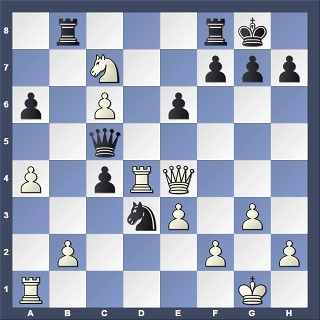
Nakamura (2793) lost as White to Onischuk (2667), and Caruana (2817) somehow managed to lose to Akobian (2645) despite being up two safe connected passed pawns. But what will probably be longest remembered is Wesley So's wonderful win with Black over current World Junior Champion, and #4 seed in the event, Jeffrey Xiong. His attack, capped by a Queen sac to ensure a pawn promotion is wonderful in its own right, but it has extra appeal since its start is reminicent of Fischer's great win over Byrne in 1963.
Both games can be replayed with notes below. It's Black to play in the diagram.
Wesley So interviewed after his brilliancy win over Jeffrey Xiong in round 9
https://youtu.be/JONo9SLFQ-E
..
[Event "U.S. Championship"]
[Site "chess24.com"]
[Date "2017.04.07"]
[Round "9.1"]
[White "Xiong, Jeffery"]
[Black "So, Wesley"]
[Result "0-1"]
[ECO "E05"]
[WhiteElo "2674"]
[BlackElo "2822"]
[Annotator "John Upper"]
[PlyCount "62"]
[EventDate "2017.??.??"]
[SourceDate "2015.02.27"]
[WhiteTeam "United States"]
[BlackTeam "United States"]
[WhiteTeamCountry "USA"]
[BlackTeamCountry "USA"]

1. d4 Nf6 2. c4 e6 3. g3 d5 4. Bg2 Be7 5. Nf3 O-O 6. O-O dxc4 7. Qc2 a6 8. a4
Bd7 9. Rd1 Bc6 10. Nc3 Bxf3 11. Bxf3 Nc6 12. Bxc6 bxc6 {[#] If you haven't
seen it before you might think that Black's c-file looks like a bad joke. But
his c-pawns will fight for control over d4, after which White might prefer it
if his g3-pawn was back on g2.} 13. Bg5 (13. a5 Nd5 14. Na2 Nf6 15. Nc3 Nd5 16.
Na4 Qb8 17. Bd2 Qb5 18. Rdc1 c5 19. dxc5 c3 20. Nxc3 Qxc5 21. Na4 Qb5 $11 {
0-1 (59) Kovalyov,A (2636)-So,W (2744) Edmonton, 2014.}) 13... Rb8 (13... a5
14. e3 Rb8 15. Qe2 h6 16. Bxf6 Bxf6 17. Qxc4 Rxb2 18. Qxc6 Qd6 19. Qf3 $14 {
1/2-1/2 (47) So,W (2667)-Hou,Y (2612) New Delhi 2011}) 14. e3 c5 15. dxc5 Qe8
16. Rd4 Nd7 $146 (16... Rb4 17. Na2 Qxa4 18. Nxb4 Qxa1+ 19. Kg2 Qa5 (19... c3
20. Qxc3 Qa4) 20. Nc6 Qxc5 21. Nxe7+ (21. Rxc4 $1 $14) 21... Qxe7 22. Rxc4 c5
$11 23. Bxf6 Qxf6 24. Rxc5 g6 25. b4 Qe7 26. Qd1 {½-½ (26) Sjugirov,S (2624)
-Smirnov,P (2610) Novosibirsk, 2012.}) 17. Bxe7 Qxe7 18. c6 $6 (18. f4 Nxc5 (
18... e5 $11) 19. Rxc4 Nb3 $11) 18... Ne5 $1 19. Qe4 Qc5 20. Nd5 {Only move.} $11 Nd3 21.
Nxc7 (21. Rxc4 $4 exd5 $19) 21... Nxf2 $1 22. Kxf2 Rxb2+ 23. Kf1 $1 (23. Kg1 $2
Qh5 $19 {hitting h2 and e2.}) 23... Qh5 24. Qg4 Qxh2 25. Qf3 {[#] At 20-ply
computers rate this as equal, but Black is winning.   Materially, Black has
two pawns for the N, and both sides have advanced passed pawns, but the
off-side Nc7 is almost worthless, which negates White's material advantage.
Much more important than material is the exposed White K and the two black
majors on the second rank: any move by the White Q allows an immediate mate.
This should lead any player to think that if Black can dislodge the white Q or
activate his Rf8 then Black wins.} c3 ({In a post-game interview, Wesley said
he was calculating mostly to make sure he wasn't risking anything; and indeed
he isn't, since Black can force a draw at any time with:} 25... Qh3+ 26. Ke1
Qh2 27. Kf1 {Only move.} $11) 26. Rc1 e5 $1 {[#]This frees the Nc7 to come back via d5,
but does two good things for Black: gains time off the Rd4 (and possibly the
Qf3) as well as opening the h3-c8 diagonal for Black's Q, which is essential
to stopping White's pawns in some variations.} 27. Rh4 (27. Rd7 $4 e4 $19 {
dislodging the Q to force mate.}) (27. Rc4 Rfb8 $3 {threatening both ...Rb1
and ...Qd2.} (27... e4 28. Rxe4 c2 29. Qg2 Qh5 30. g4 Qc5 {is probably also
winning, but not nearly as nicely.}) 28. Nb5 (28. Nd5 Rf2+ {Only move.} 29. Qxf2 Qh1+ {Only move.}
30. Qg1 (30. Ke2 Rb2+ $19 {skewers the Q.}) 30... Qxd5 31. R4xc3 Rb2 {Only move.} 32.
R3c2 Rxc2 33. Rxc2 Qd1+ 34. Kf2 Qxc2+ $19 {Black has a winning Q and P ending.}
) (28. g4 Qd2 29. R4xc3 e4 30. Qg3 Rd8 31. Nd5 Rxd5 $1 $19 {it's mate on d1.} (
31... Qxd5 $2 32. c7 $1 Rc8 {Only move.} $11)) 28... axb5 29. axb5 (29. c7 bxc4 $19)
29... Qh3+ 30. Ke1 (30. Kg1 g5 $1 31. b6 h5 {White's pawns look more dangerous
than Black's, but Black's pawn push will expose White's K.} 32. c7 Rf8 {Only move.} 33.
b7 g4 34. c8=Q Qh2+ 35. Kf1 gxf3 $19) 30... Rf8 (30... Re8 $1 {also wins, but
with some harder-for-humans-to-see geometry.}) 31. c7 (31. Rh4 Qe6 $19 {
is just a winning endgame, as Black's majors stop White's pawns.}) 31... e4 32.
Rxe4 (32. Qxe4 Qxg3+ {and mate next.}) 32... Qd7 {and Black picks off the
white pawns and keeps a huge attack on the white K.}) 27... Qd2 28. Rd1 {
[#] Black is winning, but the path is very narrow, with "only moves" all the
way.} Rd8 {Only move.} $19 (28... Rb1 $2 29. Rxb1 c2 {Only move.} $11) 29. Nd5 (29. Rxd2 Rdxd2 {
and ...Rb1 wins.} 30. Kg1 Rb1+ 31. Qf1) 29... Rxd5 {Only move.} 30. Rd4 $5 Rxd4 {Only move.} (30...
exd4 $4 31. c7 {Only move.} Qxd1+ 32. Qxd1 Rc5 33. Qxd4 $18) 31. exd4 Qxd1+ $1 (31...
Qxd1+ 32. Qxd1 c2 33. Qd2 Rb1+ 34. Ke2 c1=Q 35. Qxc1 Rxc1 {and the R stops the
c-pawn.}) 0-1


[Event "US Championship"]
[Site "New York"]
[Date "1963.12.18"]
[Round "3"]
[White "Byrne, Robert"]
[Black "Fischer, Robert"]
[Result "0-1"]
[ECO "D71"]
[Annotator "John Upper"]
[PlyCount "42"]
[EventDate "1963.12.15"]
[EventType "tourn"]
[EventRounds "11"]
[EventCountry "USA"]

1. d4 Nf6 2. c4 g6 3. g3 c6 4. Bg2 d5 5. cxd5 cxd5 6. Nc3 Bg7 7. e3 (7. Nf3 O-O
8. O-O (8. Ne5 $1 e6 9. O-O Nfd7 {with hundreds of games is now the mainline.})
8... Ne4 $1 9. Qb3 Nc6 10. Be3 Na5 11. Qd1 Nxc3 12. bxc3 b6 13. Ne5 Ba6 $15 {
0-1 (46) Smyslov,V-Fischer,R Herceg Novi (blitz), 1970.}) 7... O-O 8. Nge2 Nc6
9. O-O b6 10. b3 Ba6 11. Ba3 Re8 12. Qd2 e5 $5 (12... e6 $11 {Fischer}) 13.
dxe5 Nxe5 {[#]} 14. Rfd1 $2 {Totally natural, but the wrong Rook.} (14. Rad1
$142 Qc8 15. Qc1 Bxe2 $1 (15... Ne4 $13 {Fischer}) 16. Nxe2 Qa6 17. Nd4 Rac8
18. Qb2 Ne4 $17 {Houdini/Stockfish}) 14... Nd3 $1 15. Qc2 $2 (15. Nd4 $142 Ne4
16. Nxe4 dxe4 17. Bb2 Rc8 $17 {Fischer/Kasparov}) 15... Nxf2 {Only move.} {"The key to
Black's previous play. The complete justification for this sac does not become
apparent until White resigns!" - Fischer, M60MG} 16. Kxf2 Ng4+ 17. Kg1 Nxe3 18.
Qd2 {[#]} Nxg2 $3 (18... Nxd1 $2 19. Rxd1 $14) 19. Kxg2 d4 {Only move.} {Opening the
long diagonal.} 20. Nxd4 Bb7+ {[#]} 21. Kf1 ({or} 21. Kf2 Qd7 $1 22. Rac1 Qh3
23. Nf3 Bh6 24. Qd3 Be3+ 25. Qxe3 Rxe3 26. Kxe3 Re8+ 27. Kf2 Qf5 $1 $19 {
(Fischer M60MG).}) (21. Kg1 Bxd4+ 22. Qxd4 Re1+ $1 23. Kf2 (23. Rxe1 Qxd4+ $19)
23... Qxd4+ 24. Rxd4 Rxa1 25. Rd7 Rc8 26. Rxb7 Rxc3 27. Rb8+ Kg7 28. Bb2 Rxa2
$19 {Fischer, M60MG}) 21... Qd7 $1 (21... Qd7 {Byrne resigned because he saw
the following combo:} 22. Qf2 (22. Ndb5 Qh3+ 23. Kg1 Bh6 $19 {and ...Be3+ will
cost White the Q.}) 22... Qh3+ 23. Kg1 {and now a beautiful double deflection
combination:} Re1+ $3 24. Rxe1 Bxd4 $19) 0-1
merida
46
..