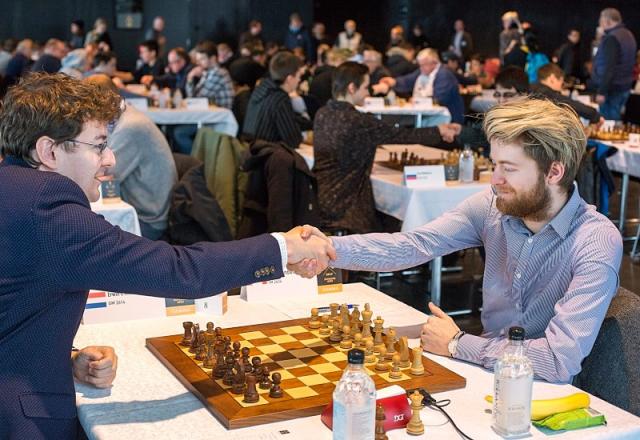
Our Canadian Game of the Week is IM Aman Hambleton's round 5 win over GM Erwin L'Ami at the 2017 Reykjavik Open, with notes by IM Aman Hambleton.
Your editor found this a strange and slightly unnerving game. While watching online, I thought Black was a little better and that White was going to have to suffer for a draw. But somewhere around move 30 White played a move on the kingside and I suddenly thought that White might be winning! It's the sort of turn-around that makes me wonder whether I understand chess at all. I'm relieved but confused to find that the players had exactly the same reaction!
..
[Event "Reykjavik Open"]
[Site "?"]
[Date "2017.04.22"]
[Round "5"]
[White "Hambleton, Aman"]
[Black "L'ami, Erwin"]
[Result "1-0"]
[ECO "A84"]
[WhiteElo "2434"]
[BlackElo "2614"]
[Annotator "Aman Hambleton"]
[PlyCount "83"]
[EventDate "2017.??.??"]
[SourceDate "2016.05.27"]

{In Round 5 of the Reykjavik Open I was paired with White against GM Erwin
L'ami. His wife Alina L'ami is a well-known ChessBase reporter and was both competing and taking pictures throughout the event. When playing such strong players, usually it's
impossible to predict exactly which opening they will use -- this game was no
exception.} 1. d4 f5 {I did not expect this opening from Erwin, although he
certainly plays it often enough. I assumed he would prefer the Nimzo,
considering one of the main lines I play against the Dutch in the database
involves playing h4!? very early, which not to everyone's taste as Black.} 2.
c4 Nf6 3. h4 {I have never really fancied the main lines against the Dutch,
but just like the Grunfeld I believe the sidelines are actually a lot more
testing! This move dissuades Black from playing a setup involving ...g6.} e6 (
3... g6 4. h5 Nxh5 5. Rxh5 gxh5 6. e4 $14 {is already better for White.}) 4. g3
{Claiming the long diagonal before Black can play ...b6, ...Bb7 and attempt to
prove that the move h4 has no particular benefit for White.} d5 5. Bg2 Bd6 6.
cxd5 {Anish Giri was giving his comments on some of the ongoing games and I
noticed he mentioned that the concept of h4 was not all that bad actually!
However, he criticized cxd5 because White often wants to wait (e.g. with Qc2)
until Black commits ...Nbd7 in order to play cxd5 when exd5 would lose the
f5-pawn. Here Black can recapture with the e-pawn and he should be happy with
that exchange.} (6. Nf3 O-O 7. Qc2 c6 8. O-O Nbd7 9. cxd5 cxd5 $14) 6... exd5
7. Nh3 O-O 8. Bf4 {Trying to execute a positional concept of exchanging the
dark squared Bishops and trying to exploit the weakened dark squares in
Black's camp.} Be7 $6 {Although it's understandable Erwin wants to avoid this
exchange, it may not have been the wisest decision in hindsight, especially
considering we exchanged these Bishops later on anyway.} 9. O-O c6 10. Nd2 Ne4
(10... Qb6 11. Nb3 a5 12. Qc2 Nbd7 13. Rac1 a4 14. Nc5 $13) 11. Nf3 {It's very
important for White to avoid trading pieces on the e4-square and instead focus
his attention on the e5, f4, and g5 squares.} Nd7 12. Nhg5 Ndf6 13. Ne5 Nxg5
14. Bxg5 (14. hxg5 $1 {is actually a good option here, although it didn't seem
very easy to justify over the board.} Ne4 15. g6 h6 16. e3 $14 {and although
this pawn on g6 is very far up the board, it's not very easy for Black to
target, and meanwhile the Ne5 is dominating.}) 14... Ng4 15. Qd2 (15. Bxe7 Qxe7
16. Nd3 (16. Nxg4 fxg4 $15 {is also better for Black with easy play on the e
and f-files and also the f5 square now available for the Bishop.}) 16... f4 $1
$17) 15... Nxe5 16. dxe5 a5 17. Bxe7 Qxe7 18. f4 Qb4 {[#] Now we reach the
critical position for the endgame. It was both the opinion of myself and my
opponent that although the position was surely equal, Black had more
constructive ideas involving some a4-a3 advance, ...Ra6-b6 to target my
Queenside, or simply supporting a well-timed ...c5 advance. We both completely
misevaluated White's chances!} 19. Rfd1 (19. Qxb4 axb4 20. a3 bxa3 21. Rxa3
Rxa3 22. bxa3 Be6 23. Rb1 Rb8 24. a4 Bc8 $1 $11 {Black intends to bring his
King to support his Queenside pawns, meanwhile tying White down to passive
defense of the isolated a-pawn.}) 19... Ra6 20. a3 Qxd2 21. Rxd2 a4 22. Rc1 {
Putting pressure on all of Black's Queenside pawns so they cannot easily
advance. In hindsight, I think that I was playing a bit too reactively,
because I never started to develop my own counterplay until much later. I
could have started that immediately with h5!} Be6 23. Rd4 Kf7 24. Rb4 Ra7 25.
e3 Ke7 26. Bf3 Rfa8 27. Kf2 Kd7 28. Be2 Kc7 {[#] After a long journey, Black
has succeeded in bringing his King over to the Queenside and now intends to
advance his pawn mass and hopefully pressure b2. It finally dawned on me that
White doesn't just have counterplay on the Kingside, but in fact is
essentially just winning.} 29. h5 $1 Ra5 30. Rd4 {Removing the Rook from the
precarious b4 square where it can be trapped in some lines after ...c5. This
Rook will sit on d2 where it protects White's only weakness (b2), while the
other Rook supports the g4 advance.} (30. Rg1 c5 31. Rb5 Rxb5 32. Bxb5 c4 $17)
30... b6 31. Rd2 Rc5 $6 {Black is trapping his own Rook without realizing it.}
32. Rg1 $1 {Now I felt as though I was winning by force over the board, or at
least Black would have to commit himself to the most passive defense possible.}
Rf8 33. g4 Rf7 (33... g6 34. Kg3 $16 {intending Kh4-g5}) 34. Bd3 $1 fxg4 35.
Bxh7 Rf8 36. Kg3 {Stepping off the f-file and away from some tactics involving
...d4. Now the threat, which is hard to stop, is f5 Bxf5 followed by Rf1
utilizing the pin. This tactic enables White to keep the initiative.} (36. Bc2
d4 $132 {is still winning, but certainly not the type of counterplay White
needs to allow.}) 36... Rb5 37. f5 Rb3 38. fxe6 Rxe3+ 39. Kh4 (39. Kxg4 Rxe5
40. Kh4 Rf4+ {is slightly less accurate}) 39... Rxe5 40. Rxg4 Rxe6 41. Rxg7+
Kd6 42. Rg6 {White will trade the Rooks and use his extra piece to help
promote the extra passed h-pawn. Black resigned with the end very near.   This
game was an interesting example of how important objectivity and psychology
can be in chess. Both my opponent and I were playing a position the computer
believes to be significantly better for White, yet we both had the
understanding that Black was pushing for a win! It is funny to think that I
would have accepted a draw at any point earlier in this game, while my
opponent would have never thought to offer one.} 1-0
..