

Book Review: Panjwani, "The Hyper Accelerated Dragon"

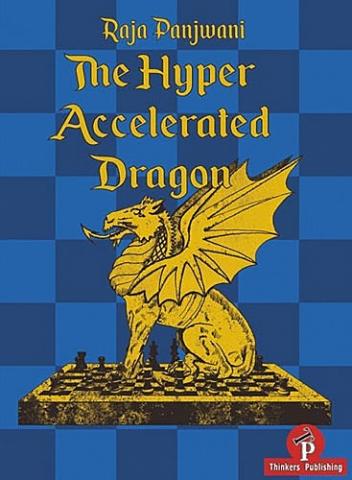
A Dragon You Can Believe In?
Raja Panjwani, "The Hyper Accelerated Dragon" (Thinkers Publishing, 2017)
After years of no chess books by Canadian authors, we are in the middle of a 9 month period when we will see three!
IM David Cummings published "Opening Repertoire: The English" (Everyman) in late 2016. GM Razvan Preotu and IM Michael Song -- or IM Michael Song and GM Razvan Preotu, if you ask Michael :) -- have a manuscript accepted for publication by Gambit, and expected out in the fall of 2017.
Last week, Thinkers Publishing released "The Hyper Accelerated Dragon" by Canadian IM Raja Panjwani. I bought it at Strategy Games on Sunday and have been going over it since. Here’s a review and excerpt.
Note to Parents: this may not be the Dragon your child is looking for. Grown ups, however…
The Sicilian Dragon is a perennial chess opening, played every day by youngsters, who love the fact that its typical opposite-side castling middlegames feature a few easily-learned maneuvers that result in pure calculate-to-mate middlegames, and played (occasionally) by World Champions (for surprise value, I suspect).
By contrast, despite their more radical-sounding names, the Accelerated and Hyper Accelerated Dragons are more sedate beasts: by delaying moving the d-pawn, Black can end up with less space, but has tactical and strategic options which cut across White’s most aggressive systems. This difference means they appeal to very different players: thrill-seekers like Nakamura give the Dragon a go from time to time, but stolid and hard-to-beat types like Tiviakov play the Accelerated. There are sharp lines in these Accelerated Dragons, but there are a lot more principled lines with extended maneuvering.
Moves and Chapters
The Hyper Accelerated Dragon begins: 1.e4 c5 2.Nf3 g6. Committing to the fianchetto before ...Nc6 rules out the very popular anti-Sicilian Rossolimo lines with Bb5, but does allow White to continue with 3.d4 cxd4 4.Qxd4, hitting h8, and this is the topic of one 12-page long chapter.
In both the Accelerated and Hyper Accelerated Dragons, Black delays ...d6, which makes ...d7-d5 (in one move) a clear equalizer in many variations. The Classical Variation (Be2 with 00) is the subject of Chapter 1, and Raja shows how Black equalizes with a quick …d5 (or less frequently …e5). That even includes a line where Black is not supposed to be able to get away with …d7-d5: 1.e4 c5 2.Nf3 g6 3.d4 cxd4 4.Nxd4 Bg7 5.Nc3 Nc6 6.Be3 Nf6 7.Be2 d5!? which will prove to be an unwelcome surprise to many White players.
If White avoids the Maroczy (c2-c4), then the only other way to stop the ...d7-d5 equalizer is 7.Bc4, which is the subject of Chapters 2 and 3. Black could allow the game to transpose into a Yugoslav attack (Bc4, f3, Qd2, 000, and a kingside pawn storm) but Raja wants to avoid that, and offers two antidotes: 7...Qa5 (ch.2) and his own system ("My System") which is a hybrid of the Dragon on the kingside (e7, f7, g6, h7/h5) and a Taimanov on the queenside (...a6, ...b5, ...e6). That's the subject of Chapter 3, and the excerpt in the game player below.
The downside of delaying central counterplay has generally been regarded as the Maroczy bind, where White clamps in the center and queenside with c2-c4. Raja has two chapters on the Maroczy: one on the Breyer variation (where Black trades a pair of Ns with ...Ng4 then plants the other N on d4 and tries to hold it there with ...e5), and the other (the longest in the book) on the main line Maroczy:
1.e4 c5 2.Nf3 g6 3.d4 cxd4 4.Nxd4 Bg7 5.c4 Nc6 6.Be3 Nf6 7.Nc3 0-0 8.Be2 d6 9.0-0 Bd7 10.Qd2 Nxd4 11.Bxd4 Bc6 12.f3.
I've long thought that White's best in the Maroczy mainline was 10.Nc2, avoiding the exchange to exploit the extra space. Black could avoid that with 9...Nxd4, but Raja credits Canadian GM Kevin Spraggett for showing him that does not equalize, thanks to 10.Bxd4 Bd7 11.Qd3!, which is analyzed in ch.5.1.
I'm not sure if I was pleased or disappointed to have my prejudices confirmed, when, at the end of the section on 10.Nc2 (ch.5.2) Raja admits that White is a bit better. But there's some good judgment -- and not just whistling in the dark -- when he writes:
"The reader should be suspicious of authors who claim pure equality in all lines in anything other than the most topical lines of the Ruy Lopez or perhaps the Najdorf Sicilian. This is the sort of += we have to live with as Accelerated Dragon players. White played very well to get here, he had to navigate his way around many landmines. After all that, we can seek consolation in the fact that objectively speaking, there are only three results in chess, and '+=' is just short-hand for '= after accurate play'."
That’s worth saying, but it’s something I think I’ve seen expressed only by a few other authors I respect – I think Aagaard said almost exactly the same thing in his book on the Tarrasch, and there was a funny moment in Svidler’s chess24 video series on the Grunfeld where he apologized, saying something like “I promised exciting counterattacking chess, but I keep delivering slightly worse endgames”.
In fact, I think the underlying point can be generalized to all opening books: if (as all the top players believe) chess is a draw with best play, then every opening repertoire book for White should conclude with at least one line where the author admits White has no realistic chance of winning. Anything other than that and your author is fooling someone, maybe himself. Any suggestions?
Author's Qualities
Raja Panjwani is a Canadian IM who has been playing this line for years, so he clearly understands what he's talking about, and it’s no surprise to see many of his games cited in the notes. Canadians will also enjoy seeing GM Kevin Spraggett and IM Dave Ross cited and thanked for advice and analysis. Even better, Raja has his own ideas for Black which he shares throughout, but in particular in Chapter 3, where he introduces his own Anti-Yugoslav Attack system.
One thing that stands out to me is his intelligent assessment of the strengths and weaknesses of computer evals in these middlegames. Raja regularly says things like:
- "the computer rates this as 0.00, but it is easier to play as Black, who can go... [and follows with a description of Black's goals and maneuvers]", or
- "the computer says Black is OK in this line, but the margin for error here is so narrow that I can't recommend it as a practical repertoire choice", or
- "the computer says White is better, but then just shuffles its pieces without making any improvement".
In our era of 3200+ Elo computers it's a good sign that an author consults them –- only an arrogant fool would not -- but it's an excllent sign when an author also knows how to interpret their evaluations. Sometimes "0.00" means the position is dead drawn, and sometimes it means there's a razor's-edge variation leading to a mind-boggling perpetual, and sometimes it means the computer can’t see any way to play the position which makes any difference to its evaluation – but humans can or think they can-- and it's essential to know which is which. Raja does. You can see some examples of this in the playable excerpt below.
This is not a complete repertoire book: if White doesn’t play d2-d4 then you’re on your own – then again, there’s no table of variations, so I might have missed something. The book does have one chapter on anti-Sicilians: the Alapin and the Morra. I was pleased to see Raja did not take the usual course of hand-waving bravado about the Morra Gambit – it’s totally refuted!! [followed by showing insanely sharp variations where… Black equalizes] --- but actually goes the opposite direction. He calls Marc Esserman’s book “Mayhem in the Morra” a “masterpiece” and concludes that the best response for a Hyper Accelerated Dragon player is to decline it:
"It is not at all clear to me that the Morra Gambit is refutable; on the contrary, Esserman's aforementioned book is a convincing defense of its soundness. Furthermore, as Hyper Accelerated Dragon players we offer White the option of a 'delayed' Morra Gambit 1.e4 c5 2.Nf3 g6 3.d4 cxd4 4.c3 after which our options are far more limited. As best I can tell, Black cannot safely accept the delayed Morra Gambit... Fortunately, the ...d4-d3 line is a reliable way of transposing into Maroczy-strucutres which we are familiar with and happy to play as Black. I cannot overstate how frustrating it is for Morra Gambit players to be denied their Romantic fantasies and instead be lulled into a slow, maneuvering Maroczy structure." (p.192)
That last line particularly stands out: no macho posturing, no “I’ll-show-you-you-can’t-play-that-nonsense-against-me!”, just a passive-aggressive judo roll –- you want mayhem, enjoy your maneuvering.
Rather in the spirit of the Hyper Accelerated Dragon, I think.
Production
The book is well manufactured, with thin glossy paper that makes it look and feel much thinner than its actual 226 pages,
There's no bibliography, but it's clear from the text which books Raja has consulted: Donaldson and Silman's book on the accelerated dragon (2008?) is sited regularly, and Raja offers antidotes to the lines recommended for White in Negi's very recent 1.e4 repertoire books for Quality Chess, Khalifman's "Opening Repertoire According to Anand" series, Sveshnikov's c3 Sicilian book, and others. Oddly, I didn't see any reference to Andrew Greet's 2008 Everyman book "Starting Out: The Accelerated Dragon", though (even there) his recommendation against the Qxd4 sideline is different from Greet’s (…Nd5-b6 vs …Nd5-c7, respectively).
There are a few typos -- e.g. there are illegal moves in the headings at the start of chapters 4 and 5 -- and inconsistency in the capitalization of the piece names, but nothing that will cause much confusion.
The only complaint I have about the production is the formatting of the variations. Most variations begin with a blank line separating it from the parent branch, with open parenthesis and an indented paragraph. This works fine for short variations, but falls apart with complex nested variations: double-indenting those is a waste of paper space, but without using some other method for distinguishing them it is much harder to scan the pages and distinguish the main variations from their subvariations. You can see this on the downloadable sample pages [link below]. Sometimes (as on the notes to move 12 on page 19 in the sample) the variations are short and non-nested, so they're easy to scan. But when the variations are complex, as they often are later in the book, the subvariations span many pages, making them difficult to follow. In fact, I noticed one place (p.67) where a variation is formatted inside a subvariation, which means even the editor got confused there. These are the standard problems of converting computer chess analysis into legible text, and different publishers have different ways of coping with them. I'd have liked Thinkers Publishers to think of a better way. If nothing else, they could do away with the blank line, which is a waste of space, since the indented paragraph sufficiently distinguishes the each note from its parent line. The extra space would have been better used by an index of variations or chapter summaries.
Summary: excellent content; could be a Book of the Year with more fastidious editing.
PS: the real test of any opening book is adopting it in your games. Obviously, that’s not possible in 3 days, but I might follow up with a review if I have time to try this.
Raja Panjwani, "The Hyper Accelerated Dragon" (Thinkers Publishing, 2017). 226 pages.
sample: the Introduction and the first game from Chapter 1: https://www.newinchess.com/Shop/Images/Pdfs/7701.pdf
You can get your copy of Raja Panjwani's "The Hyper Accelerated Dragon" delivered from Strategy Games.
Playable Excerpt
In Chapter 3: "My System" vs 7.Bc4, Raja introduces a hybrid Dragon/Taimanov system with g6, a6, and e6 (without ...d6) which he has played with success against 2500+ GMs. It will certainly cause even well-prepared White players trouble. One common motif is that Black has several ways to exploit the fact that the pawn is still on d7: sometimes bring a N to d6, either supporting ...f5 if White castles short, or heading to c4 if White castles long; sometimes playing …Qc7-d6/e5 to defend the kingside, and at other times Black will go a long way into the middle game before playing …d7-d5. You’ll see some of these in the playable excerpt below.
Even if you don’t play through many of the variations, you can get a good sense of the balance between variations and words by reading Raja’s comments (RP). Comments marked JKU are by me (John Upper).
Note: The game in the player below was copied from the book – move-by-move – by me, and it is unlikely that I made no mistakes. Please treat any egregious errors below as mine.
..
() - ()
Round: Result:
Round: Result:
..