[Event "Pacific Area Teams (bd3)"]
[Site "corr ICCF"]
[Date "1999.??.??"]
[Round "?"]
[White "Kempen, Leon JP"]
[Black "Sarosy, Zoltan L"]
[Result "0-1"]
[ECO "B14"]
[WhiteElo "2201"]
[BlackElo "2351"]
[Annotator "John Upper"]
[PlyCount "84"]
[EventDate "1999.07.01"]
[EventType "team (corr)"]
[EventRounds "2"]
[Source "Chess Mail Ltd"]
[SourceDate "2008.09.12"]
[SourceVersion "3"]
[SourceVersionDate "2008.09.12"]
[SourceQuality "1"]
[WhiteTeam "Australia"]
[BlackTeam "Canada"]

1. e4 c6 2. d4 d5 3. exd5 cxd5 4. c4 {The Panov-Botvinnik Attack. White heads
away from the maneuvering Caro-Kann middle-games and steers for an IQP
position with some attacking chances. Every Caro player should be prepared for
this.} Nf6 5. Nc3 e6 6. Nf3 Bb4 $1 {[#] The B will very often retreat (even
unprovoked) to e7, but this is not a full loss of tempo since White's usual
moves to defend c3 (Bd2 or Qc2) both reduce White's control on the d-file,
weakening the d4-pawn and eliminating the threat of d4-d5.} 7. cxd5 (7. Bd3 {
is also popular; after} dxc4 8. Bxc4 O-O 9. O-O {Black has nothing to complain
about after ...b6, or ...Nbd7 or even ...a6.}) 7... Nxd5 8. Bd2 Nc6 9. Bd3 O-O
10. a3 Be7 11. O-O Bf6 12. Qe2 {[#]} Nde7 (12... Nxd4 13. Nxd4 Bxd4 14. Bxh7+ (
14. Qe4 $2 Nf6 {defends the mate on h7 and the B on d4.}) 14... Kxh7 15. Qe4+
Kg8 16. Qxd4 $11 {with many draws, including: Adams,M (2615)-Speelman,J (2630)
Hastings, 1991 (½-½, 20).}) 13. Qe4 Ng6 (13... g6 {is interesting and
double-edged: Black weakens the kingside but can use the N to attack d4 from
f5, e.g.} 14. Bh6 Re8 15. Rad1 Nf5 (15... Nxd4 $4 16. Nxd4 Bxd4 (16... Qxd4 17.
Bb5 $18) 17. Bb5 $18) 16. Bf4 Nfxd4 17. Ne5 $44) 14. Be3 Bd7 {[#]} 15. Rfd1
$146 (15. Rad1 Qa5 16. Qg4 Nce7 17. Ne4 Rfd8 18. Nxf6+ gxf6 19. Nd2 Bc6 20. h4
h5 $1 $13 {0-1 (40) Orlov,V (2430)-Epishin,V (2620) St Petersburg 1996}) 15...
Qa5 16. Qg4 Nce7 17. Ne4 Rfd8 18. Nxf6+ gxf6 19. Nd2 Bc6 20. Rac1 f5 $5 21. Qg5
Qd5 22. Nf3 Ba4 {[#]} 23. Qf6 (23. Bc4 $142 Qd6 24. b3 Bc6 25. Ne5 $16) 23...
f4 {Only move.} {Stopping Bh6} 24. Bxf4 Nxf4 {[#]} 25. Bxh7+ $1 (25. Qxf4 Bxd1 {could
transpose after} 26. Bxh7+) 25... Kxh7 26. Qxf7+ Kh8 {Only move.} (26... Kh6 $2 27. Qxf4+
Kh7 (27... Kh5 $2 28. Re1 $18) 28. Qf7+ $18) 27. Qxf4 Bxd1 28. Qh6+ Kg8 {
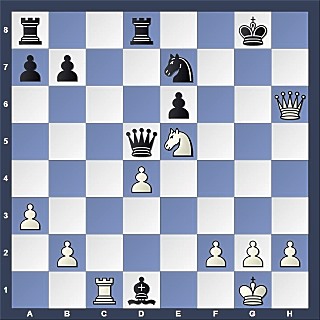
[#]A wild position: White (to play) is down a R and B for three pawns but has
chances against the exposed black K. What happens after: a) Rxd1 b) Ne5 b) Ng5}
29. Ne5 $1 {Threatening Qg5+.} (29. Rxd1 $2 Qf5 $19 {kills any attack and
Black's extra pieces win.}) (29. Ng5 $5 {Threatening Qh7-f7#.} Qf5 30. Nxe6 {Only move.}
(30. Rxd1 $2 Rxd4 $19) 30... Kf7 (30... Qf7 31. Nxd8 (31. Rxd1 $4 Rd6) 31...
Rxd8 32. Rxd1 $16 {with four pawns and an exposed King for the N.}) 31. Ng5+ {
and a repetition looks likely:} Ke8 32. Ne6 Kd7 33. Nc5+ $11 Kc7 34. Na6+ $11)
29... Bc2 $3 {[#] Tactically defending the light squares. This isn't Black's
only move (the computer says Black is OK after giving back material with ...
Rd7), but it is Black's best, as now White has to play only moves to stay in
the game.} 30. h4 $2 (30. Rxc2 $2 Qxe5 {Only move.} $19 {is the tactical point: White's
weak back rank allows Black to trade the Bd1 for the Ne5 after which there is
no attack is he's totally winning.}) (30. h3 {Only move.} {According to the computer
White is OK:} Ng6 (30... Bh7 $4 31. Rc3 Nf5 32. Qg5+ Kh8 33. Rc7 $18) 31. Rxc2
Nxe5 {Only move.} 32. Rc3 {Only move.} Rf8 {Only move.} {Black is up a R for three pawns, but his Rs are almost useless against the checks:} 33. Rg3+ (33. Qg5+ Kf7 {Only move.} 34. dxe5 Rad8 {Only move.} 35. Qh5+ (35. Rc7+ $11) 35... Ke7 36. Qg5+ Kd7 37. Qg7+ Ke8 38. Qg6+ Ke7 39.
Qg5+ $11) 33... Kf7 34. dxe5 Qxe5 35. Rf3+ Ke7 36. Qh7+ Ke8 37. Qg6+ Kd7 38.
Qh7+ Kc6 39. Qc2+ $1 Kb6 40. Rb3+ Ka5 41. Re3 {Only move.} $11 {and White can
"perpetual" the Q too.}) 30... Ng6 $1 (30... Bh7 $2 31. Rc3 {shows what White
hopes for with h2-h4.}) 31. Rxc2 (31. Nxg6 Qe4 $2 {loses to a long checking
sequence:} (31... Qxd4 {Only move.} $19 {wins by defending the dark squares and
indirectly defending the B with ...Qd1+.}) 32. Qh8+ Kf7 33. Ne5+ Ke7 34. Qg7+
Kd6 35. Nf7+ Kc6 36. Nxd8+ Rxd8 37. Qe5 {Only move.} $18 {and White wins the pinned Bc2
and the game.}) 31... Nxe5 {Only move.} {[#]} 32. Rc5 (32. Rc3 Ng4 {this is the
difference between h2-h3 and h2-h4 on move 30: Black will lose the N in return
for time to develop his Rs.} 33. Qg6+ Kh8 34. Qxg4 Rg8 $19) 32... Qxd4 {Only move.} 33.
Qg5+ Kf7 34. Rxe5 Rh8 (34... Rd5 {looks simpler, but postal chess doesn't
penalize for complicated play so long as it is sound.}) 35. Re3 Rag8 36. Rf3+
Ke8 37. Qb5+ Qd7 38. Qc4 Rh5 39. g3 Qc6 40. Qe2 Rxh4 41. Kg2 Re4 42. Qd1 Rg5
0-1