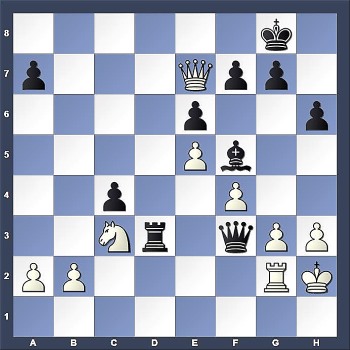
The 2017 Canadian Open began July 8 in Sault Ste. Marie and runs until July 16.
..
[Event "Canadian Open"]
[Site "Sault Ste. Marie"]
[Date "2017.07.07"]
[Round "1"]
[White "Preotu, Razvan"]
[Black "Itkin, David"]
[Result "0-1"]
[ECO "B12"]
[Annotator "John Upper"]
[PlyCount "78"]
[SourceDate "2017.07.08"]
[SourceVersionDate "2017.07.08"]

1. e4 c6 2. d4 d5 3. e5 Bf5 4. Nf3 e6 5. Be2 {[#]The Short System. White lets
Black have a "French with the "bad" c8-Bishop developed on f5, and tries to
show that the Bf5 is a either a liability (as it can be attacked by g4 or Nh4)
or no asset (if White can play around it to make its pressure on the h7-b1
diagonal irrelevant).} c5 (5... Nd7 {is the second most popular move, when
Black continutes with ...Ne7 or ...h6, making sure Black has minor pieces
ready before breaking with ...c5.}) 6. Be3 {[#]} cxd4 (6... Qb6 {leads to
poisoned-pawn complications after} 7. Nc3 Qxb2 $5 {[#]} (7... Nc6 $14) 8. Nb5 (
8. Qb1 $1) 8... c4 $5 (8... Na6 9. dxc5 $16) 9. Rb1 Qxa2 10. Nc7+ Kd8 11. Nxa8
Bxc2 12. Rxb7 $5 Bxd1 13. Rxb8+ Kd7 14. Bxd1 Ne7 15. O-O h6 $11 {1/2-1/2 (44)
Areshchenko,A (2702)-Jobava,B (2734) Burgas 2012}) 7. Nxd4 Ne7 8. c4 Nbc6 9.
Nc3 Nxd4 10. Bxd4 dxc4 11. Bxc4 (11. Qa4+ $5 Nc6 12. O-O-O $5 {is very
provocative but may be worth investigating, since the game line leads to a
small but very comfortable plus for Black.}) 11... Nc6 12. Bb5 Be7 13. O-O O-O
{Joe Gallagher says that here "Black probably has an edge as he has the more
effective minor pieces". (Starting Out: The Caro-Kann, Everyman 2011). Today's
computers agree, rating it =/+ after White's next:} 14. Bxc6 bxc6 {[#]
Structurally, Black is worse, with an isolated pawn on a half-open file; but
White doesn't have time to blockade and attack it before it moves to c4 where
it can support his B on d3 and put pressure on White's b2-pawn. Meanwhile,
White's problems (his DSB and e5-pawn are doing double-duty, and he has no LSB)
are long-term.} 15. f4 (15. Na4 $146 {looks natural, hoping for Bc5 and a
trade of the DSBs, but Black keeps a plus after:} Qa5 16. b3 Rfd8 17. Bc3 Rxd1
(17... Qa6 $5) 18. Bxa5 Rd5 19. Bc3 Rad8 20. Rac1 Ba3 $15) (15. Rc1 Qb8 16. Ne2
c5 17. Bc3 Rd8 18. Qa4 Bd3 19. Rfe1 Qb5 20. Qxb5 Bxb5 21. Ba5 Rdc8 22. Nc3 Bd3
23. Ne4 c4 24. Re3 Rcb8 25. Bc3 a5 26. g3 a4 $15 {½- (41) ½ (41) MacKinnon,K
(2140)-Gerzhoy,L (2471) Canadian Open, Toronto, 2010.}) (15. Qa4 $6 c5 16. Be3
Qb8 $1 17. Qd7 Re8 18. Nd5 $6 Bf8 $1 19. Rad1 (19. Nc7 $4 Re7 $19) 19... exd5
20. Qxf5 d4 21. Bc1 Qxe5 $17 {0-1 (52) Naiditsch,A (2697)-Anand,V (2788) Mainz
(rapid) 2009.}) 15... c5 16. Be3 Qb8 (16... Rb8) 17. Qe2 c4 $1 {[#] Black
would be happy to trade the c-file iso for the N-supporting b2-pawn, and if
White doesn't take on c4, it will keep the b2-pawn under pressure (as in the
Gerzhoy game quoted above).} 18. Rfe1 Rd8 19. Rad1 Qb4 20. Rxd8+ Bxd8 {Black
is better: he has the B-pair, pressure on the c-file, and can support this
c4-iso with Bd3.} 21. Rd1 Bd3 22. Qf3 Rc8 23. Rd2 Qb8 24. Qd1 Ba5 25. Qa4 Bb6
26. Bf2 Bxf2+ 27. Rxf2 Qb6 28. Qd7 Rf8 {I don't understand this move: f7
doesn't need defending, and both ...Rd8 and ...Rb8 make more sense. Maybe it
was a transcription error?} 29. g3 Rd8 30. Qe7 Bf5 31. Kg2 Qc6+ 32. Kg1 Qb6 33.
Kg2 {White indicates that he might be OK with a draw...} h6 $1 {...and Black
declines!} 34. h3 Rd3 35. Re2 Qc6+ 36. Kh2 Qf3 37. Rg2 {[#]Black's pieces
surround White's K, all he needs is a move that makes the house of cards
collapse.} Kh7 $1 (37... Bxh3 $2 {doesn't win when the White Q can get back to
h4:} 38. Kxh3 g5 $1 (38... Qh5+ $4 39. Qh4 $18) 39. Kh2 Qh5+ 40. Kg1 Rd1+ {
and Black can force a perpetual.}) (37... Rxc3 $2 {doesn't work where there's
a back rank check:} 38. bxc3 Be4 39. Qd8+ Kh7 40. Qd2 $16) 38. g4 (38. Qxf7
Rxc3 39. bxc3 Be4 $19 {and there's no stopping mate.}) 38... Qxf4+ 39. Kg1 Be4
{David Itkin scores the big upset of round 1 at the 2017 Canadian Open.} 0-1
..