The 2017 Canadian Open runs from July 8 - 16 in Sault Ste. Marie.
..
[Event "Canadian Open"]
[Site "Sault Ste. Marie"]
[Date "2017.07.13"]
[Round "6.2"]
[White "Hambleton, Aman"]
[Black "Vovk, Andriy"]
[Result "1-0"]
[ECO "B70"]
[WhiteElo "2471"]
[BlackElo "2630"]
[Annotator "John Upper"]
[PlyCount "87"]


1. e4 c5 2. Ne2 {This Chameleon-like move was often played by Paul Keres.
White keeps options of playing an open Sicilian with d4 or closed with d3, and
so can choose which Sicilian lines to avoid.} Nc6 3. Nbc3 Nf6 4. g3 {White's
decided there will be no Najdorf or Sveshnikov.} d6 5. Bg2 g6 6. O-O Bg7 7. d4
$5 {I was expecting a Closed with d2-d3 -- this IS a Canadian playing White in
the Canadian Open -- but Aman is one of the many Candians in the post-Suttles
and post-Day era who play the Open Sicilian as White.} cxd4 8. Nxd4 Bd7 (8...
Bg4 9. Nde2 Qc8 10. f3 Bh3 11. Bxh3 Qxh3 12. Bg5 O-O 13. Qd2 h6 14. Be3 Kh7 15.
Rac1 Qd7 16. Nd5 Nxd5 17. exd5 Ne5 18. b3 b5 19. Bd4 $14 Rac8 20. f4 Ng4 21.
Bxg7 Kxg7 22. Nd4 Nf6 23. c4 bxc4 24. bxc4 e6 25. dxe6 fxe6 26. Rfe1 Rfe8 27.
Nb3 a6 28. Qd4 Rc6 29. Red1 e5 $1 $11 30. fxe5 Rxe5 31. Qxe5 dxe5 32. Rxd7+
Nxd7 33. Rd1 Nf6 34. c5 Kf7 35. Rc1 Nd7 36. Kf2 Ke6 37. Ke3 Kd5 38. Rd1+ Ke6
39. Rc1 Kd5 {(½-½, 39) Spassky,B (2560)-Fischer,R (2785) Belgrade 1992.}) 9.
Nde2 O-O 10. h3 Ne5 11. a4 Qa5 12. b3 b5 $6 13. Be3 $1 {Defending the Ra1, and
so threatening axb5+-.} bxa4 14. Nxa4 Qc7 15. c4 {This gives Black a target on
b3, but it's still good.} (15. Qd2 $2 {steps into a fork on f3} Bxh3 $1 $17) (
15. f4 $5 {aiming to dislodge the Ns with an eventual g3-g4-g5 also deserves
consideration.}) 15... Rfb8 16. Ra3 Nc6 17. Nac3 a6 18. Qd2 Qc8 19. Kh2 Rb7 20.
f4 Rab8 {[#]} 21. Qd1 {I think this is an interestingly provocative way of
defending the b3-pawn. In part because it uncoordinates White's pieces a
little (the Be3 is undefended) but also because it sends a message to Black
that White may be perfectly happy playing this position VERY SLOWLY. Black
responds like a GM...} (21. Qc2 {would be the most natural way to defend b3.
My hunch is that White prefered Qd1 since the Qc2 could be attacked after some
sequence involving ...e5 and ...Nd4.}) (21. Nc1 {would be even more
provocative, but not necessarily bad.}) (21. Rb1 {is a natural way to defend
b3, but Black gets active after} Nb4 22. Nd4 e5 $5 $13) 21... Bg4 $1 {[#]
Clever and strong. It doesn't actually threaten anything, but it annoys White
by tying White down.} 22. f5 (22. hxg4 $4 Nxg4+ 23. Kg1 Nxe3 $19) (22. Rf2 e5
$1 $13 {a typical Dragon counter strike in the center, giving Black lots of
play.} 23. fxe5 (23. Qxd6 $4 {gets the Q trapped after} Rd7 24. Qc5 Bf8 $19) (
23. f5 $6 Nd4 $15 24. Bxd4 exd4 25. Qxd4 $2 Bxe2 $19 {and White can't
recapture on e2 without losing his Q to ...Ng4+.}) 23... Nxe5 24. Qxd6 Be6 {
threatening both ...Nfg4+ and ...Rxb3.}) 22... Bxe2 23. Nxe2 Nd7 24. fxg6 hxg6
$15 {[#] By trading his f-pawn for Black's h-pawn, White has conceded the e5
square to Black, which gives him a comfortable Dragon-type structure.} 25. e5
Ndxe5 (25... Bxe5 26. Rxa6) 26. Nf4 a5 27. Nd5 a4 $1 {Just a minority attack,
but now Black's Rooks are very strong.} 28. Rxa4 Rxb3 29. Bg5 {[#]} Bf8 (29...
Rb1 $1 {is probably winning for Black} 30. Qxb1 {is the obvious reply, but it
doesn't work since after} (30. Qe2 R8b2 $19) (30. Bc1 $1 {is the computer's
choice:} Bh6 31. Nf4 R8b4 32. Rxb4 Nxb4 $19 {Black is up a pawn and his pieces
are swarming into the weak squares behind the squares White's pawns used to
protect.}) 30... Rxb1 31. Rxb1 Qf5 $19 {Black's Q forks g5 and b1.} 32. Rb8+ {
hoping to deflect the Nc6 and fork Black on e7} Kh7 {Only move.} {and White is hanging
on b8 and g5,} 33. Nxe7 {forking g5 and c6,} (33. Bxe7 Nxb8 $19) (33. Bf4)
33... Nxe7 34. Bxe7 Qd7 $19 {forking e7 and a4.}) 30. c5 $5 {trying to make
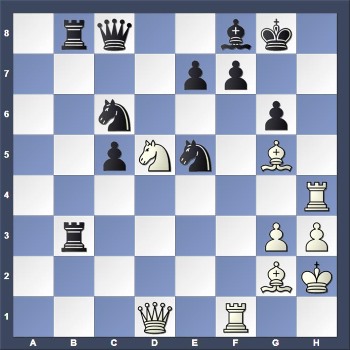
the most of the Ra4.} dxc5 $2 (30... Rb1 $1) 31. Rh4 {[#] Critical Position
What happens after 31...Rb1?} Rd3 (31... Rb1 {doesn't win for Black anymore,
but the refutation is not at all obvious:} 32. Bf6 {Only move.} {threatening mate on h8}
(32. Qa4 $2 Rxf1 33. Bxf1 Nf3+ $19) 32... Bg7 {Only move.} (32... Rxd1 $4 33. Rh8#) (
32... exf6 $4 33. Nxf6+ Kg7 34. Rh7#) 33. Bxg7 Rxd1 34. Nf6+ {Only move.} Kxg7 {Only move.} (34...
exf6 35. Bxf6 {and there's no defence to Rh8#.}) 35. Rh7+ Kf8 36. Rh8+ Kg7 37.
Rh7+ {Only move.} $11) 32. Qc1 (32. Bf6 {draws, as in the variations above after 31...
Rb1.}) 32... Nd7 $2 (32... Rd4 $1 {to trade the Rh4 while also defending the
4th rank and keeping the Ne5 where it defends f7.}) 33. Qf4 $1 $18 Nce5 34.
Nxe7+ $2 (34. Bxe7 $5 Rxd5 $1 35. Bxd5 $16) (34. Bf6 {Only move.} $18 {this wins, but
only if you see the follow up} Nxf6 35. Qxf6 {Only move.} {would be a wonderful move to
play against a 2600+ GM} Bg7 36. Nxe7+ Kf8 37. Nxg6+ (37. Rh8+ {also forces
mate.}) 37... Kg8 38. Rh8+ $1 Bxh8 39. Qxh8#) 34... Bxe7 35. Bxe7 Rb2 $2 {
This creates some terrific threats for Black, but if White can walk a
tightrope of only moves he'll end up with a winning position.} (35... Rd4 $1
$15) 36. Qh6 {Only move.} $18 {From here on, White plays perfectly.} Rxg2+ 37. Kh1 {Only move.} (
37. Kxg2 $2 Qa8+ {Only move.} 38. Kh2 Qa2+ {Only move.} 39. Kh1 Qd5+ {Only move.} 40. Kh2 Rd2+ $19) 37...
Rg1+ 38. Kxg1 {Only move.} (38. Rxg1 $2 Qb7+ 39. Kh2 Nf3+ $19) 38... Rxg3+ 39. Kh2 Rxh3+
40. Kxh3 {Only move.} (40. Rxh3 $4 Ng4+ $19) 40... Nf6+ 41. Kg2 Nh5 42. Bf6 $1 Qc6+ 43.
Kg1 $1 Nf3+ 44. Rxf3 {Only move.} {Aman moves to a 3-way tie for second with IM Kaiqi
Yang and GM Aryan Chopra, 1/2 a point behind the tournament leader, GM Razvan
Preotu.} 1-0
..