

You are here
GOTW: Vivas - Song, 2017 PanAms

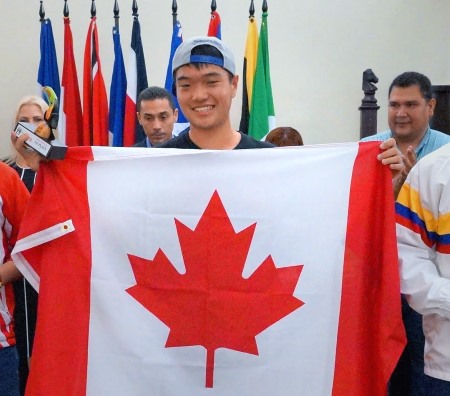
Canadian IM Michael Song won the 2017 Pan-American Youth Championship U18 in Costa Rica this month. For our Canadian Game of the Week, IM Michael Song annotates his round 7 win with Black in a very theoretical Scotch.
Michael's notes to this game offer us a look inside both the opening preparation of a serious young player, and the in-game emotional ups-and-downs on the top board in an international tournament.
If you enjoy Michael's analysis, look for his forthcoming book with GM Razvan Preotu, "The Chess Attacker's Handbook", due out from Gambit in November (possibly sooner!).
Links
Canadian Pan Am Results
http://chess.ca/newsfeed/node/975
The Chess Attacker's Handbook (publisher's description)
http://www.gambitbooks.com/books/The_Chess_Attacker's_Handbook.html
..
() - ()
Round: Result:
Round: Result:
[Event "2017 Pan-American Open"]
[Site "Costa Rica"]
[Date "2017.07.05"]
[Round "7"]
[White "Vivas, Fabian"]
[Black "Song, Michael"]
[Result "0-1"]
[ECO "C56"]
[WhiteElo "2128"]
[BlackElo "2410"]
[Annotator "Michael Michael"]
[PlyCount "104"]
[EventDate "2017.??.??"]
[SourceDate "2017.07.07"]

{This game, which was played in round seven, was arguably the most crucial
game in my overall tournament victory. At this stage, I was half a point ahead
of the field, and a win here would virtually clinch the tournament in my
favour (although my last round proved this to be false...). . I was paired
against a relatively low-rated player from Venezuela, who was not to be
underestimated as he had beat both Canadian FM Olivier Kenta Chiku-Ratte and
Peruvian IM Kevin Joel Quspe Cori earlier in the tournament. I discovered in
my preparation the night before that he played exclusively the Scotch Gambit
with 4.Bc4, which I believe to be at least equal for Black. Hence, I walked
into the tournament hall that day on board one with an exuberant amount of
confidence, knowing that I should have good chances to score the full point
with Black.} 1. e4 e5 2. Nf3 Nc6 3. d4 exd4 4. Bc4 Nf6 5. e5 (5. O-O Nxe4 6.
Re1 d5 7. Bxd5 Qxd5 8. Nc3 {is the other option for White, after which Black
has several reasonable replies including 8...Qa5, 8...Qh5, 8...Qd8, and even
my personal favourite, the enterprising 8...Qd7!?}) 5... d5 6. Bb5 Ne4 7. Nxd4
Bc5 $5 {[#] This was the variation I had prepared for this game. I felt it was
a good surprise weapon compared to the standard 7...Bd7 variation, and it was
in no way inferior to that. I also felt that there was a substantial chance
that my opponent would falter quickly in this less-familiar variation, but
sadly for me he began blitzing out the next couple of moves.} 8. Be3 $1 {
The correct response.} ({One basic point is that:} 8. Nxc6 $2 bxc6 9. Bxc6+ Bd7
10. Bxa8 Bxf2+ $19 {when White will be met with a devastating check from
Black's light-squared bishop.}) (8. O-O $6 {is also met strongly by:} O-O $1 9.
Nxc6 {Not the only move, but no other moves were promising for White in any
case.} bxc6 10. Bxc6 Ba6 $1 $15 {when Black is more than OK.}) 8... O-O 9. Nxc6
bxc6 10. Bxc5 Nxc5 11. Bxc6 Rb8 (11... Ba6 $2 {is seen just as frequently, but
the game continuation is much more accurate.} 12. Nc3 $1 Qg5 (12... d4 13. Bxa8
Qxa8 14. Qxd4 Rd8 15. Qg4 h5 16. Qf3 $18 {Black simply does not have enough
compensation here.}) 13. Qd4 Ne6 14. Qe3 $18) {[#]} 12. Qxd5 $1 {Here, my
opponent thought for about three minutes before playing this move, but was
successful in finding the right continuation. Seeing that he and I both
blitzed all our moves up until this moment, I figured that his pause was
simply an attempt to try and pretend that he was out of his preparation.} (12.
Bxd5 $6 Ba6 $40 {looks extremely dangerous for White, who cannot castle so
easily.}) (12. O-O Ba6 $1 13. Re1 Rxb2 14. Bxd5 Nd3 $1 {In the excellent book
"Playing 1.e4 e5" by Ntirlis, he claims that this shot gives Black a slightly
better position, but in fact I discovered some difficulties for Black in
variations following the move:} 15. Bb3 $1 {Eventually, I analyzed the
position up to move 30 and concluded that Black would be OK, but believe me
when I say that finding a path to equality in this variation was a nightmare
the previous evening...}) 12... Qe7 13. O-O Rxb2 {[#]} 14. Qd4 $6 {I was
pleased to see this move played on the board, because I had looked at this
position literally ten minutes before the game started and remembered that
this queen retreat was not the most challenging option.} (14. Nc3 $1 Rd8 15.
Qf3 Ne6 $1 {with the idea of bringing the knight to d4 gives Black ample
compensation for the missing pawn, although he still must play accurately to
ensure equality.}) 14... Rb6 $1 (14... Rxc2 15. Nc3 {looked a bit dangerous to
me, as after:} Ne6 16. Qd3 Rb2 17. Nd5 Qc5 18. Rac1 Qd4 19. Qf5 $36 {White's
centralized pieces look very threatening.}) 15. Bf3 Rd8 16. Qe3 ({The point is
that} 16. Qc3 {allows:} Na4 17. Qa3 Qxe5 $1 18. Nd2 Rxd2 19. Qxa4 g6 20. Rfe1
Bd7 $1 $15 {when Black has good chances to grind a victory in this endgame.})
16... Re6 17. Na3 Rxe5 $15 {[#] I could not be happier with the result of my
opening preparation. Not only have I restored material equality, but my rooks
are optimally placed on the open files. Not to mention that White's isolated
pawns are weaker than Black's isolated pawns due to the color configuration of
the pawns and the light-squared bishops.} 18. Qc3 Na4 19. Qb3 Nb6 {I figured
that the knight was better on b6 than c5, as the c5-square could be useful for
either Black's queen or rook to use in order to attack the weak c2-pawn.} 20.
Nc4 {As soon as he played this move, I nearly jumped with joy as I thought he
had blundered his knight, only to be dissapointed seconds later after
calculating the resulting variations.} Nxc4 (20... Be6 $2 {looks like it pins
and wins the knight, but unfortunately fails to:} 21. Nxe5 Bxb3 22. Nc6 $1 $14
{when White will pick up two rooks for the queen.}) 21. Qxc4 Bf5 {Developing
and pressuring c2.} 22. h3 {[#] But now what to do for Black? Now that White
has solved his back rank problems, he is ready to play Rad1, exchange rooks
and neutralize Black's initiative. This means that Black cannot follow suit
with a move like 22...h6 if he seriously wants to fight for the win. But
knowing that I had not yet made a mistake in this game and had the advantage,
it was one of those positions in which you knew that the chess gods would make
sure that there was something to play for in the position. I sat down for over
twenty minutes on this move and came up with an interesting tactical plan to
win a pawn.} Rc5 23. Qb4 $6 {A very natural move to put Black's rook in an
awkward pin, but this is a mistake as he is oblivious to my idea.} (23. Qa6 $1
{would more or less be OK for White, when he will exchange his c-pawn for
Black's a-pawn.}) 23... a5 24. Qa3 Bxh3 $1 {The point. The bishop is taboo due
to ...Rg5+, winning the queen on a3. Now Black is up a pawn for no
compensation, though the task of conversion is by no means an easy one.} 25.
Rad1 Rxd1 26. Rxd1 Be6 {Needed to stop the threat of ...Rd5.} 27. Rd8+ (27. Rb1
{My heart jumped a beat when I noticed this possibility which I forgot about
when calculating 22...Rc5, but I calmed down when I noticed that Black had the
only defense:} Qf8 $1 $15 {parrying both threats of Rb5 and Rb8.}) 27... Qxd8
28. Qxc5 Bxa2 29. Qxa5 Be6 30. Qb4 h6 31. Bg4 c5 32. Qf4 {[#] Black has a huge
decision to make here in how he will set up his queen and pawns in the
forthcoming queen endgame after the bishops are traded. In all honestly, I
still don't know the best route for Black to take here, but I am not at all
dissapointed with the path I chose in the game.} Qd4 $5 (32... Bxg4 33. Qxg4
Qd5 {was the other option I was considering, although I felt that the three
against two majority on the kingside would be very difficult to utilize.}) 33.
Qb8+ Kh7 34. Bxe6 fxe6 {The idea of making the isolated e-pawn is that I felt
one day the e-pawn might be able to advance all the way to e3 to break down
White's kingside structure.} 35. Qb3 Qa1+ $1 {[#] It looks like a simple check,
but I believe this was the most instructive move in the game, as we see why
two moves later.} 36. Kh2 Qe5+ 37. g3 (37. Kh3 {looks very dangerous as now
White must always watch out for queen checks and exchanges with his king
exposed in the open. But maybe it was objectively the best option.}) (37. Kg1 {
is strategically desireable but is impossible due to:} Qe1+ $1 {The queen
check from a1 and back to e5 allows Black to play this with tempo.} 38. Kh2
Qxf2 39. Qxe6 Qxc2 $19 {and Black's queen covers the checks.}) 37... Qh5+ {
[#] By this queen maneuver, Black was able to provoke the move g2-g3. To an
inexperienced eye, this may not look like a big difference. However, there are
significant consequences for White as a result of this move. Not only is his
king exposed to light-square checks now, but the pawn on g3 also may be a
target for a future ...h5-h4, or may have even opened up a trail for Black's
king to run to h3 for mate (Nigel Short, anyone?)} 38. Kg1 Qd1+ 39. Kh2 (39.
Kg2 $4 Qd5+ $19) 39... Qe2 40. Kg2 c4 41. Qb2 e5 42. Kg1 h5 {Slowly but surely,
Black is making progress.} 43. Qc3 Kg6 44. Kg2 {[#]} Kf5 (44... e4 $1 {was in
fact even stronger. I saw this idea, but I missed some certain moves in this
variation.} 45. Kg1 (45. Qd4 Qf3+ 46. Kg1 e3 47. fxe3 Qxg3+ 48. Kf1 Qg4 $19 {
and Black's kingside pawns should decide the game.}) 45... e3 $2 46. fxe3 Kh6
$3 {Somehow putting White in zugzwang as he cannot hold on to all of his pawns.
For example:} 47. Kh1 Qf1+ 48. Kh2 Qf2+ 49. Kh3 Qg1 $19) 45. Qa3 $2 {My
opponent goes for broke, but to no avail.} (45. Qb2 Qe4+ 46. Kg1 g6 $17 {
followed by ...h5-h4 still offers Black good winning chances, although my
intuition tells me that White should be able to hold a draw with precise
defense.}) 45... Qe4+ 46. Kh2 Qxc2 47. Qf3+ (47. Qf8+ Ke4 48. Qa8+ Kd3 49. Qd5+
Ke2 $19 {and Black will escape the checks.}) 47... Kg6 48. g4 Qd3 49. gxh5+ Kh7
50. Qc6 c3 51. Kg2 c2 52. Kh2 Qf5 {and White has no defense to the idea of
Black either bringing the queen to f4 or g5 with check and promoting the
c1-pawn. A very tough grind indeed!} 0-1
merida
46
..
Category:
© 2013-20 CFC & McGill Students' Chess Club
Designed by Shao Hang He.