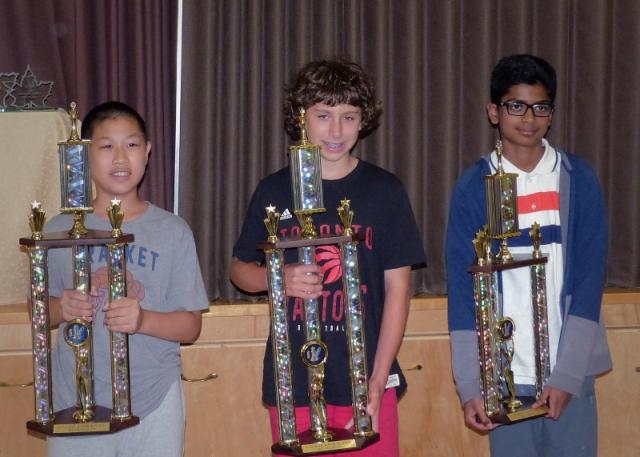
Our Game of the Week is Aiden Mirabelli's round 6 win from the 2017 Canadian Junior Reserves. White plays a bit passively in the opening and Black wins a pawn, but then has to show good technique to turn that pawn into a win... and Aiden does.
..
[Event "Canadian Junior Reserves"]
[Site "?"]
[Date "2017.08.12"]
[Round "6.15"]
[White "Bhavatharshan, Jeyakumar"]
[Black "Mirabelli, Aidan"]
[Result "0-1"]
[ECO "B22"]
[WhiteElo "1511"]
[BlackElo "1566"]
[Annotator "John Upper"]
[PlyCount "80"]
[SourceDate "2017.08.13"]
[SourceVersionDate "2017.08.13"]

1. e4 c5 2. c3 Nf6 3. e5 Nd5 4. d4 e6 5. Nf3 cxd4 6. cxd4 d6 {[#] This is one
of the main lines in the Alapin, and (perhaps surprisingly, given that White
goes for it) Black has a plus score from here: 54% and Elo +30. Perhaps one
reason White players go for this is that they hope to catch their opponents on
unfamiliar ground, since the resulting middlegames resemble 1.d4 d5 openings
more than Sicilians. White doesn't want to take on d6, so the middlegames
depend on how White will recapture on e5: with the N and a standard IQP
middlegame, or with the pawn, which gives White kingside attacking chances.} 7.
Be2 {The B is safe here, but (SPOILER ALERT) blocking the e-file makes it more
difficult to defend the e5 square.} (7. Bc4 {is both more active and more
common. Black can kick the Bc4 away with} Nb6 {usually followed by capturing
on e5,} ({or just continue developing with ...Nc6 and ...Be7.} 7... Nc6 8. O-O
Be7 9. Qe2 {and White's development looks harmonious than the game.})) 7... Nc6
8. O-O dxe5 9. dxe5 Be7 {[#]} 10. Nbd2 (10. Bd2 O-O 11. Nc3 Nxc3 12. Bxc3 {
the e5-pawn is supported and White has more space but doesn't turn it into
anything.} Bd7 13. Qd2 Qb6 14. a3 Rfd8 15. Rad1 Be8 16. Qf4 {½-½ Benko,
F-Sanguineti,R Mar del Plata, 1968.}) 10... O-O 11. Ne4 (11. Nc4 {Supports the
e5-pawn.} Qc7 12. Qc2 Bd7 (12... Ncb4 13. Qe4 b5 $11) 13. Qe4 b5 14. Ne3 Ncb4
15. a3 (15. Nxd5 $14) 15... Nxe3 16. Bxe3 Qc2 $1 17. Qb7 Nd5 18. Nd4 Qc8 19.
Qxc8 Rfxc8 $11 {Savic,M (2539)-Kovacevic,A (2571) Vrnjacka Banja, 2013 ½-½
(65).}) 11... Qc7 {White can't save the e5-pawn.} 12. Qc2 $1 $146 Nxe5 {
Winning a pawn. Interestingly, the computer prefers both ...h6 and ...Bd8,
slightly improving Black's position before taking on e5.} 13. Qxc7 Nxf3+ 14.
Bxf3 Nxc7 {[#]} 15. Be3 $6 (15. Nc3 $1 $15 {Preventting the game move leaves
Black up a pawn but without the use of the d5 outpost and difficulty finishing
developing his queenside.}) 15... Nd5 $15 {Blocking the long diagonal and
threatening to trade the B that's attacking a7.} 16. Bc5 Bxc5 17. Nxc5 b6 18.
Ne4 (18. Bxd5 $1 exd5 19. Nb3 $15 {when White has some compensation in the
form of the good N vs bad B.}) 18... Rd8 $1 (18... Bb7 {is less accurate,} 19.
Nd6 Rab8 20. Nxb7 Rxb7 21. Bxd5 exd5 22. Rfd1 {when the pair of rooks makes
the IQP hard to push.}) 19. Nc3 Bb7 20. Nxd5 Bxd5 21. Bxd5 Rxd5 22. Rfd1 (22.
Rac1) 22... Rad8 23. Rxd5 Rxd5 (23... exd5 $2 {creates a passed pawn, but it's
easily blockaded by the white K.}) 24. f3 $6 {[#] this stops back rank mates
and looks like it clears a path for the white K to approach the center, but it
also makes the second rank "longer", so that the black R on the second rank
will cut off the white K and will attack both b2 and g2 (not just b2 and f2).}
Kf8 (24... Rd2 $1 {is stronger, even though it allows White to activate his R;
for example:} 25. Rc1 g5 $1 26. Rc7 a5 27. b3 (27. Rb7 Rxb2 $19 {defends the
b6-pawn.}) 27... Rxa2 28. Rb7 Rb2 $1 29. Rxb6 a4 $1 $19) 25. Rc1 Ke7 26. Rc7+
Rd7 27. Rc2 {[#] White has the best defensive arrangement he could hope for.
Black wins if he can force off the Rs, though White doesn't have to allow that.
White draws if he can trade off the queenside pawns, though Black doesn't have
to allow that. Instead, Black induces White to push his pawns, making it
easier to create a passed pawn.} Kf6 28. Kf2 h5 29. Kg3 Kg5 30. h4+ (30. a3 h4+
31. Kf2 Rd3 32. Ke2 Rb3 33. Kf2 Kf5 {when ...g5-g4 will create a protected
passed e-pawn (if Black takes on g4) or a weakness on f3 (if White takes gxf3).
}) 30... Kf5 31. Re2 e5 32. a3 f6 33. Re3 {[#]} g5 (33... Rd2 34. Rb3 g5 {
is good too, but Black continues to play purposefully.}) 34. hxg5 fxg5 35. b4
Rd4 36. Rc3 e4 $1 37. fxe4+ Kxe4 {[#] And Black is now not only up a pawn, but
has the much more active K.} 38. Rf3 Rd3 $1 {Forcing off the Rs.} 39. Rxd3 (39.
a4 h4+ 40. Kg4 Rxf3 41. gxf3+ Ke3 42. b5 Ke2 $19) 39... Kxd3 40. Kf2 b5 {
White loses his queenside pawns. Purposeful and strong endgame play by Black,
and a pleasant surprise to see from any player under 1600.} 0-1
..