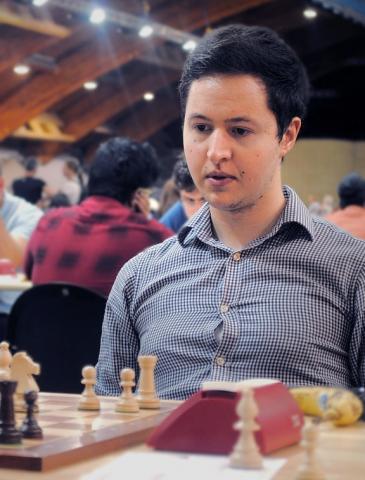
Still in transit, Michael annotates the game that pushed him over the line here...
..
[Event "Barcelona Sants Open"]
[Site "?"]
[Date "2017.08.24"]
[Round "8"]
[White "Kleinman, Michael"]
[Black "Brunner, Nicolas"]
[Result "1-0"]
[ECO "B51"]
[WhiteElo "2340"]
[BlackElo "2472"]
[Annotator "Michael Kleinman"]
[PlyCount "77"]
[EventDate "2017.08.18"]
[SourceTitle "CFC Newsfeed"]

{This game was played in round 8, and I was in the fortunate position that a
win would secure me the norm and would push my live rating above 2400, whereas
a draw would have likely been enough to secure the IM norm, but would have
left me a few points below 2400.} 1. e4 c5 2. Nf3 d6 3. Bb5+ ({In the past, I
have almost exclusively opted for the sideline of 4.Qxd4 against 2... d6, but,
while the positions are comfortable for White, it is nowadays very difficult
to fight for an opening advantage there against a well-prepared Black player.}
3. d4 cxd4 4. Qxd4) 3... Nd7 4. O-O a6 5. Bd3 {[#] Carlsen played this against
Svidler in 2013, and this position has become the tabiya of 3.Bb5+ Nd7.
White's idea is to develop a strong center after c3-Bc2-d4.} Ngf6 6. Re1 e6 (
6... b5 7. c4 g5 $5 {is another interesting variation.}) 7. c4 {This was
played by Shanglei Lu against Wei Yi a few weeks before my game, and I wanted
to try it out. The point is to aim for a Hedgehog after Nc3, Bf1, and d4.} (7.
c3 {is by far the main move, but Black has been doing well after} b5 8. Bc2 c4
$1 {hindering the d4 advance.}) 7... Ne5 8. Bf1 Be7 9. Nc3 O-O 10. d4 $5 (10.
d3 {seemed a bit slow to me.} Rb8 11. Bf4 (11. h3 b5) 11... Ng6 12. Bg3 e5 {
and the bishop would be misplaced on g3.}) 10... Nxf3+ 11. gxf3 cxd4 12. Qxd4 {
[#] This is quite a unique hedgehog with double f-pawns, but it is difficult
for Black to take advantage of them. Ideally, Black would want to take
advantage of the weakened king by placing the knight on an active square such
as f4, or on g4 if White is to advance the pawn from f3. In contrast to a
typical hedgehog, White has the advantage of having a pawn along the g1-a7
diagonal which makes the king quite a bit safer, potentially mobile f and
e-pawns, as well as options to activate the light square bishop via g2, which
usually stays on f1 in a normal Hedgehog.} Qa5 (12... e5 13. Qd3 Be6 14. f4 {
and we can see the advantage of having double f-pawns}) 13. Bg2 {[#]} Bd7 (
13... b5 14. cxb5 axb5 15. b4 $14) ({Rerouting the queen to h5 is very
dangerous for Black as the queen has very few squares, as can be seen from the
following lines.} 13... Qh5 14. e5 dxe5 15. Rxe5 Qg6 16. Rg5 Qh6 17. Rg3 ({
White has the option of repeating} 17. Re5 Qg6 18. Rg5 $11) 17... Qh5 18. Ne4 (
18. Bg5 $1 {is the computer's suggestion, and also a very natural move.}) 18...
Kh8 (18... Rd8 19. Qxf6) 19. Rg5 Qh4 20. Rxg7 $1 Kxg7 (20... Nxe4 21. Rxf7+ Bf6
22. Rxf8+ Kg7 23. Rxf6 $18) 21. Bg5 Qh5 22. Bxf6+ Bxf6 23. Qxf6+ Kg8 24. Qc3
$18) 14. Bd2 Qc5 (14... Qh5 15. e5 {is similar to 13...Qh5.}) (14... Qc7 {
might be the best square for the queen, but it is difficult to play such a
move after already playing ...Qa5.}) (14... e5 15. Qd3 ({The immediate} 15. Nd5
{does not quite work.} Nxd5 (15... Qxd5 16. exd5 exd4 17. Rxe7 Rfe8 18. Rae1
$11) 16. Bxa5 exd4 $11) 15... Nh5 16. Nd5 Qd8 17. Ba5 Qxa5 18. Nxe7+ Kh8 19.
Qxd6 Be6 20. Nd5 $14) 15. Qxc5 dxc5 {[#]} 16. Bg5 {Objectively, this move is
innacurate, but I wanted to exchance off my dark square bishop before
advancing my pawns to e5 and f4.} ({The logical} 16. e5 Ne8 (16... Nh5 17. f4
Rab8 18. Bf3) 17. f4 Rb8 {led to a position that I had mis-evaluated during
the game. I thought Black would continue with ...g6, and ...Ng7, thereby
solving all of his problems, but Black does not have time for this as the
Bishop on d7 does not have many squares.} 18. Rad1 g6 19. Be3 $16 Bc8 (19...
Bc6 {leads to a horrible structure} 20. Bxc6 bxc6 21. b3 $16) 20. Na4 b6 21. b4
$16 {and White is crashing through on queenside, while Black is underdeveloped.
}) 16... h6 17. Bxf6 Bxf6 (17... gxf6 $5 {is also possible.}) 18. e5 Be7 19.
Rad1 ({The immediate} 19. f4 {would give Black the extra option of} Rfb8 20.
Rad1 Be8) 19... Rfd8 20. f4 Rab8 21. Re2 {[#]} b5 ({The slow} 21... b6 {
is met by} 22. Red2 Be8 23. Rxd8 Bxd8 24. Bb7 a5 {and Black's queenside is
weakened.}) 22. Red2 Be8 23. Rxd8 Bxd8 24. Ne4 (24. Bb7 {was my original idea,
but Black is probably better after the precise} bxc4 (24... Rxb7 25. Rxd8 Kf8
26. Ne4 Re7 27. Nd6 {and Black is in zugzwang.}) 25. Bxa6 Ba5 $1) 24... Be7 (
24... bxc4 $1 {was necessary} 25. Nxc5 (25. Nd6 $2 Ba4 $1 26. Rd2 Ba5 $19)
25... Be7 26. Nb7 $13) 25. Nd6 Bxd6 (25... Rd8 26. b4 $1 cxb4 27. c5 $14) (
25... Kf8 26. b4 $13) (25... bxc4 {is probably still necessary.} 26. Nxc4 Bb5
27. Nd6) 26. exd6 Bd7 27. b4 $1 {[#]} Rc8 (27... cxb4 28. c5 Rc8 29. c6 Bxc6
30. Bxc6 Rxc6 31. d7 $18) (27... bxc4 28. bxc5 c3 29. Rc1 (29. c6 $4 c2 30. Rc1
Rb1 31. cxd7 Rxc1+ 32. Bf1 Rxf1+ 33. Kxf1 c1=Q+ {and Black can stop the pawns})
29... c2 30. Be4 $1 $18) 28. Bb7 Rb8 29. Bg2 {Repeating to get closer to time
control} Rc8 30. Bb7 Rb8 31. Bxa6 {[#]} bxc4 (31... cxb4 32. c5 {followed by
Rd4-xb4 should win.} (32. Bxb5 $2 Bxb5 33. cxb5 Kf8 {might be OK for Black.}))
32. bxc5 c3 33. Rc1 Bc6 34. Bd3 (34. Rxc3 Rb1+ 35. Bf1 Bb5 {is Black's point.
Even here, White actually still wins wins with 36.Rb3, but there is really no
point to allow this.}) 34... Ra8 {[#]} 35. f3 $1 {This move dislodges the
Bishop from its ideal square on c6 by preparing Be4, and also makes space for
the king.} Bxf3 (35... Kf8 36. Be4 Bxe4 37. fxe4 $18) (35... f5 36. Bc4 $18)
36. Bb5 Rxa2 37. d7 Rd2 38. Rxc3 Be4 39. Bd3 1-0
..