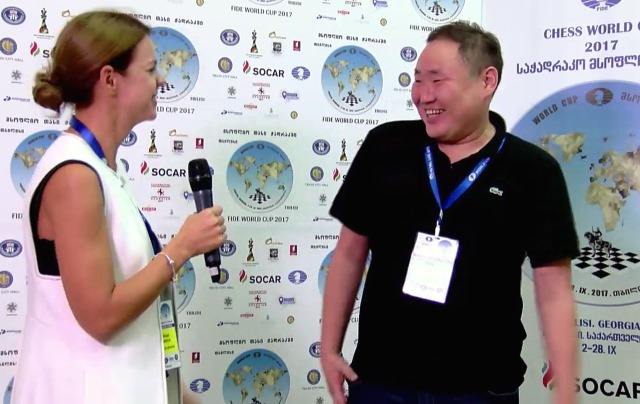
Both Canadians won their opening round games at the 2017 World Cup in Tbilisi today:
..
[Event "FIDE World Cup 2017"]
[Site "Tbilisi"]
[Date "2017.09.03"]
[Round "1.1"]
[White "Sambuev, Bator"]
[Black "Wei, Yi"]
[Result "1-0"]
[ECO "E20"]
[WhiteElo "2529"]
[BlackElo "2748"]
[Annotator "John Upper"]
[PlyCount "47"]
[EventDate "2017.??.??"]

1. Nf3 Nf6 2. c4 e6 3. Nc3 d5 4. d4 Bb4 {Black's first longish think of the
game. There are 11 Wei Yi games in MegaBase from this position, but noone has
played the next move against him...} 5. g3 O-O 6. Bg2 dxc4 7. O-O Nc6 8. a3 Be7
{[#] Another longish think. So far Bator has been playing all his moves in
less than a minute.} 9. e4 Na5 10. Be3 Rb8 {Almost 20 minutes on this, a clear
sign that Black is uncomfortable.} 11. Qe2 b5 12. Rad1 {[#] After the game,
Bator said that he had reviewed Wei Yi's games and had found some ways to
create positions he believed the 18-year-old would find uncomfortable. Judging
by the time Black was using, this is one of them.} Bb7 $146 (12... a6 13. d5
Qe8 14. Rfe1 Nb3 15. Bf4 Rb7 16. h3 Nc5 17. dxe6 fxe6 18. Ne5 Rb6 19. Be3 Rd6 {
a very nice maneuver of the R by Karjakin} 20. f4 Bb7 21. Bf2 Rxd1 22. Rxd1 Qa8
$1 23. Rd4 Rd8 $17 {0-1 (45) Onischuk,A (2662)-Karjakin,S (2762) Baku 2015})
13. Ne5 (13. d5 {is playable, but not initiating forcing play is a good choice
against the Chinese teenager, who is well known as an excellent calculator.}
exd5 14. e5 Ng4 (14... Ne8 15. Bxa7 (15. e6 $5)) 15. Bf4 $13) 13... a6 {
14 minutes on this.} 14. g4 $5 Ne8 15. d5 exd5 16. Nxd5 Nd6 17. g5 {[#]} Bxd5 {
15+ minutes on this.} (17... Bxg5 {was a complex and playable option:} 18. Bxg5
Qxg5 19. Nd7 Rbd8 (19... Rfe8) (19... Rbe8 20. f4 $13) 20. Nxf8 Rxf8 21. Qd2 (
21. Nxc7 $4 Bxe4 22. f3 Bd3 $19) 21... Qxd2 22. Rxd2 Nb3 $11) 18. Rxd5 $14 (18.
exd5 $4 Bxg5 $17) 18... c6 (18... Bxg5 19. Bxg5 Qxg5 (19... f6 20. Bd2 $18) 20.
Nc6 $1 {the discovered attack on the Q wins a a piece. It's funny how all
these central and kingside tactics work because of the undefended Na5.}) 19.
Rdd1 $36 Qc7 {[#]} 20. Qh5 $1 g6 $2 (20... Nb3 21. Ng4 {preparing Nf6 or
f2-f4-f4.} (21. Bf4 $5)) 21. Qh6 $18 Nxe4 $6 22. Nd7 (22. Ng4 {is still
winning, but not nearly as clear cut as the game:} f5 23. Bxe4 fxe4 24. Bd4 Bd6
25. Rfe1 $1 (25. Nf6+ Rxf6 26. gxf6 Nb3 27. Bb6 $1 Qd7 28. f3 $1 $18 (28. Rxd6
$4 Qg4+ $11)) 25... Nb3 26. Rxe4 {White is still down a pawn but has a huge
attack.}) 22... Nd6 {[#]} 23. Bh3 {Only move.} {Defending the Nd7 and preventing ...Nf5.}
Rfd8 24. Rd4 $1 {The most precise.} (24. Rd4 {the game might have ended:} Rxd7
(24... Bf8 25. Nf6+ Kh8 26. Qxh7#) 25. Rh4 f5 26. Qxh7+ Kf8 27. Qxg6 Nf7 28.
Rh7 Bd6 29. Re1 $18) 1-0

[Event "FIDE World Cup 2017"]
[Site "Tbilisi GEO"]
[Date "2017.09.05"]
[Round "1.1"]
[White "Akobian, Varuzhan"]
[Black "Kovalyov, Anton"]
[Result "0-1"]
[ECO "D27"]
[WhiteElo "2662"]
[BlackElo "2641"]
[Annotator "John Upper"]
[PlyCount "122"]
[EventDate "2017.09.03"]

1. d4 Nf6 2. c4 e6 3. Nf3 d5 $5 {Already unusual: Anton's games in the
database all continue ...b6.} 4. Nc3 dxc4 5. e3 {[#] Akobian usually plays 5.
e4 and has a good score with it, but may have suspected Anton had prepared
something there, possibly transposing into the sharp Vienna with 5...Bb4.} a6
6. a4 (6. Bxc4 c5 7. O-O b5 8. Bd3 Bb7 9. dxc5 Bxc5 10. a3 Nbd7 11. b4 Be7 12.
Bb2 O-O {White would be better off if his Nc3 was on d2.} 13. Rc1 {1/2-1/2 (13)
Akobian,V (2612)-Shulman,Y (2632) Chicago 2009}) 6... c5 7. Bxc4 Nc6 8. O-O Be7
{[#] With nearly 2000 games in the dB, and Black scoring slightly better than
50% it is probably fair to say that this is not a way for White to play for an
advantage.} 9. dxc5 (9. d5 Na5 10. Ba2 exd5 11. Nxd5 Be6 12. Nxe7 Qxd1 13. Rxd1
Kxe7 14. Bd2 Nb3 15. Bxb3 Bxb3 16. Rdc1 Ne4 17. Bc3 f6 18. Nd2 Nxd2 19. Bxd2 c4
{½-½ Karpov,A (2668)-Kasparov,G (2812) Zuerich (blitz), 2006.}) (9. Qe2 cxd4
10. Rd1 e5 11. exd4 exd4 12. Nxd4 Nxd4 13. Qe5 Qd6 {"with equality" - Kasparov,
MGP v.1 (notes to Zukertort - Steinitz, 1886.} 14. Qxd4 Qxd4 15. Rxd4 Bc5 16.
Rd1 O-O (16... Be6 $11) 17. h3 Be6 18. Bxe6 fxe6 19. Kf1 Nd5 20. f3 (20. Ne4
$11) 20... Nxc3 21. bxc3 Rac8 22. Rb1 b6 23. Re1 Rc6 24. Re4 Rd8 25. Bf4 Kf7
26. Be5 Rd2 27. Rg4 g6 28. Ke1 Rd5 29. Rf4+ Ke7 30. Re4 Bd6 31. Bd4 {1/2-1/2
(31) Eljanov,P (2741)-Caruana,F (2813) Douglas 2016}) 9... Bxc5 10. Qe2 Qc7 11.
h3 (11. e4 Ng4 12. e5 (12. h3 $4 Nd4 $19) (12. g3 $11) 12... Ngxe5 13. Ne4 Be7
14. Bf4 Nxf3+ 15. Qxf3 Ne5 $1 16. Qg3 (16. Qc3 $15) 16... Qxc4 17. Qxg7 Ng6 $17
{0-1 (41) Ross,D (2345)-Lesiege,A (2535) Montreal 1995}) 11... O-O 12. Rd1 b6
13. e4 Nd7 14. Be3 Bxe3 15. Qxe3 Nb4 16. Qe2 Bb7 17. Rac1 Nc5 18. Qe3 Rad8 19.
Be2 {[#] The position is still pretty close to equal, but Black's minors look
more active than White's.} Rxd1+ 20. Rxd1 h6 21. Qd4 Nc6 22. Qc4 Na5 23. Qd4
Nc6 24. Qc4 {A tactit draw offer?} a5 $1 $15 {[#] stabilizing the Nc5 and
fixing a target on a4.} 25. g3 Rd8 26. Rxd8+ Qxd8 27. Kf1 Ba6 28. Nb5 Nb4 29.
b3 Qf6 $17 30. e5 Qf5 31. Kg2 Bb7 $17 {[#]pinning the Nf3 and winning a pawn.
There are probably some good lessons to be learned from the past 10 moves,
which have seen the game go from close to = to close to won for Black.} 32. Nd6
({White can defend e5 with} 32. Qc3 Qb1 $1 {and White is hanging on b3,} 33.
Bc4 {defends b3, but loses a piece to} (33. Nbd4 Nbd3 $19) 33... Qd1 34. Nbd4
Nbd3 35. Bxd3 Nxd3 {followed by ...Ne1+ or ...Nxe5.}) 32... Bxf3+ 33. Bxf3 Qxe5
34. Ne4 Nbd3 $6 (34... Ncd3 $142) 35. Nxc5 Ne1+ $1 36. Kh1 bxc5 (36... Qxc5 37.
Qxc5 bxc5 38. Be4 f5 {and the Ne1 escapes.}) 37. Be4 f5 38. Bc6 Qd6 39. Qb5 Nd3
40. f4 g5 $1 41. Bf3 gxf4 42. Qe8+ Kg7 43. Bh5 Qd5+ $1 44. Kh2 fxg3+ 45. Kxg3
Qd6+ 46. Kf3 Ne5+ 47. Ke2 Qd3+ 48. Ke1 Qe3+ 49. Kf1 Qxh3+ 50. Kg1 Qg3+ 51. Kf1
Qd3+ 52. Ke1 Qd6 53. Be2 f4 54. Qa8 Qd5 55. Qxa5 f3 56. Bb5 Qe4+ 57. Kd2 Qd4+
58. Kc2 c4 59. bxc4 f2 60. Qc7+ Kf6 61. c5 Nc4 0-1
..