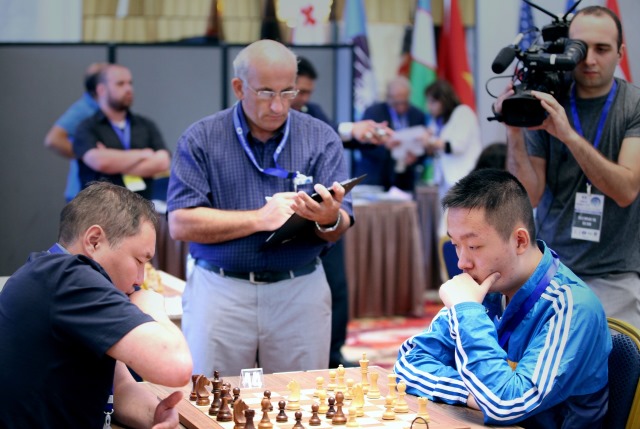
The round 1 rapid tiebreaks were played today in Tibilisi. Most of the rating favourites advanced, including Wei Yi, who eliminated Canadian GM Bator Sambuev.
Their two-game rapid match was anticlimactic: following two complex and exciting long games, Samubev blundered horribly on move 10 in the first game to leave himself in a must-win-against-a-2748-player in the second game. He didn't, and goes home after giving one of the Big Boys a scare for the second World Cup in a row -- recall that Bator beat Morozevich in their first game in 2015, before losing the tiebreak.
[Event "World Cup 2017"]
[Site "Tbilisi"]
[Date "2017.09.05"]
[Round "1.3"]
[White "Yi , Wei"]
[Black "Sambuev, Bator"]
[Result "1-0"]
[ECO "D31"]
[WhiteElo "2753"]
[BlackElo "2522"]
[Annotator "John Upper"]
[PlyCount "77"]
[EventDate "2017.??.??"]
[WhiteClock "0:14:11"]
[BlackClock "0:02:24"]

1. Nf3 d5 2. c4 e6 3. d4 c6 4. g3 dxc4 5. Bg2 b5 6. Ne5 Bb7 7.
O-O {[#] A very interesting choice of opening by Wei Yi, since he lost a
similar middlegame to Bator in the first game of their match. Black is up a
pawn but White gets play against the queenside with a choice between b2-b3 and
a2-a4 pawn breaks. Delaying Nb1-c3 gives Black fewer options in response to
those breaks, since ...b4 won't come with a tempo.} a6 (7... Nd7 8. a4 (8. Nxc6
Qb6 9. Be3 $1 $13 {1/2-1/2 (27) Lysyj,I (2671)-Lupulescu,C (2626) Baku, 2015.})
8... Qc8 9. b3 cxb3 10. Qxb3 b4 11. a5 (11. Nxd7 $142 Qxd7 12. Bb2 {with comp.}
) 11... c5 $1 {and White couldn't get the pawn back} 12. Bxb7 Qxb7 13. Nxd7
Qxd7 14. dxc5 Bxc5 15. Bb2 Nf6 16. Rd1 Qc6 17. Rc1 Rc8 18. Bd4 Qd6 19. Qd3 Ke7
20. Bxc5 Rxc5 21. Rxc5 Qxc5 22. Ra4 $4 Qc1+ 23. Kg2 Qc6+ {0-1 (23) Ezat,M
(2479)-Jakovenko,D (2744) Tsaghkadzor, 2015.}) 8. Nc3 {Black has scored very
well from here (56% and Elo=) with the normal move ...Nf6, so it is curious
that Bator opts for a Novelty here (though it transposes after White's next
move).} Bb4 (8... Nf6 9. b3 (9. a4 Nd5 10. e4 Nxc3 11. bxc3 Nd7 12. Bf4 Be7 13.
Qg4 g6 14. Nxd7 Qxd7 15. Bh6 f6 $13 {½-½ (51) Kortchnoi,V (2602)-Wang,Y
(2704) Amsterdam, 2008.}) 9... b4 10. Ne4 Nxe4 (10... c3 $4 11. Ng5 $18) 11. Bxe4
c3 12. a3 a5 13. axb4 Bxb4 14. Qd3 $13 {0-1 (34) Mamedyarov,S (2761)
-Harikrishna,P (2752) Baku Ol 2016.}) 9. a4 Ne7 {One point of ...Ne7 (rather
than ...Nf6) is to allow ...f6 which not only kicks away the Ne5, but
eliminates White's B pair in the line in the next two notes.} (9... f6 $5) (
9... Nf6 10. axb5 axb5 11. Rxa8 Bxa8 12. Nxb5 cxb5 13. Bxa8 {I think I'd
rather have the B pair, but Stockfish says 0.00.}) 10. Ne4 {[#]} (10. axb5 axb5
11. Rxa8 Bxa8 12. Nxb5 cxb5 13. Bxa8 f6 14. Nf3 Nbc6 $15 {and White doesn't
get to keep the B pair and the central majority doesn't seem so imposing with
half the pieces traded off.}) 10... Nd7 $4 {Horrible. Turns a complex
middlegame into a dead loss in one move, and stains the good impression
Sambuev made with his first two games in the match.} (10... f6 $13) (10... O-O
$13 11. Bd2 {Trading the defender of the dark squares.} c5 (11... a5 $5) 12.
dxc5 Bxd2 13. Qxd2 Qxd2 14. Nxd2 Bxg2 15. Kxg2 Nbc6 (15... f6 16. axb5 $3 fxe5
17. c6 {looks very promising for White.}) 16. Nxc6 Nxc6 $14 {1-0 (62) Bruzon
Batista,L (2691)-Vera Gonzalez Quevedo,R (2482) Guarenas, 2012.}) 11. Bd2 $1
$18 {Trading the defender of the dark squares. A N will land on d6 and Black
is totally lost. "I think this position is already resignable" - Sokolov.} ({
During the live commentary, Sokolov started analyzing this sac:} 11. Nxf7 Kxf7
12. Ng5+ Kg8 13. Nxe6 {which is probably not enough outside a coffehouse. But
then White played Bd2! and the result was obvious.}) 11... Bxd2 (11... Qa5 {
loses more than a piece} 12. Nd6+ $18 {since the Bb4 is pinned.}) 12. Nd6+ Kf8
{White has a choice of +3 continuations, and chooses the best. Even without
winning a piece, the Kf8 guarantees White will invade on the a-file and win
the queenside pawns before Black's Rh8 moves, as in the following variations:}
13. Nexf7 $1 (13. Qxd2 $18 Nxe5 14. dxe5 Qc7 15. axb5 axb5 16. Rxa8+ Bxa8 17.
Ra1 $18 {+7}) (13. Nxb7 $18 Qc7 14. Qxd2 Qxb7 (14... Nxe5 15. Nc5 N5g6 (15...
Nd7 16. Nxd7+ Qxd7 17. axb5 {transposes.}) 16. axb5) 15. Nxd7+ Qxd7 16. axb5
$18) 13... Qc7 14. Qxd2 Nc8 (14... Rg8 {saves the R, but it's not worth
anything on g8:} 15. axb5 axb5 16. Rxa8+ Bxa8 17. Ra1 $18) 15. Qf4 Nf6 16. Nxc8
Qxf4 17. gxf4 Rxc8 18. Nxh8 Nd5 19. axb5 cxb5 20. f5 $1 Re8 (20... exf5 21.
Bxd5 Bxd5 22. Rxa6 Kg8 23. Rb6 {White doesn't need the Nh8 once his R's are
active.}) 21. Rfc1 exf5 22. Bxd5 Bxd5 23. Rxa6 Rxe2 24. Rd6 Bf3 {White won't
bunder into a backrank mate.   I think Bator would have resigned earlier if he
didn't need to calm his nerves after his earlier blunder and before the next
game.} 25. Ra1 b4 26. d5 $1 c3 27. bxc3 b3 28. Rd7 Re8 29. Rf7+ Kg8 30. Re7 $1
Rd8 31. c4 Be4 32. Rb7 Bc2 33. Nf7 Rf8 34. Ng5 Rc8 35. Raa7 f4 36. Rxg7+ Kh8
37. Rxh7+ Bxh7 38. Rxh7+ Kg8 39. Rb7 1-0

[Event "World Cup 2017"]
[Site "Tbilisi"]
[Date "2017.09.05"]
[Round "1.4"]
[White "Sambuev, Bator"]
[Black "Yi, Wei"]
[Result "1/2-1/2"]
[ECO "A13"]
[WhiteElo "2522"]
[BlackElo "2753"]
[Annotator "John Upper"]
[PlyCount "161"]
[EventDate "2017.??.??"]
[WhiteClock "0:10:59"]
[BlackClock "0:21:36"]

1. Nf3 Nf6 2. c4 e6 3. e3 {[#] This slow play is recommended in two recent
opening repertoire books: David Cummings' "the English" (Everyman, 2016), and
"e3 Poison" by Axel Smith (Quality, 2017). This opening is highly
transpositional, but one unifying idea in both books is that White is aiming
for a 1.d4 middle game while avoiding the 1.d4 killer defences: the Grunfeld,
the Nimzo, and the Slav.} d5 4. b3 ({Cummings' book recommends:} 4. Nc3 c5 5.
cxd5 Nxd5 6. Bc4 $5 {again, with the idea of avoiding lines with ...Bb4. This
shouldn't give White a theoretical advantage, but one thing to note is that
White will be able to achieve an IQP position without Black being able to
simplify quickly as in our main game. See the Cummings book for more.}) 4... c5
5. Bb2 Nc6 6. cxd5 exd5 {[#]} 7. d4 ({Axel Smith's new book says this:} 7. Be2
$1 {"Not 7.d4?! which allows Black to check on b4." - Smith. His main line
from here, with a few sidelines and comments omitted, runs:} Bd6 (7... a6 $5)
8. O-O O-O 9. Nc3 $1 Re8 10. Rc1 d4 $1 11. exd4 cxd4 12. Nb5 a6 $5 (12... Bg4
13. h3 d3 $1 14. Bxd3 Bxf3 15. Qxf3 Be5 $1 {Black is OK.}) 13. Nbxd4 Nxd4 14.
Bxd4 Ba3 15. Bxf6 Qxf6 16. Rc3 {Euker - Wolff, 2009 corr.}) ({Another way for
White to avoid Nimzo-like counterplay by Black with ...Bb4 is by playing Bb5
first, and then castling, as Wesley So did with good results this summer in
blitz events in Europe:} 7. Bb5 Bd6 8. O-O (8. d4 cxd4 $1 9. Nxd4 O-O $1 10.
Nxc6 bxc6 11. Bxc6 Bg4 {with a lot of play for Black.}) 8... O-O 9. d4 cxd4 (
9... Bg4 10. dxc5 Bxc5 11. h3 Bh5 12. Nc3 a6 13. Bxc6 $5 bxc6 14. Rc1 Bd6 15.
Ne2 Bxf3 16. gxf3 Rc8 17. Qd3 Nd7 18. f4 $14 {1-0 (29) So,W (2812)-Nakamura,H
(2785) Paris, 2017.}) 10. Nxd4 Qb6 11. Bxc6 bxc6 12. Nc3 c5 13. Nf3 Bb7 $15 14.
Rc1 Rac8 15. Ne2 Ne4 16. Ng3 Nxg3 17. hxg3 Rfd8 $15 18. Qd2 Be7 19. Rc2 h5 20.
Rfc1 Rc7 $4 21. Bc3 $18 d4 22. exd4 cxd4 23. Ba5 {1-0 So,W (2812)-Anand,V
(2786) Leuven, 2017.}) 7... cxd4 8. Nxd4 Bb4+ 9. Bc3 {[#]} Qb6 $1 $146 {
A Novelty. Unlike the more obvious ....Qa5, Qb6 attacks d4, and so "threatens"
to take on d4 forcing exd4 producing a symmetrical center where Black is in no
way worse.} (9... Qa5 10. Qd2 Bxc3 11. Nxc3 O-O 12. Be2 {With a small
structural advantage to White, who can play against the iso or the hanging
pawns, as in this model game:} Bg4 13. Nxc6 bxc6 14. Bxg4 Nxg4 15. h3 Nf6 16.
O-O c5 17. Rfd1 Rfd8 18. Ne4 $1 Qb6 19. Nxf6+ Qxf6 20. Rac1 Qb6 21. Rc3 Rd7 22.
Rdc1 Rc8 23. e4 d4 24. Rc4 Rdc7 25. Qc2 a5 26. e5 Qc6 27. Qd2 Qb6 28. Ra4 Ra8
29. Qf4 Re8 30. Rac4 Qc6 $2 31. Qxd4 $16 cxd4 32. Rxc6 Rxc6 33. Rxc6 g5 34. Rc5
$18 {1-0 (59) Wojtaszek,R (2536)-Kharitonov,A (2464) Heraklio, 2004.}) 10. Bb5
O-O 11. Nxc6 (11. O-O $6 {doesn't lose a piece, but does lose the advantage:}
Nxd4 12. Qxd4 Bc5 $15 (12... Bxc3 $2 13. Qxb6 $14)) ({Instead, White might get more with} 11. Bxb4 $5 Nxb4 12. Nc3 $14 {with an IQP position where the DSBs are already traded. White might
prefer to have his pawn back on b2, but this is about as good a positional
plus as can be hoped for from this sort of slow play opening.}) 11... Bxc3+ 12.
Nxc3 bxc6 13. Be2 c5 {[#]} 14. O-O (14. Nxd5 $5 {looks dangerous -- and it is
-- but creates an unbalanced positon with more winning chances. I imagine that
if this was the first game of their tiebreak, and did not follow 1 hour after
Bator's blunder in game 1.3, that he might have tried this.} Nxd5 15. Qxd5 Bb7
16. Qd2 (16. Qe5 $4 {is a trap} Bxg2 17. Rg1 Qb4+ $19) (16. Qc4 $5 $13) 16...
Bxg2 (16... Qg6 17. Rg1 $13) 17. Rg1 {I don't like White's K in the middle,
but it feels more like a three result game.}) 14... Be6 15. Na4 Qa5 16. Qe1
Qxe1 17. Rfxe1 Rfc8 18. Rac1 (18. Ba6 Rc7 19. Rac1 c4 20. e4 $1 (20. Nb2 $2 Rb8
$1 $17) 20... Nxe4 21. bxc4 Nf6 $11) 18... c4 $1 {Saving the c-pawn and
stopping Ba6.} 19. f3 cxb3 20. axb3 Rxc1 21. Rxc1 d4 22. exd4 Bxb3 23. Nc5 Bd5
{[#]} 24. Na6 (24. Ra1 $1 a5 25. Ba6 $1 {A Carlsen and Karpov type move! Black
will have to find a way to get some comp for the pawn.}) 24... Rd8 25. Rc7 Be6
26. Rxa7 Kf8 27. Nb4 Rxd4 {[#] White can only hope for a blunder here. He
doesn't get one.} 28. Nc6 Rd6 29. Ra8+ Ne8 30. Ne5 Ke7 31. Ra7+ Kf8 32. Ra8 Ke7
33. Bb5 Nc7 34. Ra7 Kf6 35. Rxc7 Kxe5 36. Be8 Kf6 37. Kf2 Rd8 38. Bb5 Rd5 39.
Rb7 Rd2+ 40. Kg3 Rb2 41. Bc6 Rxb7 42. Bxb7 $11 {[#] There's no reason to hurry
to the airport, so...} g5 43. Kf2 Ke5 44. Ke3 h6 45. g3 f6 46. Be4 Kd6 47. Kd4
Ke7 48. Kc5 Kf8 49. Kd6 Bc4 50. Bd5 Be2 51. Ke6 Kg7 52. Kf5 Bd3+ 53. Be4 Bb5
54. Ke6 Bc4+ 55. Bd5 Bf1 56. Kf5 Bd3+ 57. Ke6 Bf1 58. Be4 Bc4+ 59. Kd6 Bf1 60.
Bd5 Bd3 61. Kc5 Bf5 62. g4 Bd3 63. Kd4 Bg6 64. Be4 Bf7 65. Kc5 h5 66. h3 Be8
67. Bd3 Bf7 68. Kd6 hxg4 69. hxg4 Be8 70. Ke7 Bc6 71. Be4 Bb5 72. Kd6 Bc4 73.
Bd5 Bf1 74. Kc5 Bg2 75. Kd4 Kf8 76. Be4 Ke7 77. Ke3 Bf1 78. Bd3 Bxd3 79. Kxd3
Ke6 80. Ke4 f5+ 81. gxf5+ 1/2-1/2
..